Department of Ophthalmology, Guangdong Provincial Key Laboratory of Malignant Tumor Epigenetics and Gene Regulation, Sun Yat-sen Memorial Hospital, Sun Yat-sen University, Guangzhou, China.
These authors contributed equally to this work.
J Glob Health. 2019 Dec;9(2):020436. doi: 10.7189/jogh.09.020436.
To evaluate the disease burden of glaucoma in terms of disability-adjusted life years (DALY) and assess the contribution of risk factors to DALY due to glaucoma.
Global, regional, and country DALY number, rate, and age-standardized rates of glaucoma were obtained from the Global Burden of Disease Study 2017 database. The Human Development Index (HDI), Inequality-Adjusted HDI, Socio-Demographic Index (SDI), and other country-level data were derived from international open databases. Regression analysis was used to assess the correlations between the age-standardized DALY rate and the variables.
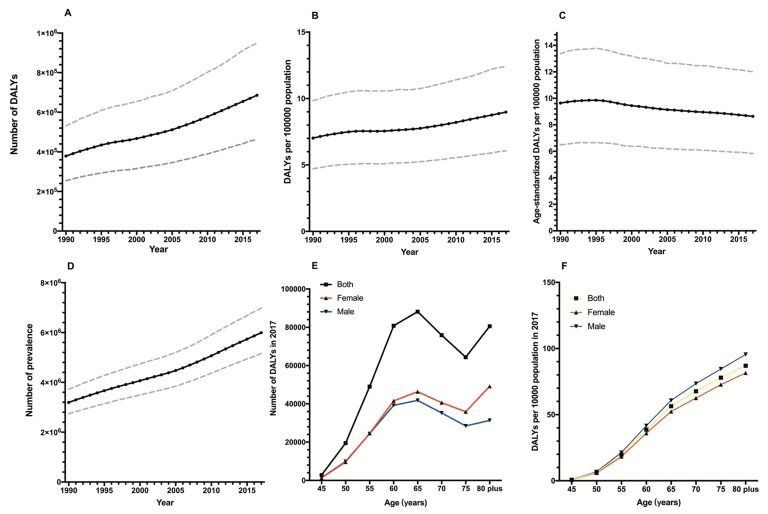
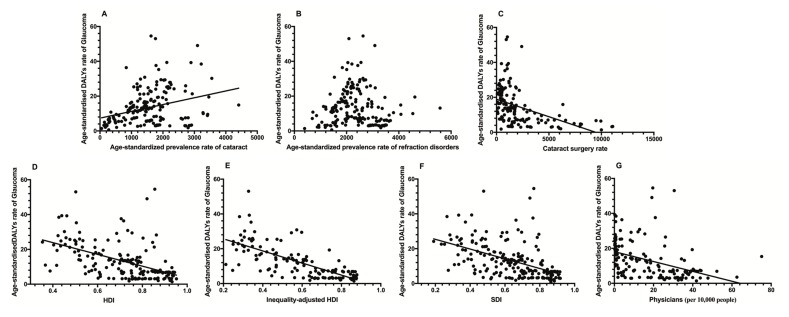
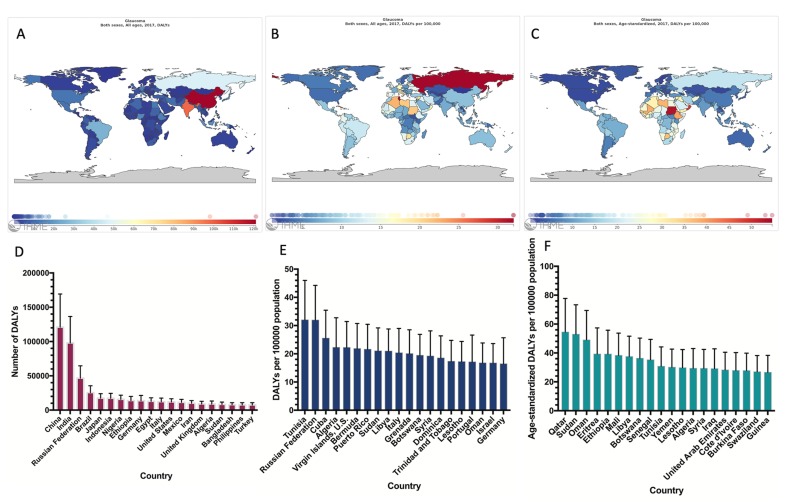
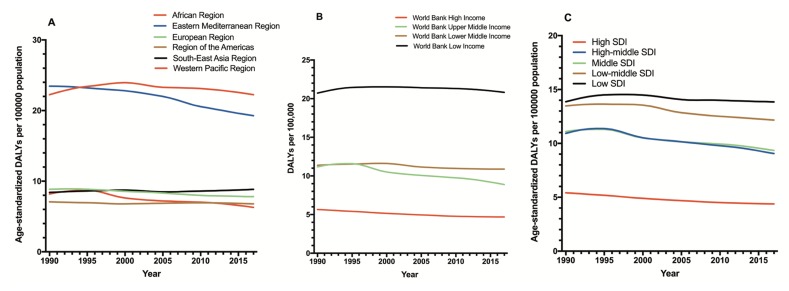
The global DALY due to glaucoma increased by 81% from 1990 to 2017 and decreased by 10% over the last two decades after adjusting for age and population size. Males had higher age-standardized DALY rates ( < 0.001). The age-standardized DALY rate was higher in countries with lower income or lower SDI ( < 0.001). The country-level age-standardized DALY rates in 2017 were negatively associated with HDI, SDI, country-level age-standardized prevalence rates of cataracts, cataract surgery rates (CRS), physician rates, and Inequality-Adjusted HDI. Stepwise multiple regressions showed that HDI, CRS, and Inequality-Adjusted HDI were significantly negatively associated with the country-level age-standardized DALY rate in 2017 after adjusting for other confounding factors ( < 0.001).
Higher education, higher CRS, and diminishing the inequality in resource distribution may help reduce the disease burden of glaucoma. These findings can provide information for policymakers and could serve as an impetus for efforts toward alleviating the disease burden of glaucoma.
评估青光眼的疾病负担,从残疾调整生命年(DALY)的角度出发,评估风险因素对青光眼造成的 DALY 的影响。
从 2017 年全球疾病负担研究数据库中获取全球、区域和国家的 DALY 数量、比率和年龄标准化率。人类发展指数(HDI)、不平等调整后的 HDI、社会发展指数(SDI)和其他国家层面的数据来自国际开放数据库。回归分析用于评估年龄标准化 DALY 率与变量之间的相关性。
全球因青光眼导致的 DALY 从 1990 年到 2017 年增加了 81%,在过去二十年中,由于人口年龄和人口数量的调整,DALY 下降了 10%。男性的年龄标准化 DALY 率更高(<0.001)。收入较低或 SDI 较低的国家的年龄标准化 DALY 率更高(<0.001)。2017 年,国家层面的年龄标准化 DALY 率与 HDI、SDI、国家层面的年龄标准化白内障患病率、白内障手术率(CRS)、医生人数和不平等调整后的 HDI 呈负相关。逐步多元回归显示,在调整了其他混杂因素后,HDI、CRS 和不平等调整后的 HDI 与 2017 年国家层面的年龄标准化 DALY 率呈显著负相关(<0.001)。
更高的教育水平、更高的 CRS 和减少资源分配不均可能有助于减轻青光眼的疾病负担。这些发现可为政策制定者提供信息,并为减轻青光眼疾病负担的努力提供动力。