Department of Pediatrics, Duke University, Durham, NC, United States.
Department of Computer Science & Engineering, Wright State University, Dayton, OH, United States.
JMIR Mhealth Uhealth. 2019 Dec 2;7(12):e13671. doi: 10.2196/13671.
Sickle cell disease (SCD) is an inherited red blood cell disorder affecting millions worldwide, and it results in many potential medical complications throughout the life course. The hallmark of SCD is pain. Many patients experience daily chronic pain as well as intermittent, unpredictable acute vaso-occlusive painful episodes called pain crises. These pain crises often require acute medical care through the day hospital or emergency department. Following presentation, a number of these patients are subsequently admitted with continued efforts of treatment focused on palliative pain control and hydration for management. Mitigating pain crises is challenging for both the patients and their providers, given the perceived unpredictability and subjective nature of pain.
The objective of this study was to show the feasibility of using objective, physiologic measurements obtained from a wearable device during an acute pain crisis to predict patient-reported pain scores (in an app and to nursing staff) using machine learning techniques.
For this feasibility study, we enrolled 27 adult patients presenting to the day hospital with acute pain. At the beginning of pain treatment, each participant was given a wearable device (Microsoft Band 2) that collected physiologic measurements. Pain scores from our mobile app, Technology Resources to Understand Pain Assessment in Patients with Pain, and those obtained by nursing staff were both used with wearable signals to complete time stamp matching and feature extraction and selection. Following this, we constructed regression and classification machine learning algorithms to build between-subject pain prediction models.
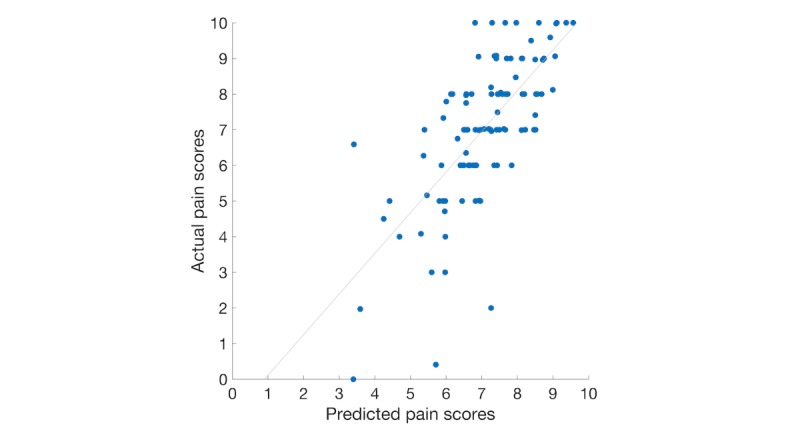
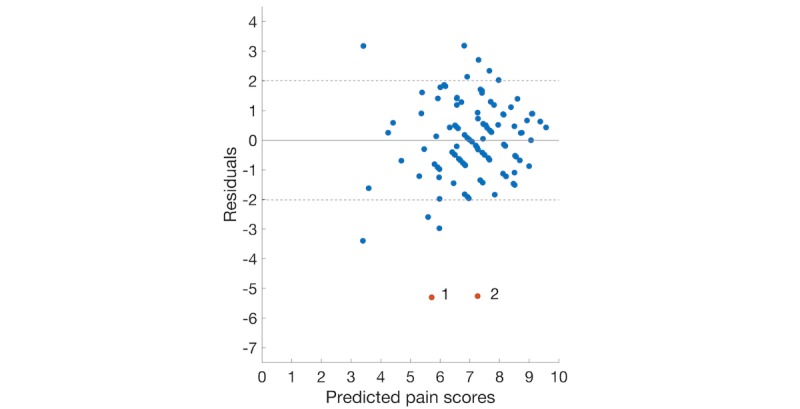
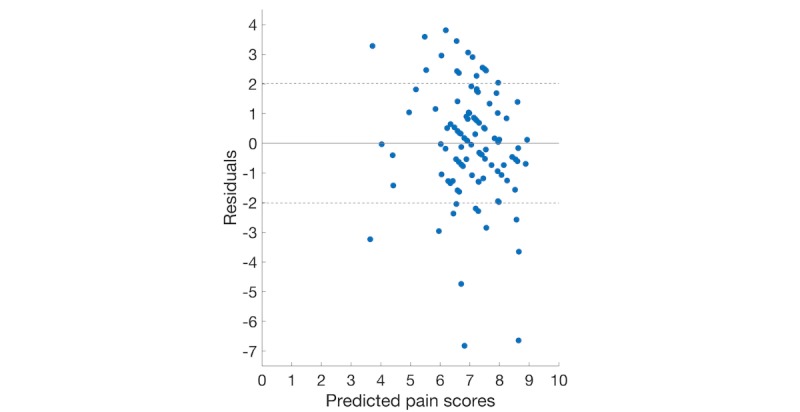
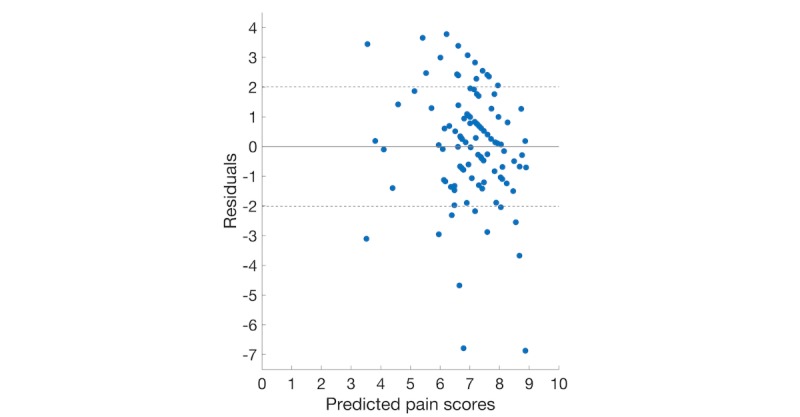
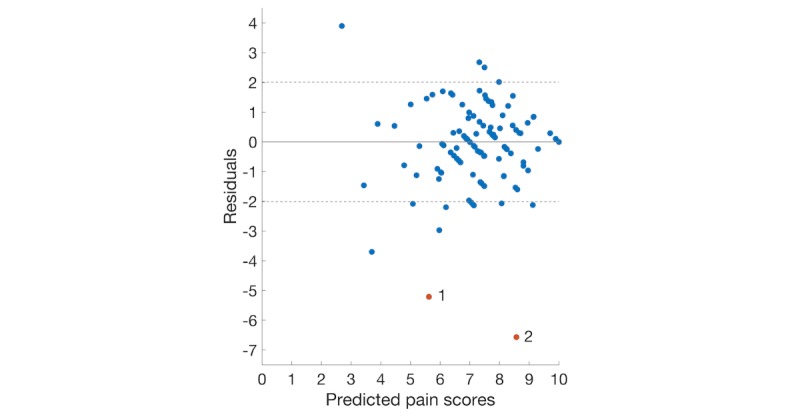
Patients were monitored for an average of 3.79 (SD 2.23) hours, with an average of 5826 (SD 2667) objective data values per patient. As expected, we found that pain scores and heart rate decreased for most patients during the course of their stay. Using the wearable sensor data and pain scores, we were able to create a regression model to predict subjective pain scores with a root mean square error of 1.430 and correlation between observations and predictions of 0.706. Furthermore, we verified the hypothesis that the regression model outperformed the classification model by comparing the performances of the support vector machines (SVM) and the SVM for regression.
The Microsoft Band 2 allowed easy collection of objective, physiologic markers during an acute pain crisis in adults with SCD. Features can be extracted from these data signals and matched with pain scores. Machine learning models can then use these features to feasibly predict patient pain scores.
镰状细胞病(SCD)是一种影响全球数百万人的遗传性红细胞疾病,它会导致生命过程中的许多潜在的医疗并发症。SCD 的标志是疼痛。许多患者经历日常慢性疼痛以及间歇性、不可预测的急性血管阻塞性疼痛发作,称为疼痛危机。这些疼痛危象通常需要通过日间医院或急诊部门进行急性医疗护理。就诊后,许多患者随后因持续治疗而住院,治疗重点是姑息性疼痛控制和水化管理。由于疼痛的可预测性和主观性,减轻疼痛危机对患者和他们的提供者来说都是具有挑战性的。
本研究的目的是展示使用可穿戴设备在急性疼痛危机期间获得的客观生理测量值来预测患者报告的疼痛评分(在应用程序和护理人员中)的可行性,使用机器学习技术。
在这项可行性研究中,我们招募了 27 名成年患者,他们因急性疼痛到日间医院就诊。在开始疼痛治疗时,每位参与者都佩戴了一个可穿戴设备(微软手环 2),该设备收集生理测量值。我们的移动应用程序“Technology Resources to Understand Pain Assessment in Patients with Pain”中的疼痛评分和护理人员获得的疼痛评分都与可穿戴信号一起使用,以完成时间戳匹配和特征提取和选择。之后,我们构建了回归和分类机器学习算法来构建基于个体的疼痛预测模型。
患者平均监测 3.79 小时(标准差 2.23),每位患者平均有 5826 个(标准差 2667)客观数据值。正如预期的那样,我们发现大多数患者在住院期间的疼痛评分和心率都有所下降。使用可穿戴传感器数据和疼痛评分,我们能够创建一个回归模型,该模型以 1.430 的均方根误差和 0.706 的观测值与预测值之间的相关性来预测主观疼痛评分。此外,我们通过比较支持向量机(SVM)和 SVM 回归的性能,验证了回归模型优于分类模型的假设。
微软手环 2 允许在 SCD 成人急性疼痛危机期间轻松收集客观的生理标志物。可以从这些数据信号中提取特征,并与疼痛评分匹配。机器学习模型然后可以使用这些特征来预测患者的疼痛评分。