
髓系来源抑制细胞水平对肝细胞癌的预后价值:系统评价和荟萃分析。
The prognostic value of myeloid derived suppressor cell level in hepatocellular carcinoma: A systematic review and meta-analysis.
机构信息
Graduate College of Hebei Medical University, Hebei Medical University, Shijiazhuang, Hebei, China.
Clinical Research Center, Shijiazhuang Fifth Hospital, Shijiazhuang, Hebei, China.
出版信息
PLoS One. 2019 Dec 2;14(12):e0225327. doi: 10.1371/journal.pone.0225327. eCollection 2019.
BACKGROUND AND AIMS
Many studies have investigated the association between the level of myeloid derived suppressor cells (MDSCs) and clinical features and prognosis of hepatocellular carcinoma (HCC), but the results remain controversial. This systematic review and meta-analysis was conducted to summarize all available data and estimate the relationship.
METHODS
A comprehensive literature review was carried out using Medline, Embase and Web of Science database through December 2018 to identify relevant studies. The standardized mean difference (SMD) and the hazard ratio (HR) with 95% confidence interval (CI) were utilized for evaluating continuous outcomes and survival analysis, respectively. All statistical analyses were performed by STATA 14.0 software.
RESULTS
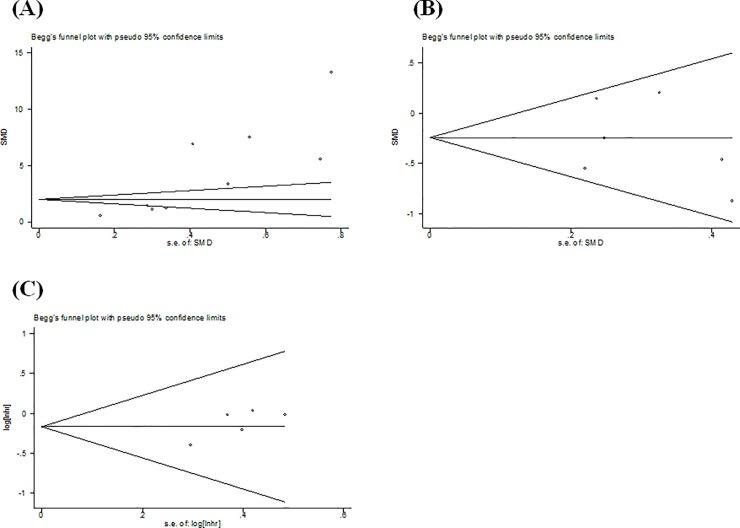
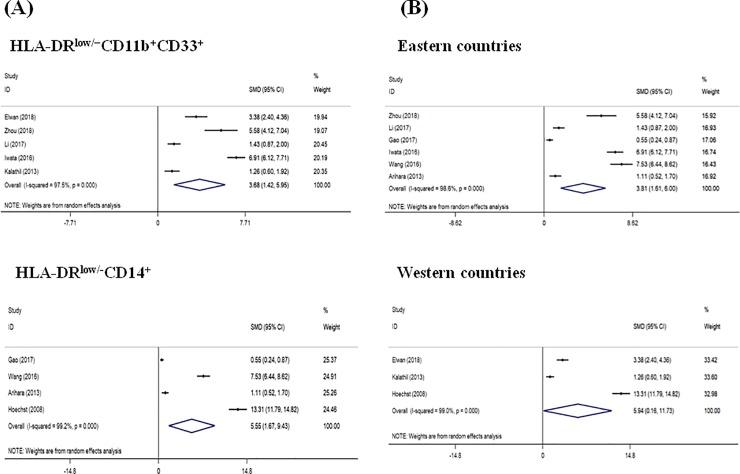
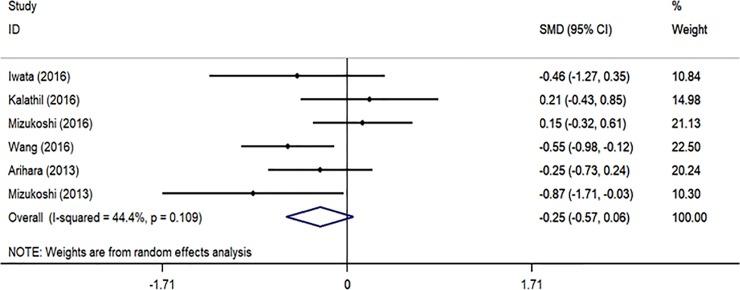
A total of 13 studies with 1002 HCC patients were included in the meta-analysis. Overall, the proportion of MDSCs in HCC patients was higher than that in healthy controls (SMD = 4.49, 95% CI = 2.53-6.46, P<0.001), and patients with chronic liver disease (SMD = 3.41, 95% CI = 1.58-5.24, P<0.001). Subgroup analysis based on the phenotypes of MDSCs and geographical areas showed similar results. However, the frequency of MDSCs was not affected by the treatment with conventional approaches for HCC (SMD = -0.25, 95% CI = -0.57-0.06, P = 0.119). Moreover, increased MDSCs level was significantly associated with poorer overall survival (HR = 2.36, 95% CI = 1.70-3.29, P<0.001) and recurrence-free survival (HR = 2.72, 95% CI = 1.70-4.35, P<0.001), but not significantly correlated with any clinicopathological parameters.
CONCLUSION
The results of this systematic review suggest that elevated MDSCs level appears to be associated with an increased risk for disease progression and poor prognosis for HCC.
背景与目的
许多研究已经探讨了骨髓来源的抑制性细胞(MDSCs)水平与肝细胞癌(HCC)的临床特征和预后之间的关系,但结果仍存在争议。本系统评价和荟萃分析旨在总结所有现有数据并评估这种关系。
方法
通过 Medline、Embase 和 Web of Science 数据库进行全面的文献检索,检索时间截至 2018 年 12 月,以确定相关研究。使用标准化均数差(SMD)和风险比(HR)及其 95%置信区间(CI)分别评估连续结局和生存分析。所有统计分析均使用 STATA 14.0 软件进行。
结果
共纳入 13 项研究,包含 1002 例 HCC 患者,纳入荟萃分析。总体而言,HCC 患者中 MDSCs 的比例高于健康对照组(SMD = 4.49,95%CI = 2.53-6.46,P<0.001),且高于慢性肝病患者(SMD = 3.41,95%CI = 1.58-5.24,P<0.001)。基于 MDSCs 表型和地理区域的亚组分析显示出相似的结果。然而,MDSCs 频率不受 HCC 常规治疗方法的影响(SMD = -0.25,95%CI = -0.57-0.06,P = 0.119)。此外,MDSCs 水平升高与总生存(HR = 2.36,95%CI = 1.70-3.29,P<0.001)和无复发生存(HR = 2.72,95%CI = 1.70-4.35,P<0.001)显著相关,但与任何临床病理参数无显著相关性。
结论
本系统评价的结果表明,MDSCs 水平升高似乎与 HCC 疾病进展风险增加和预后不良相关。



 Zotero 插件