Gueldner Emily Katharina, Schuppisser Carole, Borel Nicole, Hilbe Monika, Schnyder Manuela
Institute of Parasitology, Vetsuisse Faculty, University of Zurich, Winterthurerstrasse 266a, 8057 Zürich, Switzerland.
Clinic for Small Animal Internal Medicine, Vetsuisse Faculty, University of Zurich, Winterthurerstrasse 260, 8057 Zürich, Switzerland.
Vet Parasitol Reg Stud Reports. 2019 Dec;18:100342. doi: 10.1016/j.vprsr.2019.100342. Epub 2019 Oct 17.
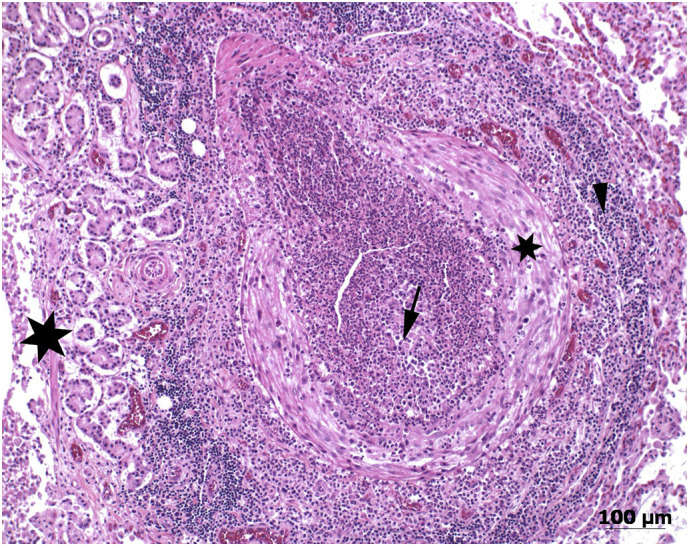
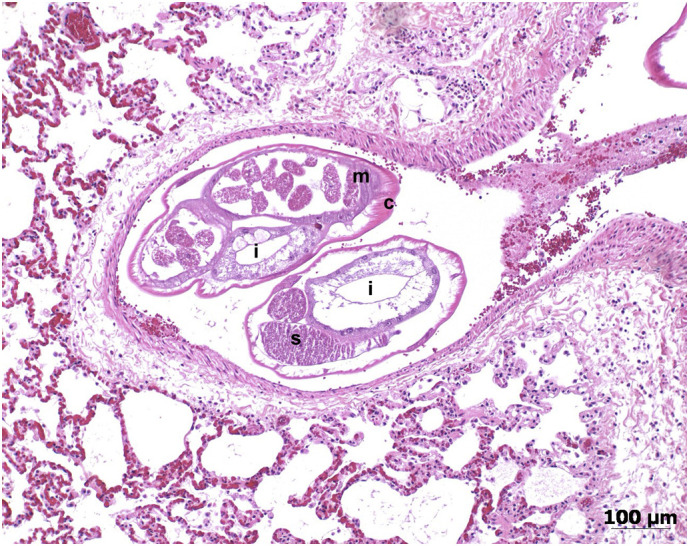
Cardiopulmonary nematodes in cats include different parasite species affecting feline lungs and the heart, with the metastrongyloid Aelurostrongylus abstrusus being the most frequent feline lungworm worldwide. The present case report describes an 11-month-old male neutered European short hair cat which presented with generalised subcutaneous oedema and pleural and peritoneal effusions. According to clinical examination, abdominal imaging and laboratory analyses, a tentative diagnosis of severe glomerulopathy with massive proteinuria was made. Due to worsening of the clinical signs despite therapeutic interventions and a poor prognosis, the cat was euthanised. Necropsy and histological examinations revealed severe bilateral collagenofibrotic glomerulopathy, generalised oedema and a focal verminous pneumonia with thrombosis in arterial lung vessels containing nematode cross sections. A serum sample was tested for the presence of antibodies against the cat lungworm A. abstrusus, resulting negative. Genetic analyses confirmed the presence of nematode DNA; after exclusion of common lung and heart parasites occurring in cats, DNA of the canid heart worm nematode Angiostrongylus vasorum was identified. This is the first description of a naturally occurring infection with A. vasorum in a cat. Previous experimental studies demonstrated the development of adult male and female A. vasorum worms containing eggs in cats, but no larval excretion in the faeces. Although cats did not become patent, A. vasorum infections were clinically relevant. As A. abstrusus and A. vasorum are both gastropod transmitted nematodes, they may share the same intermediate hosts within overlapping areas. In addition, especially chronic A. abstrusus infected cats become non-patent and do not excrete L1. Considering that patent A. vasorum infections are widespread in the dog and fox population in Switzerland (and several other countries) but are apparently not patent in cats, we cannot exclude that infections with A. vasorum may occur more frequently than expected.
猫心肺线虫包括影响猫肺部和心脏的不同寄生虫种类,其中类圆线虫科的隐匿猫圆线虫是全球最常见的猫肺线虫。本病例报告描述了一只11个月大的已绝育欧洲短毛雄性猫,它出现了全身性皮下水肿以及胸腔和腹腔积液。根据临床检查、腹部影像学检查和实验室分析,初步诊断为重度肾小球病伴大量蛋白尿。尽管进行了治疗干预,但临床症状仍恶化且预后不良,于是对这只猫实施了安乐死。尸检和组织学检查显示严重的双侧胶原纤维性肾小球病、全身性水肿以及局灶性蠕虫性肺炎,在含有线虫横切面的肺血管动脉中有血栓形成。检测了一份血清样本中抗猫肺线虫隐匿猫圆线虫抗体的存在情况,结果为阴性。基因分析证实存在线虫DNA;在排除了猫常见的肺部和心脏寄生虫后,鉴定出了犬心丝虫线虫管圆线虫的DNA。这是首次描述猫自然感染管圆线虫的病例。先前的实验研究表明,猫体内可发育出含有虫卵的成年管圆线虫雌雄虫,但粪便中无幼虫排出。尽管猫未出现显性感染,但管圆线虫感染具有临床相关性。由于隐匿猫圆线虫和管圆线虫均为通过腹足类动物传播的线虫,它们在重叠区域可能共享相同的中间宿主。此外,尤其是慢性感染隐匿猫圆线虫的猫会成为非显性感染,且不排出L1幼虫。考虑到管圆线虫显性感染在瑞士(以及其他几个国家)的犬类和狐类种群中广泛存在,但在猫中显然不显性,我们不能排除管圆线虫感染的发生频率可能比预期更高。