Research Institute of Medical Science, Konkuk University School of Medicine, Seoul, South Korea.
Internal Medicine, Konkuk University Chungju Hospital, Chungju, South Korea.
BMJ Open Diabetes Res Care. 2019 Nov 17;7(1):e000776. doi: 10.1136/bmjdrc-2019-000776. eCollection 2019.
Fibroblast growth factor 21 (FGF21) is a novel metabolic regulator that has beneficial effects on glucose and lipid metabolism. However, plasma FGF21 levels are paradoxically increased in type 2 diabetes mellitus (T2DM) and obesity, suggesting resistance to this ligand. FGF21 acts mainly on adipose tissue and ectopic fat accumulation is a typical feature in metabolic deterioration such as diabetes, metabolic syndrome, and cardiovascular disease.
To investigate the relationship between FGF21 resistance and ectopic fat accumulation.
Subjects who underwent 64-slice multidetector CT (MDCT) were enrolled (n=190). Plasma FGF21 levels and MDCT data of ectopic fats at various sites were analyzed. Human visceral and subcutaneous fat tissues from abdominal and coronary artery bypass surgery were obtained. FGF21 receptor expression and postreceptor signaling in different fat deposits of both control and T2DM subjects were analyzed.
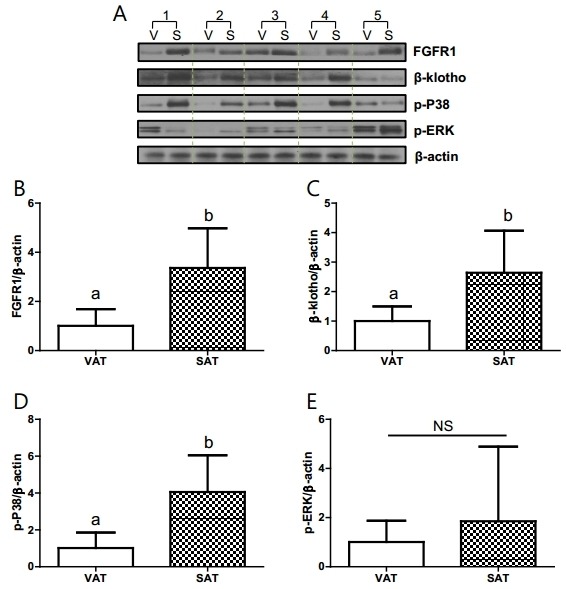
Plasma FGF21 levels were significantly associated with body mass index, triglyceride, homeostatic model assessment of insulin resistance, and Matsuda index. Plasma FGF21 levels were significantly higher in patients with T2DM than in the pre-diabetes and normal glucose tolerance groups. The ectopic fat phenotypes (visceral, epicardial, intrahepatic, and intramuscular fat) of T2DM were significantly higher than controls. Plasma FGF21 levels were elevated and exhibited a strong positive correlation with ectopic fat accumulation in T2DM. The expression of genes comprising the FGF21 signaling pathway was also lower in visceral fat than in subcutaneous fat in this disease.
Human FGF21 resistance in T2DM could result from increases in FGF21-resistant ectopic fat accumulation. Our study provides novel clinical evidence linking FGF21 resistance and T2DM pathogenesis.
成纤维细胞生长因子 21(FGF21)是一种新型代谢调节剂,对葡萄糖和脂质代谢有有益作用。然而,2 型糖尿病(T2DM)和肥胖症患者的血浆 FGF21 水平反而升高,表明对这种配体存在抵抗。FGF21 主要作用于脂肪组织,异位脂肪堆积是糖尿病、代谢综合征和心血管疾病等代谢恶化的典型特征。
研究 FGF21 抵抗与异位脂肪堆积的关系。
共纳入 190 名接受 64 排多层螺旋 CT(MDCT)检查的受试者。分析了血浆 FGF21 水平和各部位异位脂肪的 MDCT 数据。从腹部和冠状动脉旁路手术中获得了人类内脏和皮下脂肪组织。分析了不同脂肪沉积中来自对照和 T2DM 患者的 FGF21 受体表达和受体后信号。
血浆 FGF21 水平与体重指数、甘油三酯、稳态模型评估的胰岛素抵抗和 Matsuda 指数显著相关。T2DM 患者的血浆 FGF21 水平明显高于糖尿病前期和正常糖耐量组。T2DM 的异位脂肪表型(内脏、心外膜、肝内和肌内脂肪)明显高于对照组。T2DM 患者的血浆 FGF21 水平升高,并与异位脂肪堆积呈强烈正相关。在这种疾病中,内脏脂肪中组成 FGF21 信号通路的基因表达也低于皮下脂肪。
T2DM 中人类 FGF21 抵抗可能是由于增加了 FGF21 抵抗的异位脂肪堆积所致。我们的研究提供了将 FGF21 抵抗与 T2DM 发病机制联系起来的新的临床证据。