Center for Cognition, Action, and Perception, Department of Psychology, University of Cincinnati, Cincinnati, OH.
Department of Physical Therapy, High Point University, High Point, NC.
Med Sci Sports Exerc. 2020 May;52(5):1088-1098. doi: 10.1249/MSS.0000000000002235.
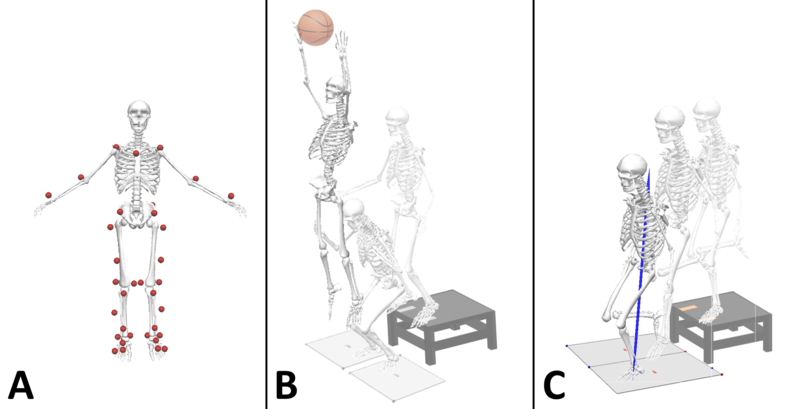
Coordination of multiple degrees of freedom in the performance of dynamic and complex motor tasks presents a challenging neuromuscular control problem. Experiments have inferred that humans exhibit self-organized, preferred coordination patterns, which emerge due to actor and task constraints on performance. The purpose of this study was to determine if the set of effective coordination strategies that exist for a task centers on a small number of robust, invariant patterns of behavior.
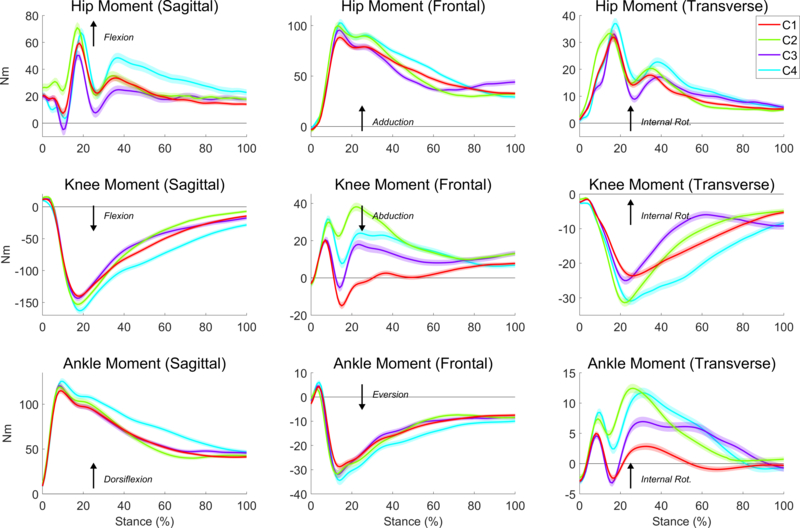
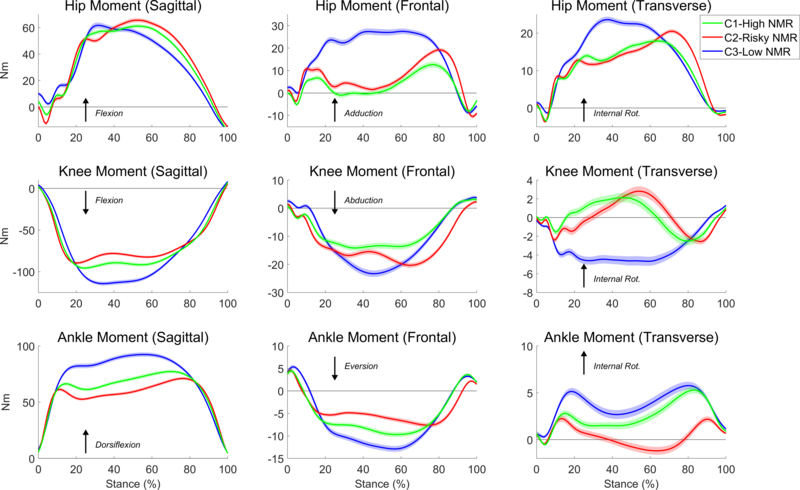
Kinetic movement patterns computed from a cohort of 780 primarily female adolescent athletes performing a drop vertical jump (DVJ) task were analyzed to discover distinct groups into which individuals could be classified based on the similarity of movement coordination solutions.
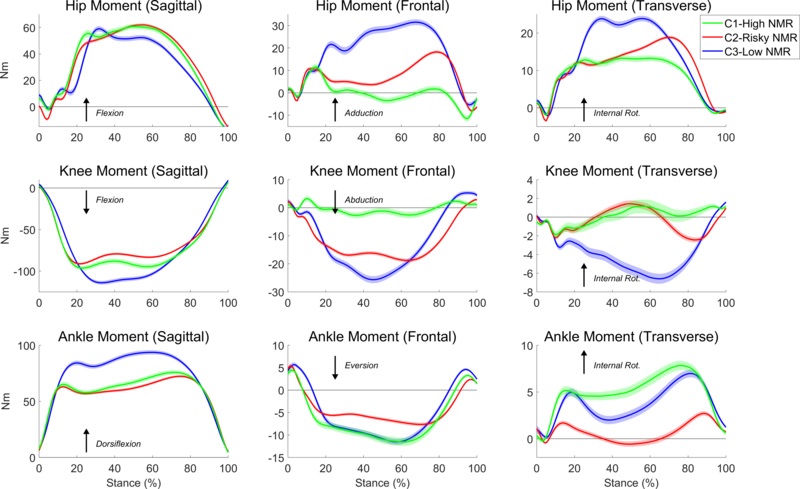
Clustering of reduced-dimension joint moment of force time series revealed three very distinct, precisely delineated movement profiles that persisted across trials, and which exhibited different functional performance outcomes, despite no other apparent group differences. The same analysis was also performed on a different task-a single-leg drop landing-which also produced distinct movement profiles; however, the three DVJ profiles did not translate to this task as group assignment was inconsistent between these two tasks.
The task demands of the DVJ and single-leg drop-successful landing, reversal of downward momentum, and, in the case of the DVJ, vertical propulsion toward a maximally positioned target-constrain movement performance such that only a few successful outcomes emerge. Discovery of the observed strategies in the context of associated task constraints may help our understanding of how injury risk movement patterns emerge during specific tasks, as well as how the natural dynamics of the system may be exploited to improve these patterns.
在执行动态和复杂的运动任务时,协调多个自由度是一个具有挑战性的神经肌肉控制问题。实验推断,人类表现出自我组织的、优选的协调模式,这些模式是由于执行者和任务对表现的限制而产生的。本研究的目的是确定对于一项任务,是否存在一组有效的协调策略,这些策略集中在少数几个稳健、不变的行为模式上。
从 780 名主要为女性青少年运动员的队列中计算出的运动动力学模式,用于执行垂直跳落(DVJ)任务,通过分析这些模式来发现可以根据运动协调解决方案的相似性对个体进行分类的不同群体。
对简化后的关节力时间序列的聚类揭示了三个非常独特、精确界定的运动轮廓,这些轮廓在试验中持续存在,尽管没有其他明显的群体差异,但表现出不同的功能性能结果。同样的分析也应用于另一个不同的任务——单腿跳下着陆——也产生了不同的运动轮廓;然而,这三个 DVJ 轮廓并不能转化为这个任务,因为这两个任务之间的分组分配不一致。
DVJ 和单腿跳下着陆的任务要求——成功着陆、反转向下的动量,以及在 DVJ 的情况下,向最大位置目标垂直推进——限制了运动表现,以至于只有少数成功的结果出现。在相关任务约束的背景下发现观察到的策略可能有助于我们理解在特定任务中如何出现受伤风险的运动模式,以及如何利用系统的自然动态来改善这些模式。