Laboratory of Virus Molecular Biology, Intercollegiate Faculty of Biotechnology, University of Gdańsk, Abrahama 58, 80-307 Gdańsk, Poland.
Department of Medical Microbiology, University Medical Center Utrecht, Heidelberglaan 100, 3584CX Utrecht, The Netherlands.
Cells. 2019 Dec 7;8(12):1590. doi: 10.3390/cells8121590.
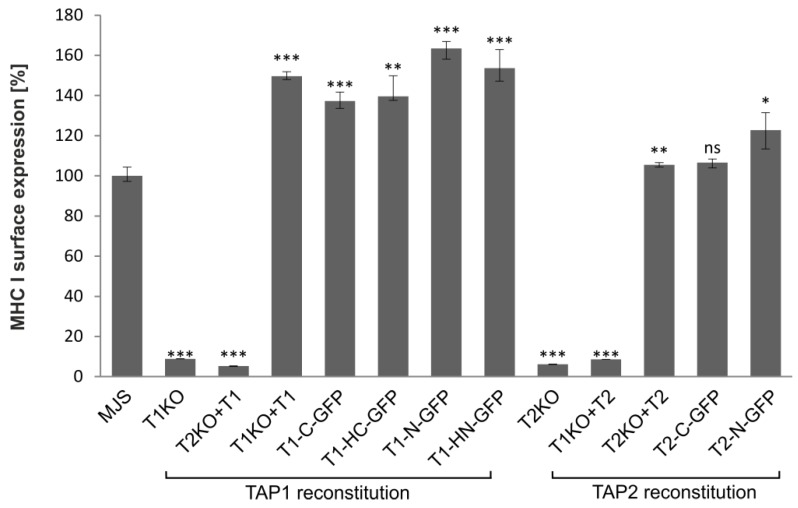
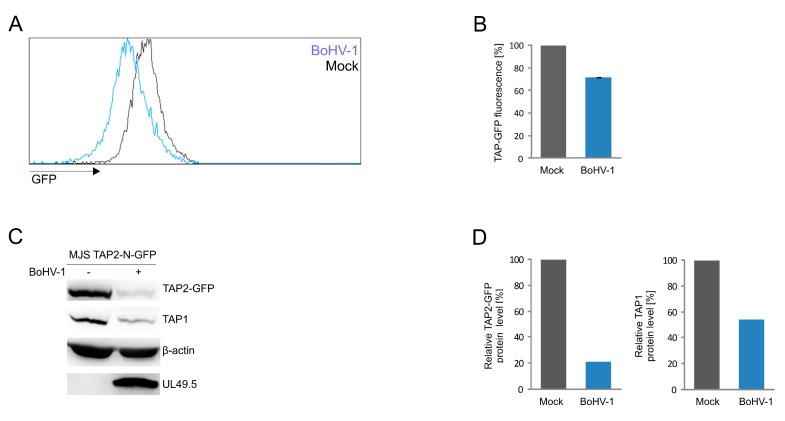
Transporter associated with antigen processing (TAP), a key player in the major histocompatibility complex class I-restricted antigen presentation, makes an attractive target for viruses that aim to escape the immune system. Mechanisms of TAP inhibition vary among virus species. Bovine herpesvirus 1 (BoHV-1) is unique in its ability to target TAP for proteasomal degradation following conformational arrest by the UL49.5 gene product. The exact mechanism of TAP removal still requires elucidation. For this purpose, a TAP-GFP (green fluorescent protein) fusion protein is instrumental, yet GFP-tagging may affect UL49.5-induced degradation. Therefore, we constructed a series of TAP-GFP variants using various linkers to obtain an optimal cellular fluorescent TAP platform. Mel JuSo (MJS) cells with CRISPR/Cas9 TAP1 or TAP2 knockouts were reconstituted with TAP-GFP constructs. Our results point towards a critical role of GFP localization on fluorescent properties of the fusion proteins and, in concert with the type of a linker, on the susceptibility to virally-induced inhibition and degradation. The fluorescent TAP platform was also used to re-evaluate TAP stability in the presence of other known viral TAP inhibitors, among which only UL49.5 was able to reduce TAP levels. Finally, we provide evidence that BoHV-1 UL49.5-induced TAP removal is p97-dependent, which indicates its degradation via endoplasmic reticulum-associated degradation (ERAD).
抗原加工相关转运体(TAP)是主要组织相容性复合体 I 类限制性抗原呈递中的关键分子,是病毒逃避免疫系统的一个有吸引力的靶点。不同病毒的 TAP 抑制机制有所不同。牛疱疹病毒 1(BoHV-1)通过 UL49.5 基因产物引起构象捕获后靶向 TAP 进行蛋白酶体降解,这使其具有独特性。TAP 去除的确切机制仍需阐明。为此,TAP-GFP(绿色荧光蛋白)融合蛋白是必不可少的,然而 GFP 标记可能会影响 UL49.5 诱导的降解。因此,我们使用各种接头构建了一系列 TAP-GFP 变体,以获得最佳的细胞荧光 TAP 平台。使用 CRISPR/Cas9 敲除 TAP1 或 TAP2 的 Mel JuSo(MJS)细胞用 TAP-GFP 构建体进行重建。我们的结果表明 GFP 定位对融合蛋白的荧光特性起着关键作用,并且与接头的类型一起,对病毒诱导的抑制和降解的敏感性也起着关键作用。该荧光 TAP 平台还被用于重新评估在其他已知的病毒 TAP 抑制剂存在的情况下 TAP 的稳定性,其中只有 UL49.5 能够降低 TAP 水平。最后,我们提供了证据表明 BoHV-1 UL49.5 诱导的 TAP 去除依赖于 p97,这表明其通过内质网相关降解(ERAD)途径进行降解。