
“为慢性阻塞性肺疾病(COPD)注入新活力”——英国患者在线调查结果
"Breathing New Life Into Chronic Obstructive Pulmonary Disease (COPD)" - Results From An Online Survey Of UK Patients.
作者信息
Titmarsh Steve, Poliziani Michele, Russell Richard E
机构信息
M&F Health, London EC1N 8TE, UK.
Opinion Health, London W1F 8QA, UK.
出版信息
Int J Chron Obstruct Pulmon Dis. 2019 Dec 4;14:2799-2807. doi: 10.2147/COPD.S222139. eCollection 2019.
BACKGROUND
There is a lack of data on the impact of COPD on individuals, their illness, behavior and attitude to the disease.
METHOD
500 UK patients with a primary care diagnosis of COPD responded to an online survey.
RESULTS
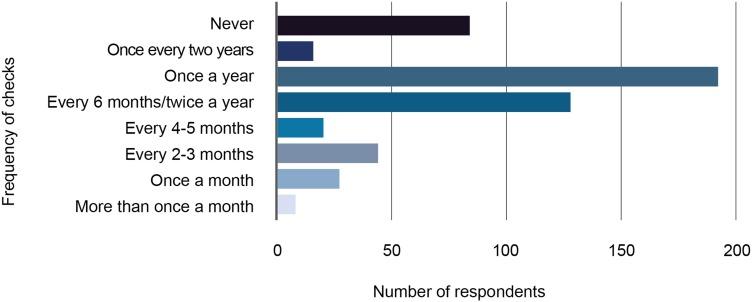
61.2% of respondents were female and 85.8% were between 50 and 80 years old. Two-thirds (67.8%) of respondents did not smoke at the time of the survey. Almost half of those surveyed (46.2%, n=231) used three inhalers, and 31% (n=155) agreed or strongly agreed with the statement "I feel that my treatment is not adequately controlling my condition", while 39.4% (n=197) disagreed or strongly disagreed. 48.8% (n=244) agreed their COPD was well managed. Over half the sample (56.8%, n=284) said they never forgot to use their inhaler as prescribed. Checks on inhaler use by doctors or nurses were reported as every six months/twice a year by 24.4% (n=122) and once a year by 38.8% (n=194). However, 17.2% (n=86) said their technique had never been checked, and at their last annual review, a third (33.2%, n=166) did not receive inhaler technique advice. Exacerbations were reported to affect an average of 7.4 days a year. They led to time in hospital, time off work and significantly affected quality of life. Patients reported that their COPD affected all aspects of their daily lives to a greater or lesser extent, with some living in fear of what the impact of the next flare-up could bring.
CONCLUSION
COPD impairs people's ability to carry out daily tasks, leads to hospital admission, time off work and even unemployment. Respondents reported stress, worry and depression or low mood because of their COPD. This study highlights areas of concern for patients not being addressed by health care practitioners, including: pulmonary rehabilitation referral, better information giving and medicines optimization.
背景
关于慢性阻塞性肺疾病(COPD)对个体、其疾病、行为及对该疾病态度的影响,目前缺乏相关数据。
方法
500名在英国初级医疗中被诊断为COPD的患者对一项在线调查做出了回应。
结果
61.2%的受访者为女性,85.8%的受访者年龄在50至80岁之间。三分之二(67.8%)的受访者在调查时不吸烟。近一半的受访者(46.2%,n = 231)使用三种吸入器,31%(n = 155)同意或强烈同意“我觉得我的治疗没有充分控制我的病情”这一说法,而39.4%(n = 197)不同意或强烈不同意。48.8%(n = 244)认为他们的COPD得到了良好管理。超过一半的样本(56.8%,n = 284)表示他们从未忘记按规定使用吸入器。据报告,医生或护士每六个月/每年两次检查吸入器使用情况的占24.4%(n = 122),每年检查一次的占38.8%(n = 194)。然而,17.2%(n = 86)表示他们的吸入技术从未被检查过,在他们上次年度复查时,三分之一(33.2%,n = 166)没有得到吸入技术方面的建议。据报告,急性加重平均每年影响7.4天。这导致了住院时间、误工时间,并显著影响了生活质量。患者报告称,他们的COPD在或多或少的程度上影响了他们日常生活的方方面面,有些人生活在对下一次发作可能带来的影响的恐惧之中。
结论
COPD损害了人们进行日常任务的能力,导致住院、误工甚至失业。受访者报告称,由于患有COPD,他们感到压力、担忧、抑郁或情绪低落。本研究突出了医疗从业者未解决的患者关注领域,包括:肺康复转诊、更好的信息提供和药物优化。


 Zotero 插件