State Key Laboratory of Analytical Chemistry for Life Sciences, Nanjing University, 210023, Nanjing, China.
School of Chemistry and Chemical Engineering, Nanjing University, 210023, Nanjing, China.
Nat Commun. 2019 Dec 11;10(1):5668. doi: 10.1038/s41467-019-13677-2.
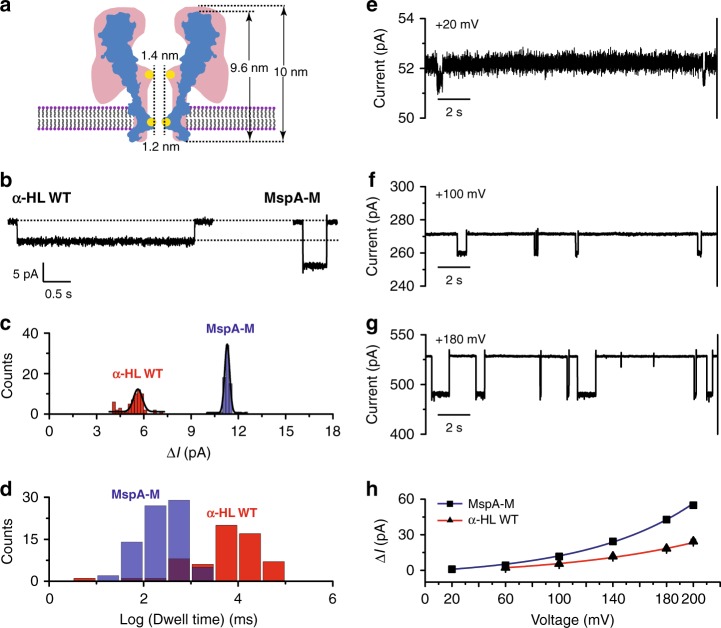
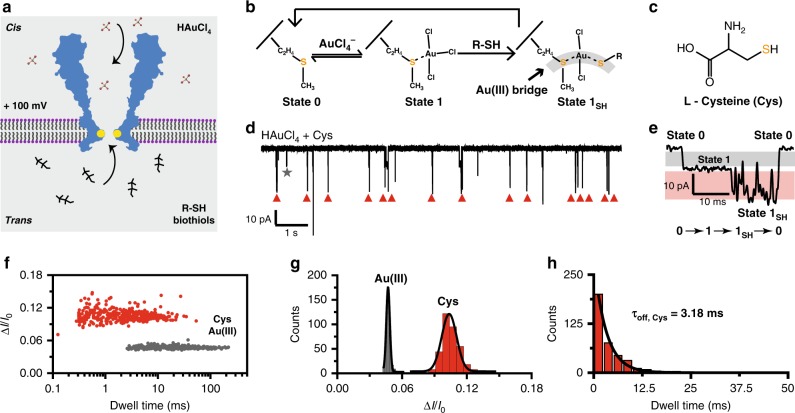
Biological nanopores are capable of resolving small analytes down to a monoatomic ion. In this research, tetrachloroaurate(III), a polyatomic ion, is discovered to bind to the methionine residue (M113) of a wild-type α-hemolysin by reversible Au(III)-thioether coordination. However, the cylindrical pore geometry of α-hemolysin generates shallow ionic binding events (~5-6 pA) and may have introduced other undesired interactions. Inspired by nanopore sequencing, a Mycobacterium smegmatis porin A (MspA) nanopore, which possesses a conical pore geometry, is mutated to bind tetrachloroaurate(III). Subsequently, further amplified blockage events (up to ~55 pA) are observed, which report the largest single ion binding event from a nanopore measurement. By taking the embedded Au(III) as an atomic bridge, the MspA nanopore is enabled to discriminate between different biothiols from single molecule readouts. These phenomena suggest that MspA is advantageous for single molecule chemistry investigations and has applications as a hybrid biological nanopore with atomic adaptors.
生物纳米孔能够分辨小至单原子离子的分析物。在这项研究中,发现多原子离子四氯金酸(III)通过可逆的 Au(III)-硫醚配位与野生型α-溶血素的蛋氨酸残基(M113)结合。然而,α-溶血素的圆柱形孔几何形状产生了浅的离子结合事件(约 5-6 pA),并且可能引入了其他不希望的相互作用。受纳米孔测序的启发,一种具有锥形孔几何形状的分枝杆菌 porin A (MspA) 纳米孔被突变以结合四氯金酸(III)。随后,观察到进一步放大的阻塞事件(高达约 55 pA),这是从纳米孔测量中报告的最大单离子结合事件。通过将嵌入的 Au(III) 作为原子桥,MspA 纳米孔能够从单分子读出中区分不同的生物硫醇。这些现象表明,MspA 有利于单分子化学研究,并且可以作为具有原子适配器的混合生物纳米孔应用。