Department of Endocrinology, Translational Research Key Laboratory for Diabetes, Xinqiao Hospital, Army Medical University (Former Name: Third Military Medical University), Chongqing, China.
Medical Research Center, Southwest Hospital, Army Medical University (Former Name: Third Military Medical University), Chongqing, China.
Mediators Inflamm. 2019 Nov 11;2019:8247019. doi: 10.1155/2019/8247019. eCollection 2019.
High levels of branched-chain amino acids (BCAAs) and aromatic amino acids (AAAs) were associated with an increased risk of hyperglycemia and the onset of diabetes. This study is aimed at assessing circulating valine concentrations in subjects with type 2 diabetes (T2D) and in T2D patients and high-fat diet- (HFD-) fed mice treated with the hypoglycemic agent sitagliptin (Sit) and analyzing the association of valine concentrations with metabolic parameters.
Metabolomics in HFD-fed mice were analyzed by gas chromatography-mass spectrometry (GC-MS) systems. Plasma valine concentrations were detected with a commercial kit in 53 subjects with normal glucose levels ( = 19), newly diagnosed T2D ( = 20), placebo-treated T2D ( = 7), or Sit-treated T2D ( = 7). Biochemical parameters were also assessed in all participants.
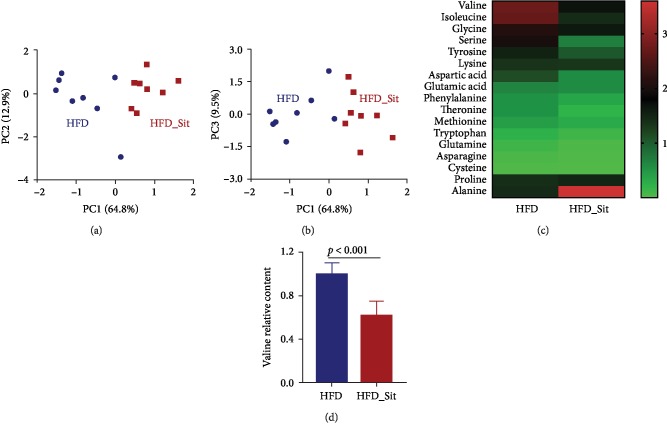
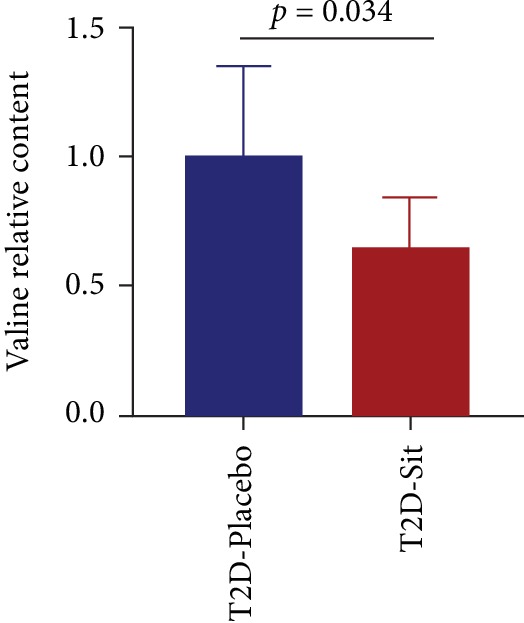
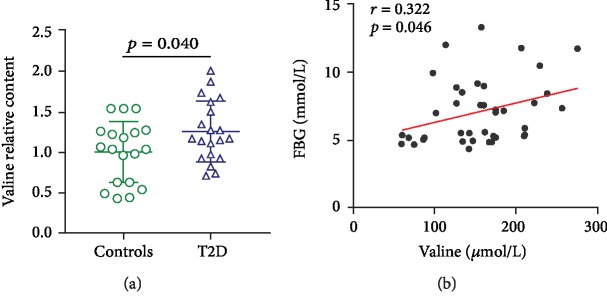
Sit treatment markedly changed the pattern of amino acid in HFD-fed mice, especially by reducing the level of the BCAA valine. Compared with the healthy controls, the plasma valine concentrations were significantly higher in the T2D patients ( < 0.05). Correlation analysis showed that the plasma valine concentration was positively correlated with the level of fasting plasma glucose ( < 0.05). Moreover, the plasma valine concentrations were notably reduced after Sit treatment in T2D patients ( < 0.05).
Our findings demonstrate an important effect of Sit on the BCAA valine in T2D patients and HFD-fed mice, revealing a new hypoglycemic mechanism of it. Furthermore, the results suggest that the circulating valine level might be a novel biomarker for T2D and restoring the level of valine might be a potential strategy for diabetes therapy.
支链氨基酸(BCAAs)和芳香族氨基酸(AAAs)水平升高与高血糖和糖尿病的发生风险增加有关。本研究旨在评估 2 型糖尿病(T2D)患者和 T2D 患者及高脂肪饮食(HFD)喂养并用降血糖药物西他列汀(Sit)治疗的小鼠的循环缬氨酸浓度,并分析缬氨酸浓度与代谢参数的相关性。
通过气相色谱-质谱(GC-MS)系统分析 HFD 喂养小鼠的代谢组学。使用商业试剂盒检测 53 例血糖正常受试者( = 19)、新诊断的 T2D 患者( = 20)、安慰剂治疗的 T2D 患者( = 7)和 Sit 治疗的 T2D 患者( = 7)的血浆缬氨酸浓度。所有参与者还评估了生化参数。
Sit 治疗明显改变了 HFD 喂养小鼠的氨基酸模式,特别是通过降低 BCAA 缬氨酸的水平。与健康对照组相比,T2D 患者的血浆缬氨酸浓度明显升高( < 0.05)。相关性分析显示,血浆缬氨酸浓度与空腹血糖水平呈正相关( < 0.05)。此外,Sit 治疗后 T2D 患者的血浆缬氨酸浓度明显降低( < 0.05)。
我们的研究结果表明 Sit 对 T2D 患者和 HFD 喂养小鼠的 BCAA 缬氨酸有重要影响,揭示了其新的降血糖机制。此外,结果表明循环缬氨酸水平可能是 T2D 的一种新的生物标志物,恢复缬氨酸水平可能是糖尿病治疗的一种潜在策略。