Xu Benling, Yuan Long, Chen Guangyu, Li Tiepeng, Zhou Jinxue, Zhang Chengjuan, Qin Peng, Muthana Musleh M, Wang Shengdian, Du Xuexiang, Gao Quanli
1Department of Immunotherapy, The Affiliated Cancer Hospital of Zhengzhou University, Zhengzhou, Henan People's Republic of China.
2Department of General Surgery, The Affiliated Cancer Hospital of Zhengzhou University, Zhengzhou, Henan People's Republic of China.
Cancer Cell Int. 2019 Dec 3;19:322. doi: 10.1186/s12935-019-1043-3. eCollection 2019.
Autologous tumor-infiltrating lymphocytes (Tils) immunotherapy is a promising treatment in patients with advanced hepatocellular cancer. Although Tils treatment has shown great promise, their persistence and the efficacy after adoptive-transfer are insufficient and remain a challenge. Studies have demonstrated that IL-15 and Akt inhibitor can regulate T cell differentiation and memory. Here, we constructed S-15 (Super human IL-15), a fusion protein consisting of human IL-15, the sushi domain of the IL-15 receptor α chain and human IgG-Fc. Herein we compared the effects of S-15 with IL-2 or in combination with Akti on the expansion and activation of Tils.
Hepatocellular cancer tissues were obtained from 6 patients, Tils were expanded using IL-2, IL-2/S-15, IL-2/Akti or in combination IL-2/S-15/Akti. At day 10, anti-CD3 antibody was added to the culture media and expanded to day 25. The composition, exhaustion and T-cell differentiation markers (CD45RA/CCR7) were analyzed by flow cytometry.
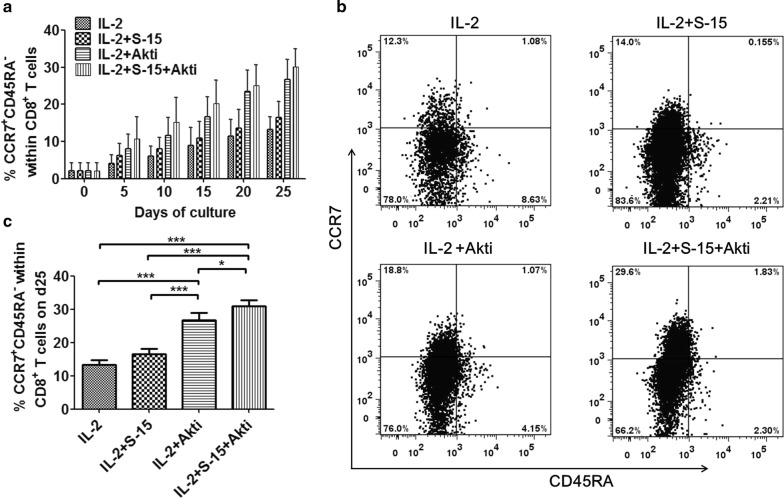
We found that IL-2/S-15/Akti expanded Tils and showed the highest percentage of central memory CD45RACCR7 phenotype prior to anti-CD3 antibody activation and after anti-CD3 antibody activation. T cells cultured with IL-2/S-15/Akti exhibited a mixture of CD4, CD8, and CD3CD4CD8 T cells; S-15 in combination with Akt inhibitor downregulated the expression of PD-1Tim-3 on Tils and decreased the Tregs in Tils. Additionally, the Tils expanded in the presence of the Akt inhibitor and S-15 showed enhanced antitumor activity as indicated by the increase in IFN-γ producing tumor infiltrating CD8 T cells and without comprising the Tils expansion.
Our study elucidates that IL-2/S-15/Akti expanded Tils and represent a viable source for the cellular therapy for patients with hepatocellular cancer.
自体肿瘤浸润淋巴细胞(Tils)免疫疗法是晚期肝细胞癌患者一种有前景的治疗方法。尽管Tils治疗已显示出巨大潜力,但其持久性和过继转移后的疗效仍不足,仍是一个挑战。研究表明,白细胞介素-15(IL-15)和Akt抑制剂可调节T细胞分化和记忆。在此,我们构建了S-15(超级人IL-15),一种由人IL-15、IL-15受体α链的寿司结构域和人IgG-Fc组成的融合蛋白。在此,我们比较了S-15与IL-2或与Akti联合使用对Tils扩增和激活的影响。
从6例患者获取肝细胞癌组织,使用IL-2、IL-2/S-15、IL-2/Akti或联合使用IL-2/S-15/Akti扩增Tils。在第10天,将抗CD3抗体添加到培养基中并扩增至第25天。通过流式细胞术分析其组成、耗竭情况和T细胞分化标志物(CD45RA/CCR7)。
我们发现,在抗CD3抗体激活之前和之后,IL-2/S-15/Akti扩增的Tils显示出最高比例的中央记忆CD45RACCR7表型。用IL-2/S-15/Akti培养的T细胞表现为CD4、CD8和CD3CD4CD8 T细胞的混合;S-15与Akt抑制剂联合使用可下调Tils上PD-1Tim-3的表达,并减少Tils中的调节性T细胞(Tregs)。此外,在Akt抑制剂和S-15存在下扩增的Tils显示出增强的抗肿瘤活性,表现为产生干扰素-γ的肿瘤浸润CD8 T细胞增加,且不影响Tils的扩增。
我们的研究表明,IL-2/S-15/Akti可扩增Tils,是肝细胞癌患者细胞治疗的一个可行来源。