Prince Stephanie A, Butler Gregory P, Roberts Karen C, Lapointe Pam, MacKenzie Andrew M, Colley Rachel C, Foley Maria, Saunders Travis J, Thompson Wendy
1Centre for Surveillance and Applied Research, Public Health Agency of Canada, 785 Carling Avenue, Ottawa, K1A 0K9 Canada.
2Division of Cardiac Prevention and Rehabilitation, University of Ottawa Heart Institute, Ottawa, Canada.
Arch Public Health. 2019 Dec 4;77:53. doi: 10.1186/s13690-019-0380-y. eCollection 2019.
While physical (in) activity surveillance has grown and continues to grow globally, surveillance of sedentary behaviour is in its infancy. As surveillance evolves to meet the changing nature of these behaviours, there is a need for the development of national health survey questions to provide accurate and consistent measures over time. The development of national health survey content is a complex, detailed and often undocumented process. The objective of this paper is to outline the process that the Public Health Agency of Canada (PHAC) and Statistics Canada took in partnership with academic experts to develop a short, flexible, sedentary behaviour module for the Canadian Health Measures Survey (CHMS) and to provide an approach for the development of future survey content.
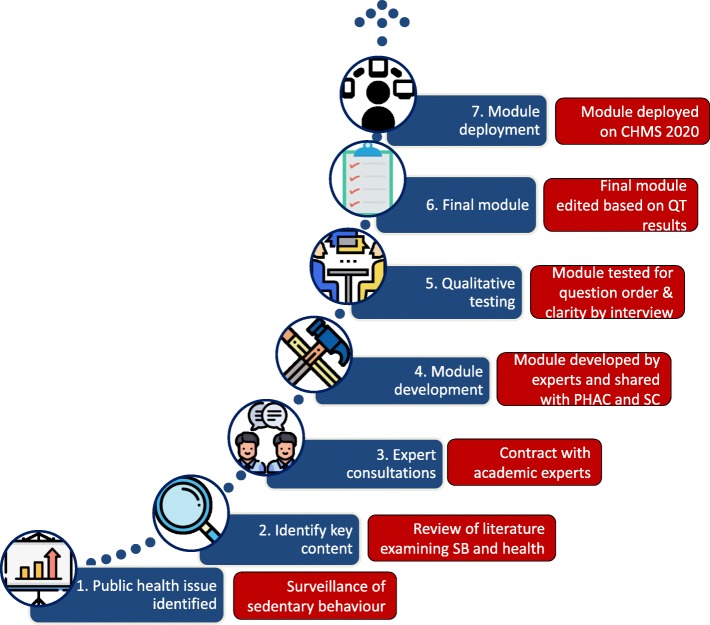
Development of the module followed a multi-step process. The results of this paper describe this process and present a framework for content development.
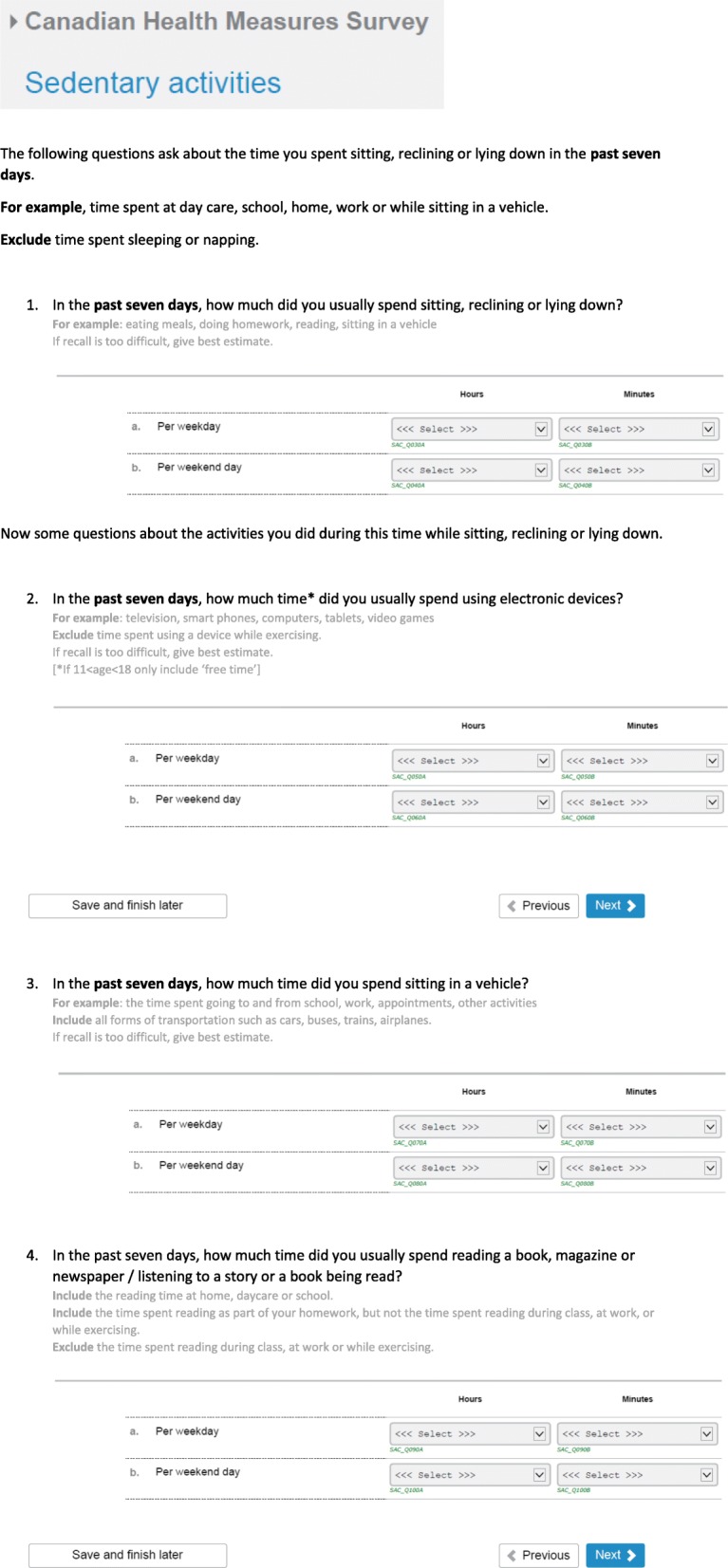
Initially, PHAC and Statistics Canada analysts worked together to identify key content required for a potential survey module. Next, this work was formalized through a contract with academic experts, the scope included a: review of existing Canadian sedentary behaviour modules; literature review linking different sedentary behaviours to health outcomes; and, international scan of modules currently in use in large national health surveys and research. The key output from both review processes was recommendations for a short sedentary behaviour questionnaire module (International Sedentary Assessment Tool). These recommendations provided an evidence-informed basis for discussions about how to revise and update the CHMS sedentary behaviour questionnaire content. Qualitative testing was undertaken and a final module was developed using survey design best practices.
Content volume in national surveys is limited due to demand to measure core content in addition to emerging health topics while keeping surveys as short as possible. Questions must therefore, be concise, valid/reliable, evidence-based, and developed using best practices. The paper describes the development process of a new survey module addressing the emerging area of sedentary behaviour for use in a national survey that may serve as a model for future population survey content development.
虽然全球范围内身体活动(不活动)监测工作一直在发展并持续增长,但久坐行为监测仍处于起步阶段。随着监测工作不断发展以适应这些行为的变化特性,需要开发国家健康调查问题,以便随着时间推移提供准确且一致的测量方法。国家健康调查内容的开发是一个复杂、详细且通常无文档记录的过程。本文的目的是概述加拿大公共卫生局(PHAC)和加拿大统计局与学术专家合作,为加拿大健康措施调查(CHMS)开发一个简短、灵活的久坐行为模块所采取的过程,并提供未来调查内容开发的方法。
该模块的开发遵循多步骤过程。本文结果描述了此过程并提出了内容开发框架。
最初,PHAC和加拿大统计局的分析师共同努力确定潜在调查模块所需的关键内容。接下来,这项工作通过与学术专家签订的合同正式确定,范围包括:审查加拿大现有的久坐行为模块;将不同久坐行为与健康结果联系起来的文献综述;以及对目前在大型国家健康调查和研究中使用的模块进行国际扫描。两个审查过程的关键产出是关于简短久坐行为问卷模块(国际久坐评估工具)的建议。这些建议为讨论如何修订和更新CHMS久坐行为问卷内容提供了基于证据的基础。进行了定性测试,并使用调查设计最佳实践开发了最终模块。
由于除了新兴健康主题外还需要测量核心内容,同时要使调查尽可能简短,国家调查中的内容量受到限制。因此,问题必须简洁、有效/可靠、基于证据,并采用最佳实践来开发。本文描述了一个新的调查模块的开发过程,该模块针对久坐行为这一新兴领域,用于国家调查,可为未来人口调查内容开发提供一个范例。