Department of Physiology & Biophysics, University of Mississippi Medical Center, 2500 N. State Street, Jackson, MS, 39216, USA.
Experimental and Clinical Research Center and Max-Delbrück Center for Molecular Medicine, and HELIOS Clinic Berlin, Berlin, Germany.
Biol Sex Differ. 2019 Dec 11;10(1):58. doi: 10.1186/s13293-019-0275-1.
Placental ischemia and hypertension, characteristic features of preeclampsia, are associated with impaired cerebral blood flow (CBF) autoregulation and cerebral edema. However, the factors that contribute to these cerebral abnormalities are not clear. Several lines of evidence suggest that angiotensin II can impact cerebrovascular function; however, the role of the renin angiotensin system in cerebrovascular function during placental ischemia has not been examined. We tested whether the angiotensin type 1 (AT1) receptor contributes to impaired CBF autoregulation in pregnant rats with placental ischemia caused by surgically reducing uterine perfusion pressure.
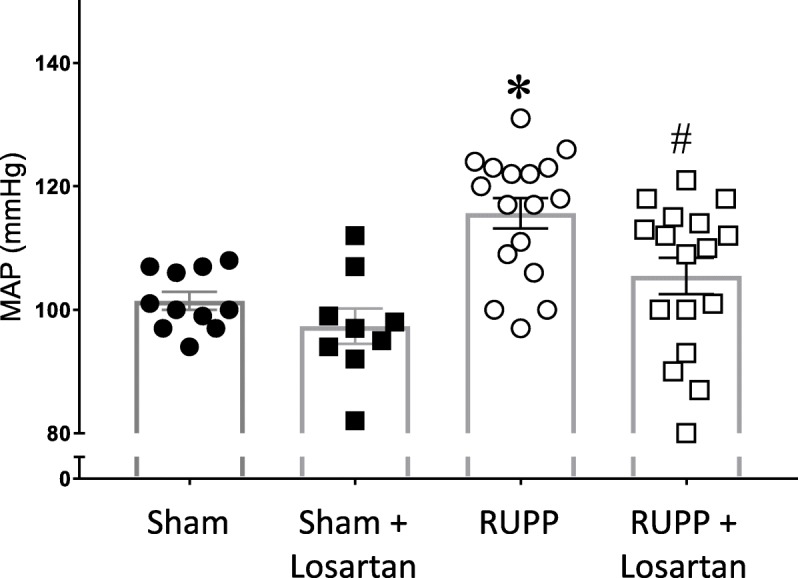
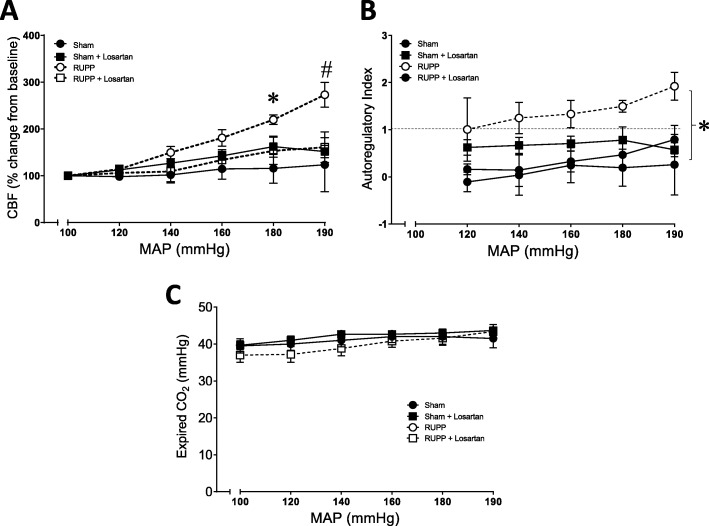
Placental ischemic or sham operated rats were treated with vehicle or losartan from gestational day (GD) 14 to 19 in the drinking water. On GD 19, we assessed CBF autoregulation in anesthetized rats using laser Doppler flowmetry.
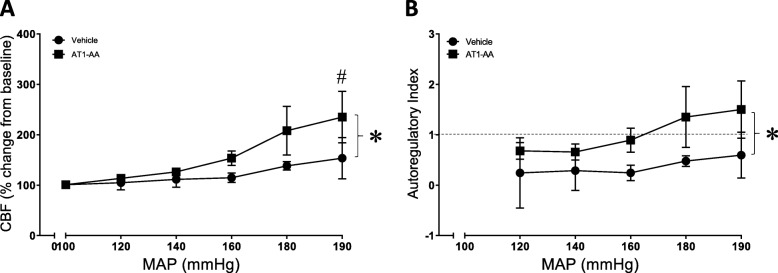
Placental ischemic rats had impaired CBF autoregulation that was attenuated by treatment with losartan. In addition, we examined whether an agonistic autoantibody to the AT1 receptor (AT1-AA), reported to be present in preeclamptic women, contributes to impaired CBF autoregulation. Purified rat AT1-AA or vehicle was infused into pregnant rats from GD 12 to 19 via mini-osmotic pumps after which CBF autoregulation was assessed. AT1-AA infusion impaired CBF autoregulation but did not affect brain water content.
These results suggest that the impaired CBF autoregulation associated with placental ischemia is due, at least in part, to activation of the AT1 receptor and that the RAS may interact with other placental factors to promote cerebrovascular changes common to preeclampsia.
胎盘缺血和高血压是子痫前期的特征,与脑血流 (CBF) 自动调节受损和脑水肿有关。然而,导致这些脑部异常的因素尚不清楚。有几条证据表明血管紧张素 II 可以影响脑血管功能;然而,肾素-血管紧张素系统在胎盘缺血期间对脑血管功能的作用尚未被研究。我们检测了血管紧张素 II 型 1 (AT1) 受体是否会影响由手术降低子宫灌注压引起的胎盘缺血的孕鼠的 CBF 自动调节受损。
胎盘缺血或假手术大鼠从妊娠第 14 天至 19 天在饮用水中接受 vehicle 或氯沙坦治疗。在妊娠第 19 天,我们使用激光多普勒血流计评估麻醉大鼠的 CBF 自动调节。
胎盘缺血大鼠的 CBF 自动调节受损,氯沙坦治疗可减轻这种受损。此外,我们还研究了报告存在于子痫前期妇女中的血管紧张素 II 型 1 (AT1) 受体激动性自身抗体 (AT1-AA) 是否会导致 CBF 自动调节受损。在妊娠第 12 天至 19 天,通过迷你渗透泵向孕鼠输注纯化的大鼠 AT1-AA 或载体,然后评估 CBF 自动调节。AT1-AA 输注会损害 CBF 自动调节,但不会影响脑含水量。
这些结果表明,与胎盘缺血相关的 CBF 自动调节受损至少部分是由于 AT1 受体的激活所致,而 RAS 可能与其他胎盘因素相互作用,促进与子痫前期共同的脑血管变化。