Sydney Institute of Marine Science, 19 Chowder Bay Road, Mosman, New South Wales, 2088, Australia.
Institute for Marine and Antarctic Studies, IMAS Waterfront Building, 20 Castray Esplanade, Battery Point, Tasmania, 7004, Australia.
Sci Rep. 2019 Dec 12;9(1):19013. doi: 10.1038/s41598-019-55152-4.
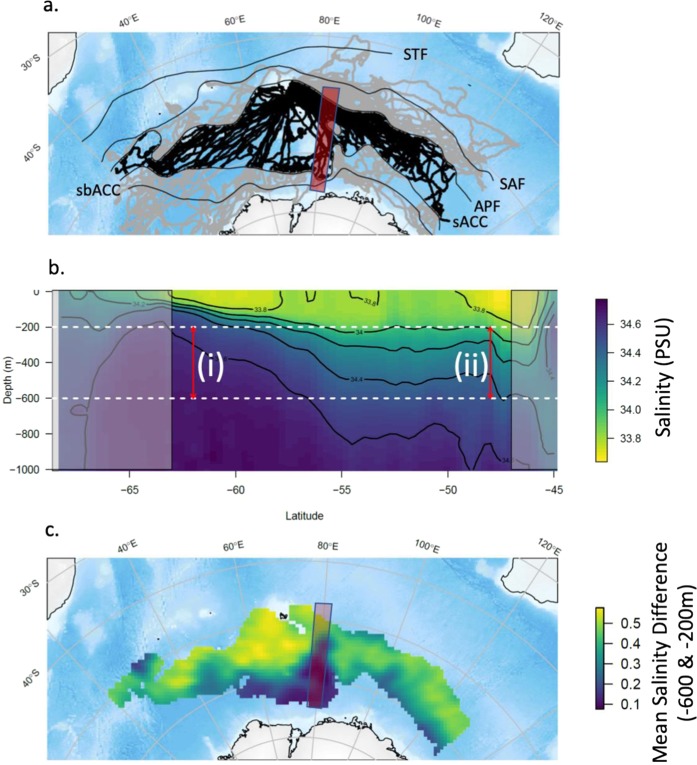
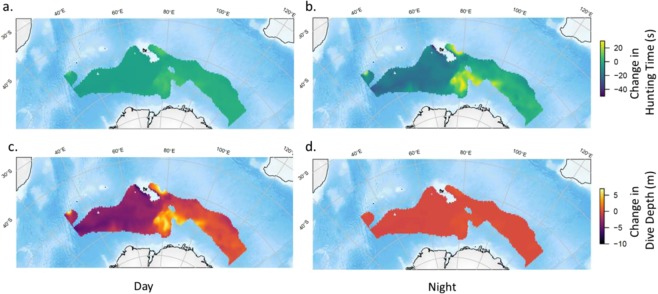
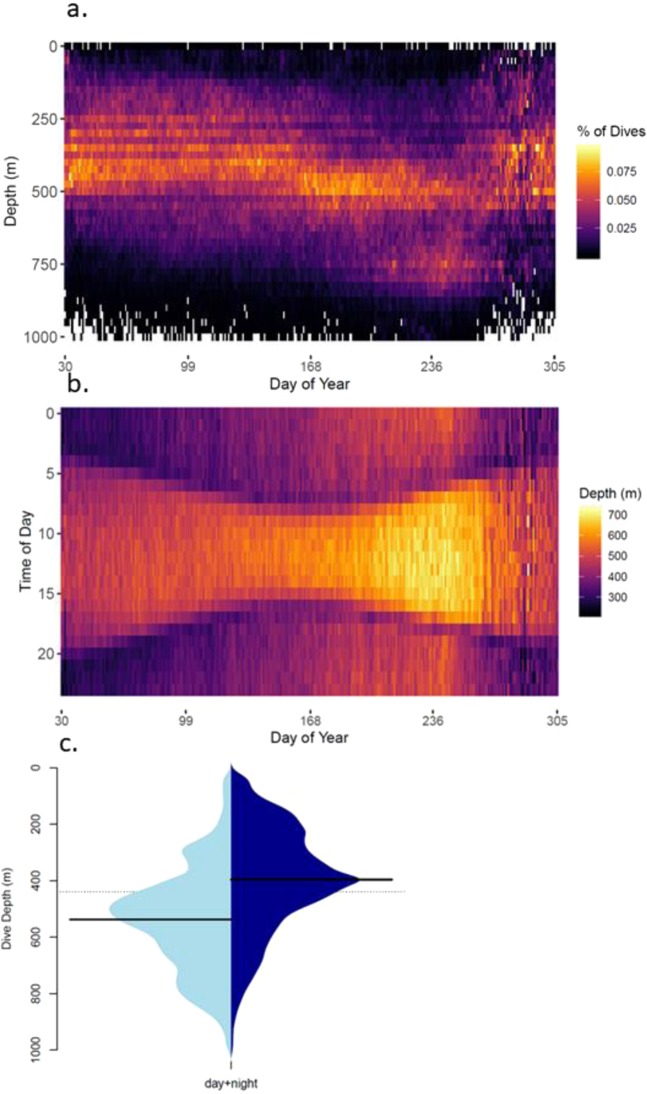
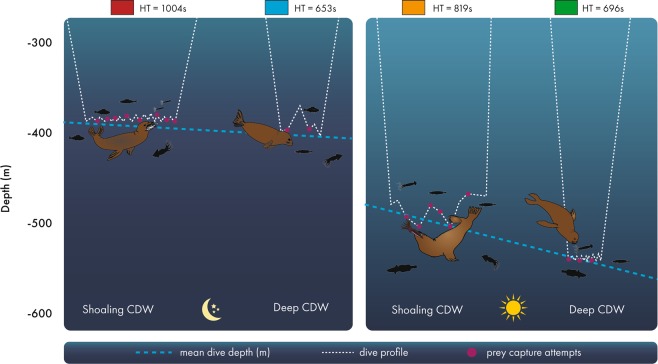
Mesopelagic fish and squid occupy ocean depths extending below the photic zone and their vertical migrations represent a massive pathway moving energy and carbon through the water column. Their spatio-temporal distribution is however, difficult to map across remote regions particularly the vast Southern Ocean. This represents a key gap in understanding biogeochemical processes, marine ecosystem structure, and how changing ocean conditions will affect marine predators, which depend upon mesopelagic prey. We infer mesopelagic prey vertical distribution and relative abundance in the Indian sector of the Southern Ocean (20° to 130°E) with a novel approach using predator-derived indices. Fourteen years of southern elephant seal tracking and dive data, from the open ocean between the Antarctic Polar Front and the southern Antarctic Circumpolar Current front, clearly show that the vertical distribution of mesopelagic prey is influenced by the physical hydrographic processes that structure their habitat. Mesopelagic prey have a more restricted vertical migration and higher relative abundance closer to the surface where Circumpolar Deep Water rises to shallower depths. Combining these observations with a future projection of Southern Ocean conditions we show that changes in the coupling of surface and deep waters will potentially redistribute mesopelagic prey. These changes are small overall, but show important spatial variability: prey will increase in relative abundance to the east of the Kerguelen Plateau but decrease to the west. The consequences for deep-diving specialists such as elephant seals and whales over this time scale will likely be minor, but the changes in mesoscale vertical energy flow have implications for predators that forage within the mesopelagic zone as well as the broader pelagic ecosystem.
中层鱼类和鱿鱼栖息在透光层以下的海洋深处,它们的垂直迁徙是能量和碳在水柱中大规模移动的主要途径。然而,由于这些鱼类和鱿鱼在偏远地区,特别是广阔的南大洋的时空分布难以绘制,因此对于理解生物地球化学过程、海洋生态系统结构以及海洋环境变化将如何影响依赖中层猎物的海洋捕食者来说,这是一个关键的知识空白。我们利用一种新的方法,通过捕食者的指标,推断南大洋(东经 20°至 130°)印度区域中层猎物的垂直分布和相对丰度。在南大洋开阔海域(南极极锋和南极绕极流之间),对 14 年的南象海豹追踪和潜水数据进行分析,结果清楚地表明,中层猎物的垂直分布受到塑造其栖息地的物理水文过程的影响。由于环极深水流上升到较浅的深度,中层猎物的垂直迁移更加受限,在靠近水面的地方相对丰度更高。将这些观察结果与对南大洋未来条件的预测相结合,我们表明,表面和深部水的耦合变化可能会重新分配中层猎物。这些变化总体上很小,但表现出重要的空间变异性:在 Kerguelen 高原以东,猎物的相对丰度将会增加,但在高原以西,猎物的相对丰度将会减少。在这段时间内,对于象海豹和鲸鱼等深潜专家来说,这些变化的后果可能很小,但中尺度垂直能量流的变化对在中层觅食的捕食者以及更广泛的浮游生态系统都有影响。