McHuron Elizabeth A, Adamczak Stephanie, Arnould John P Y, Ashe Erin, Booth Cormac, Bowen W Don, Christiansen Fredrik, Chudzinska Magda, Costa Daniel P, Fahlman Andreas, Farmer Nicholas A, Fortune Sarah M E, Gallagher Cara A, Keen Kelly A, Madsen Peter T, McMahon Clive R, Nabe-Nielsen Jacob, Noren Dawn P, Noren Shawn R, Pirotta Enrico, Rosen David A S, Speakman Cassie N, Villegas-Amtmann Stella, Williams Rob
Cooperative Institute for Climate, Ocean, and Ecosystem Studies, University of Washington, Seattle, WA, 98195, USA.
Ecology and Evolutionary Biology Department, University of California Santa Cruz, Santa Cruz, CA, 95064, USA.
Conserv Physiol. 2022 Aug 6;10(1):coac055. doi: 10.1093/conphys/coac055. eCollection 2022.
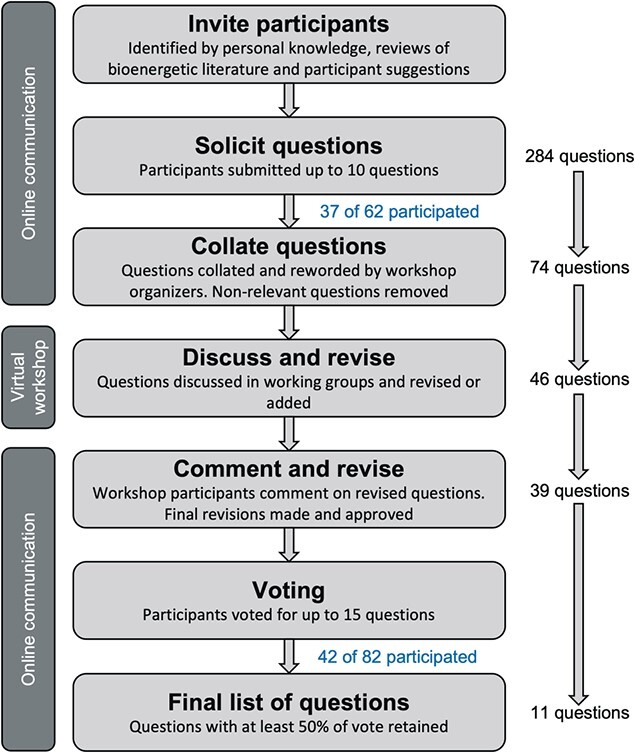
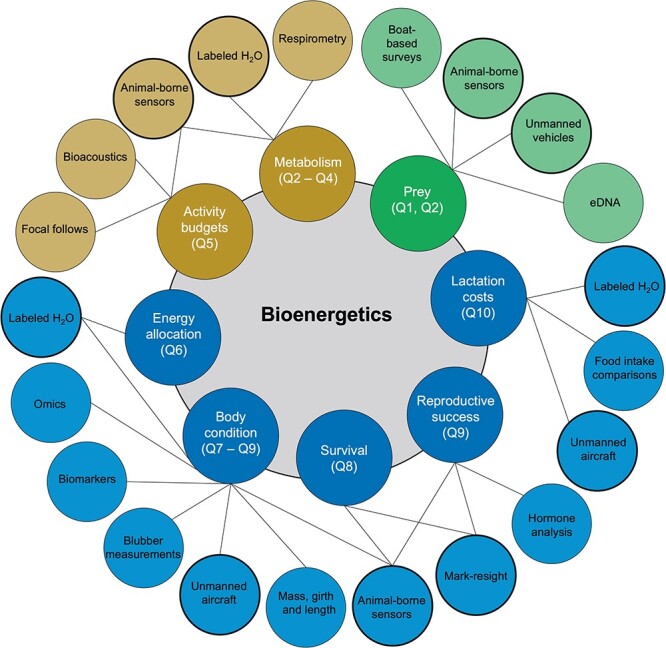
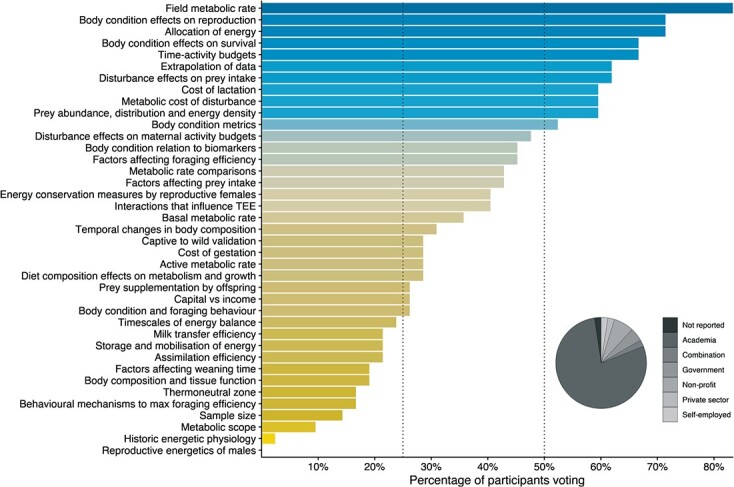
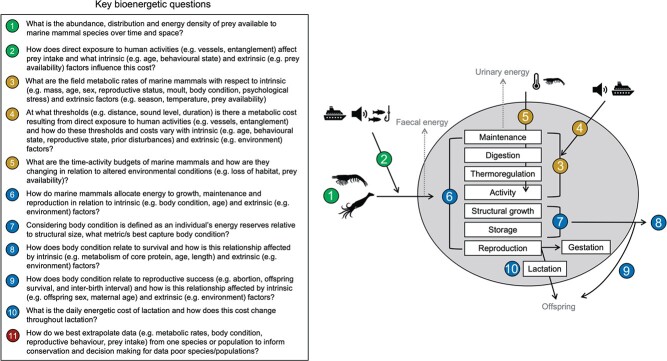
Bioenergetic approaches are increasingly used to understand how marine mammal populations could be affected by a changing and disturbed aquatic environment. There remain considerable gaps in our knowledge of marine mammal bioenergetics, which hinder the application of bioenergetic studies to inform policy decisions. We conducted a priority-setting exercise to identify high-priority unanswered questions in marine mammal bioenergetics, with an emphasis on questions relevant to conservation and management. Electronic communication and a virtual workshop were used to solicit and collate potential research questions from the marine mammal bioenergetic community. From a final list of 39 questions, 11 were identified as 'key' questions because they received votes from at least 50% of survey participants. Key questions included those related to energy intake (prey landscapes, exposure to human activities) and expenditure (field metabolic rate, exposure to human activities, lactation, time-activity budgets), energy allocation priorities, metrics of body condition and relationships with survival and reproductive success and extrapolation of data from one species to another. Existing tools to address key questions include labelled water, animal-borne sensors, mark-resight data from long-term research programs, environmental DNA and unmanned vehicles. Further validation of existing approaches and development of new methodologies are needed to comprehensively address some key questions, particularly for cetaceans. The identification of these key questions can provide a guiding framework to set research priorities, which ultimately may yield more accurate information to inform policies and better conserve marine mammal populations.
生物能量学方法越来越多地被用于理解海洋哺乳动物种群如何受到不断变化和受到干扰的水生环境的影响。我们对海洋哺乳动物生物能量学的了解仍存在相当大的差距,这阻碍了生物能量学研究在为政策决策提供信息方面的应用。我们开展了一项确定优先事项的工作,以找出海洋哺乳动物生物能量学中尚未得到解答的高度优先问题,重点是与保护和管理相关的问题。通过电子通信和虚拟研讨会,我们征求并整理了来自海洋哺乳动物生物能量学领域的潜在研究问题。在39个问题的最终清单中,有11个被确定为“关键”问题,因为它们获得了至少50%的调查参与者的投票。关键问题包括与能量摄入(猎物分布、接触人类活动)和能量消耗(野外代谢率、接触人类活动、哺乳、时间活动预算)、能量分配优先级、身体状况指标以及与生存和繁殖成功的关系,以及从一个物种到另一个物种的数据外推等相关的问题。解决关键问题的现有工具包括标记水、动物携带传感器、长期研究项目的标记重捕数据、环境DNA和无人驾驶车辆。需要进一步验证现有方法并开发新方法,以全面解决一些关键问题,特别是针对鲸类动物的问题。确定这些关键问题可以提供一个指导框架,以确定研究优先事项,最终可能产生更准确的信息,为政策提供依据,并更好地保护海洋哺乳动物种群。