Zhang Wei, Huang Rui, Wang Yi, Rao Huiying, Wei Lai, Su Grace L, Lok Anna S
Peking University Hepatology Institute Peking University People's Hospital Beijing China.
Division of Gastroenterology and Hepatology University of Michigan Ann Arbor MI.
Hepatol Commun. 2019 Oct 7;3(12):1585-1597. doi: 10.1002/hep4.1435. eCollection 2019 Dec.
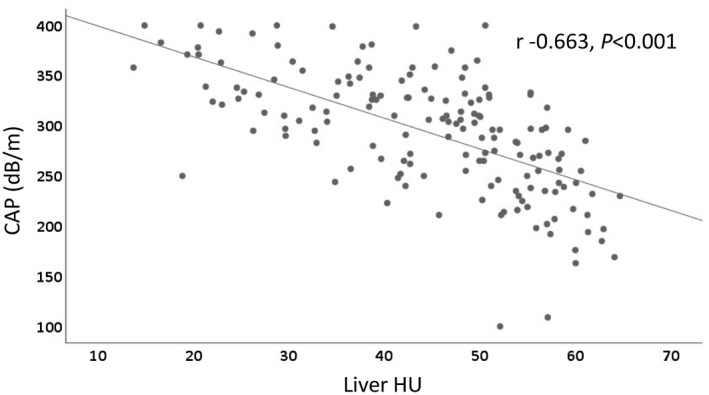
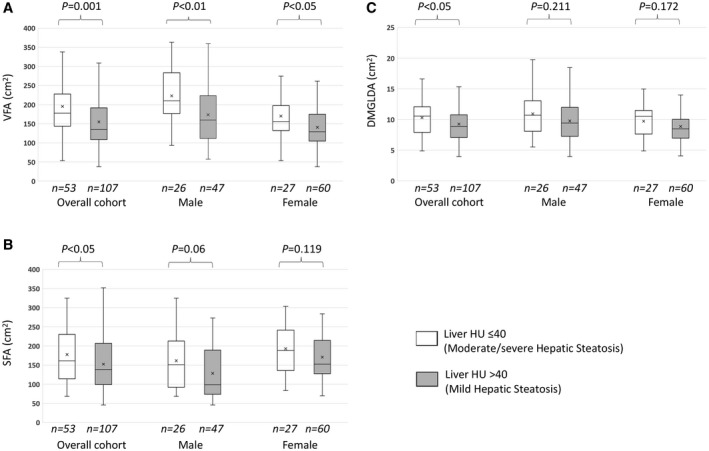
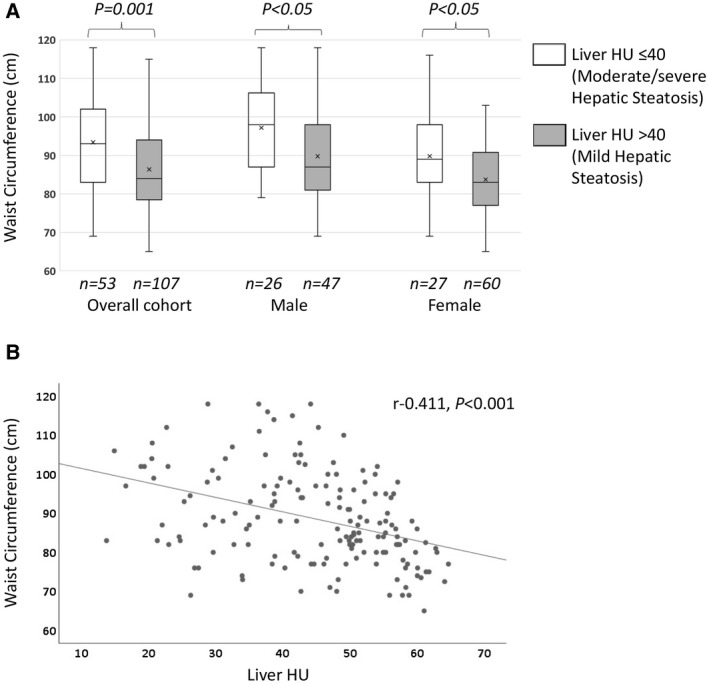
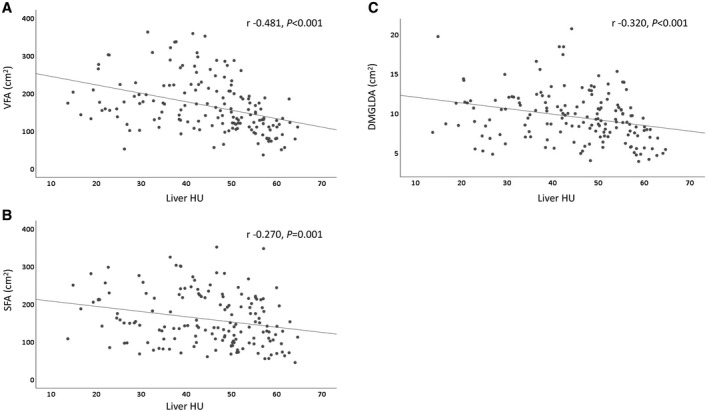
Several drugs in development for nonalcoholic fatty liver disease (NAFLD) aim to decrease the amount of fat in the liver. We compared quantity and quality of fat in subcutaneous, visceral and muscle compartments, liver fibrosis, and prevalence of metabolic abnormalities between Chinese patients with moderate/severe hepatic steatosis versus those with mild hepatic steatosis. NAFLD patients were prospectively recruited from Peking University People's Hospital in Beijing, China. All patients had baseline body composition measurements using computed tomography and analytic morphomics, clinical evaluation, labs and Fibroscan® controlled attenuation parameter and liver stiffness measurement. Moderate/severe hepatic steatosis was defined as computed tomography liver attenuation of 40 Hounsfield units or less. Calorie intake and physical activity were based on self-report. A total of 160 NAFLD patients were included (46% men, median age 47 years): 50% had normal body mass index (BMI), 24% were diabetic, and 56% had metabolic syndrome (MS). Fifty-three (33%) had moderate/severe steatosis, of whom 19 (35.8%) had normal BMI, and the rest had mild steatosis. Patients who had moderate/severe steatosis had significantly higher BMI, waist circumference, aminotransferases, controlled attenuation parameter, liver stiffness measurement, and prevalence of MS compared to those with mild steatosis. They also had larger visceral fat area, subcutaneous fat area, and low density dorsal muscle area. In addition, their calorie intake was higher and time spent on recreation activities was shorter. : NAFLD patients with moderate/severe steatosis, including those with normal BMI, had higher prevalence of MS and more fat in visceral, subcutaneous, and muscle compartments than those with mild steatosis. They also had more advanced liver disease. Strategies to decrease hepatic fat may benefit both liver and metabolic diseases.
几种正在研发用于治疗非酒精性脂肪性肝病(NAFLD)的药物旨在减少肝脏中的脂肪量。我们比较了中国中度/重度肝脂肪变性患者与轻度肝脂肪变性患者在皮下、内脏和肌肉组织中的脂肪数量和质量、肝纤维化以及代谢异常的患病率。NAFLD患者是从中国北京的北京大学人民医院前瞻性招募的。所有患者均使用计算机断层扫描和分析形态学进行了基线身体成分测量、临床评估、实验室检查以及Fibroscan®受控衰减参数和肝脏硬度测量。中度/重度肝脂肪变性定义为计算机断层扫描肝脏衰减为40亨氏单位或更低。热量摄入和身体活动基于自我报告。总共纳入了160名NAFLD患者(46%为男性,中位年龄47岁):50%的患者体重指数(BMI)正常,24%患有糖尿病,56%患有代谢综合征(MS)。53名(33%)患者患有中度/重度脂肪变性,其中19名(35.8%)BMI正常,其余患者为轻度脂肪变性。与轻度脂肪变性患者相比,患有中度/重度脂肪变性的患者BMI、腰围、转氨酶、受控衰减参数、肝脏硬度测量值以及MS患病率显著更高。他们的内脏脂肪面积、皮下脂肪面积和低密度背部肌肉面积也更大。此外,他们的热量摄入更高,用于娱乐活动的时间更短。:中度/重度脂肪变性的NAFLD患者,包括BMI正常的患者,与轻度脂肪变性患者相比,MS患病率更高,在内脏、皮下和肌肉组织中的脂肪更多。他们的肝脏疾病也更严重。减少肝脏脂肪的策略可能对肝脏疾病和代谢疾病都有益。