Taft Diana H, Akre Samir, Madrid Nicolas, Knoesen Andre, Mills David A, Lewis Zachery T
Department of Food Science and Technology, University of California, Davis, Davis, CA, USA.
Department of Electrical and Computer Engineering, University of California, Davis, Davis, CA, USA.
PeerJ. 2019 Dec 13;7:e8168. doi: 10.7717/peerj.8168. eCollection 2019.
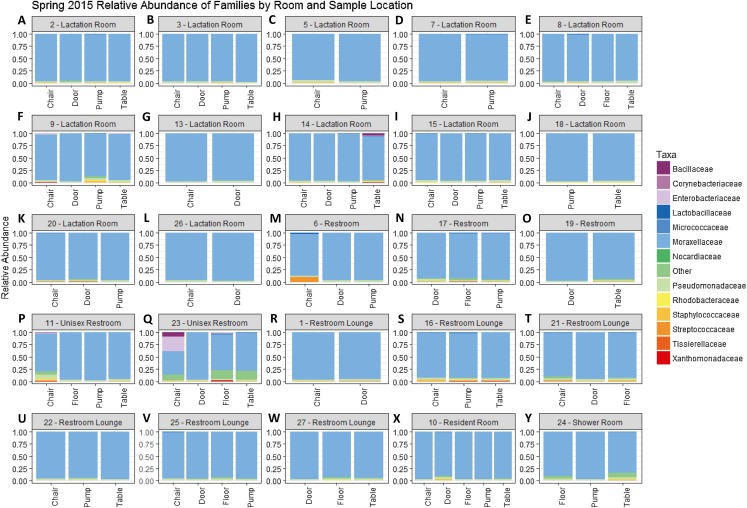
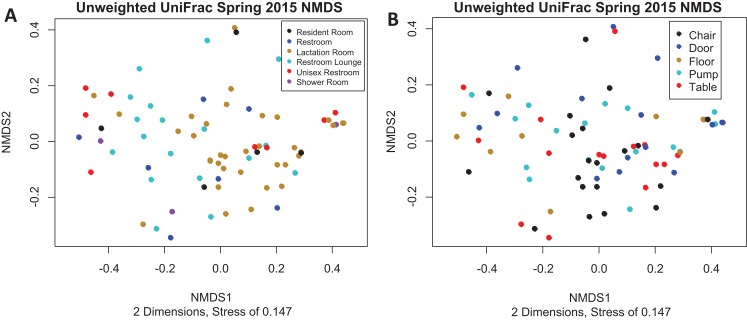
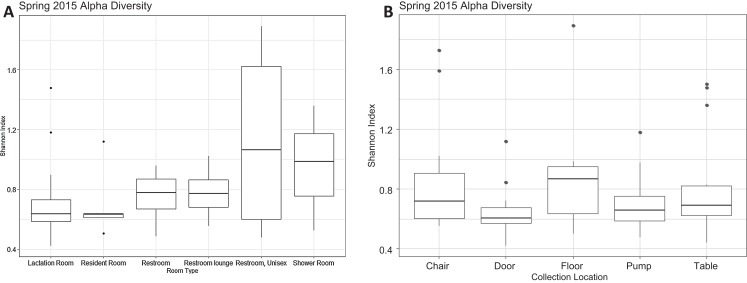
Dedicated lactation rooms are a modern development as mothers return to work while still providing breastmilk to their absent infants. This study describes the built environment microbiome of lactation rooms and daycares, and explores the influence of temperature and humidity on the microbiome of lactation rooms. Sterile swabs were used to collect samples from five different sites in lactation rooms at University of California, Davis and from five different sites in daycares located in Davis, California. DNA from the swabs was extracted and the V4 region of the 16S rRNA gene was sequenced using Illumina MiSeq. Temperature and relative humidity data were collected on a subset of the lactation rooms. Sampled lactation rooms could be either dedicated lactation rooms or could also serve other functions (e.g., combined lactation room and restroom lounge). The majority of sequence reads were identified as belonging to family Moraxellaceae, with 73% of all reads included in analysis identified as an unknown species of . Alpha diversity was analyzed using the Shannon index, while beta diversity was analyzed using unweighted and weighted UniFrac distance. The Jaccard distance was used to measure amount of change at sampling locations between time points for analysis of the impact of temperature and humidity on the microbiome. There were significant differences in the beta diversity of the microbiome of lactation rooms by room type. There were also significant differences in the beta diversity of the microbiome by sample collection location. There were no significant differences in either alpha or beta diversity associated with room temperature or humidity. Additional studies are needed to understand if the differences in lactation room type may result in differences in the breastmilk microbiome of milk collected in those rooms, and to what extent any such differences may influence the infant microbiome.
随着母亲们在回归工作岗位的同时仍要为不在身边的婴儿提供母乳,专用哺乳室成为了一种现代的发展趋势。本研究描述了哺乳室和日托中心的室内环境微生物群落,并探讨了温度和湿度对哺乳室微生物群落的影响。使用无菌拭子从加利福尼亚大学戴维斯分校的哺乳室的五个不同位置以及位于加利福尼亚州戴维斯的日托中心的五个不同位置采集样本。从拭子中提取DNA,并使用Illumina MiSeq对16S rRNA基因的V4区域进行测序。在一部分哺乳室中收集了温度和相对湿度数据。采样的哺乳室可以是专用哺乳室,也可以兼作其他功能(例如,哺乳室和洗手间休息室合并)。大多数序列读数被鉴定为属于莫拉克斯氏菌科,分析中包含的所有读数中有73%被鉴定为一种未知的物种。使用香农指数分析α多样性,而使用未加权和加权的UniFrac距离分析β多样性。使用杰卡德距离来测量时间点之间采样位置的变化量,以分析温度和湿度对微生物群落的影响。哺乳室微生物群落的β多样性因房间类型而异。微生物群落的β多样性在样本采集位置上也存在显著差异。与室温或湿度相关的α或β多样性均无显著差异。需要进一步的研究来了解哺乳室类型的差异是否可能导致在这些房间中收集的母乳的微生物群落存在差异,以及任何此类差异可能在多大程度上影响婴儿微生物群落。