Carafini Adriano, Sacco Isabel C N, Vieira Marcus Fraga
Bioengineering and Biomechanics Laboratory, Universidade Federal de Goiás, Goiânia, Goiás, Brazil.
Physical Therapy, Speech and Occupational Therapy Department, School of Medicine, Universidade de São Paulo, São Paulo, São Paulo, Brazil.
PeerJ. 2019 Dec 9;7:e8207. doi: 10.7717/peerj.8207. eCollection 2019.
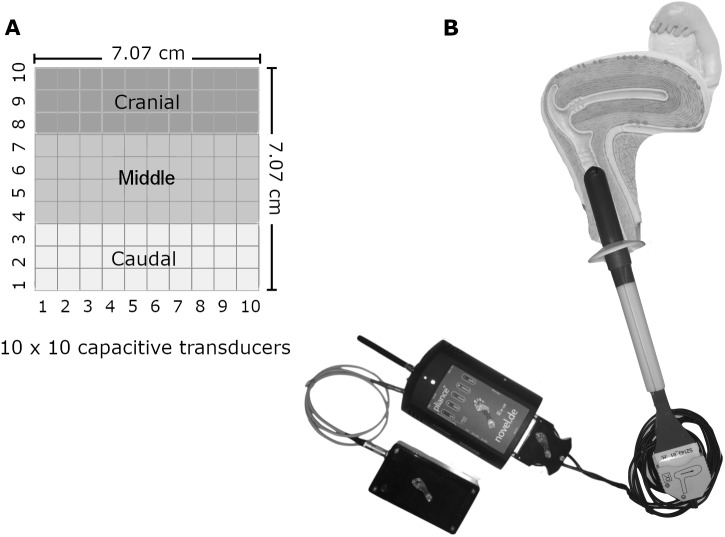
Pelvic floor pressure distribution profiles, obtained by a novel instrumented non-deformable probe, were used as the input to a feature extraction, selection, and classification approach to test their potential for an automatic diagnostic system for objective female urinary incontinence assessment. We tested the performance of different feature selection approaches and different classifiers, as well as sought to establish the group of features that provides the greatest discrimination capability between continent and incontinent women.
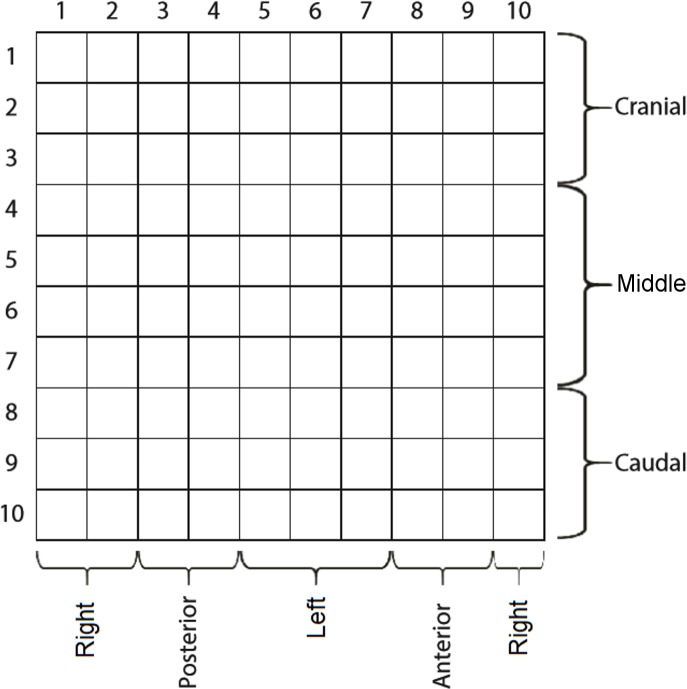
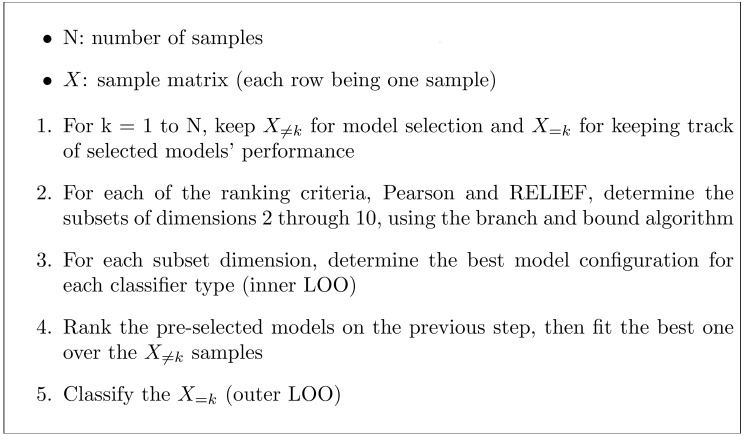
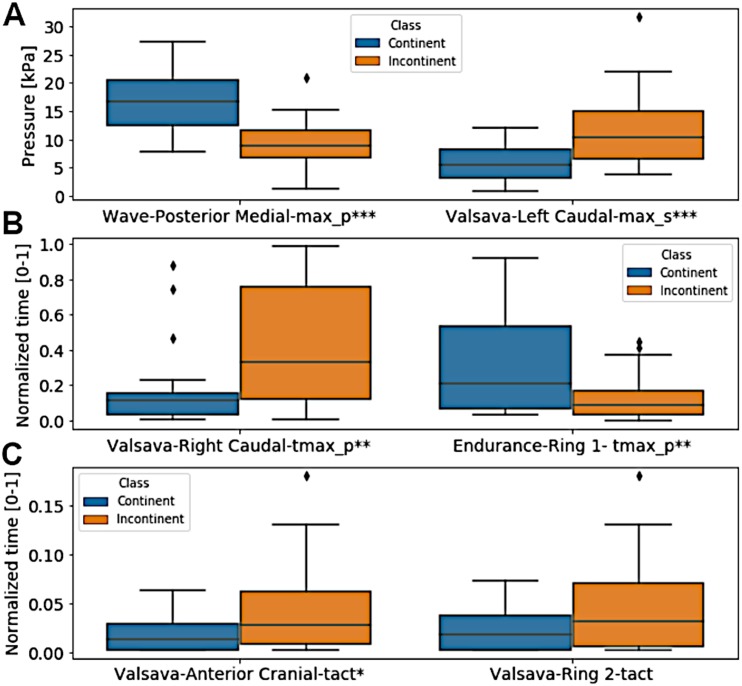
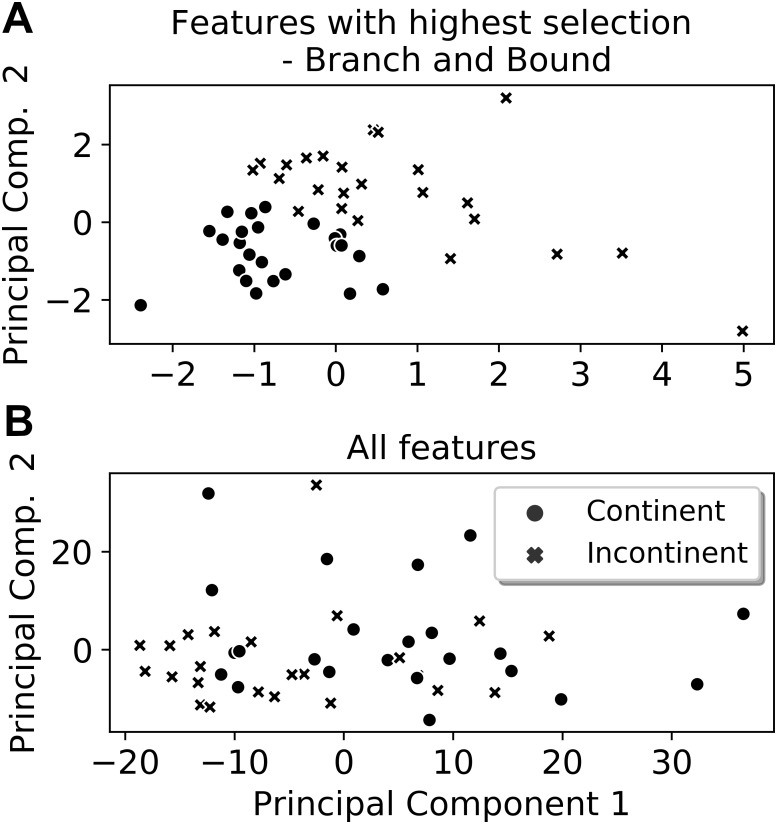
The available data for evaluation consisted of intravaginal spatiotemporal pressure profiles acquired from 24 continent and 24 incontinent women while performing four pelvic floor maneuvers: the maximum contraction maneuver, Valsalva maneuver, endurance maneuver, and wave maneuver. Feature extraction was guided by previous studies on the characterization of pressure profiles in the vaginal canal, where the extracted features were tested concerning their repeatability. Feature selection was achieved through a combination of a ranking method and a complete non-exhaustive subset search algorithm: branch and bound and recursive feature elimination. Three classifiers were tested: k-nearest neighbors (k-NN), support vector machine, and logistic regression.
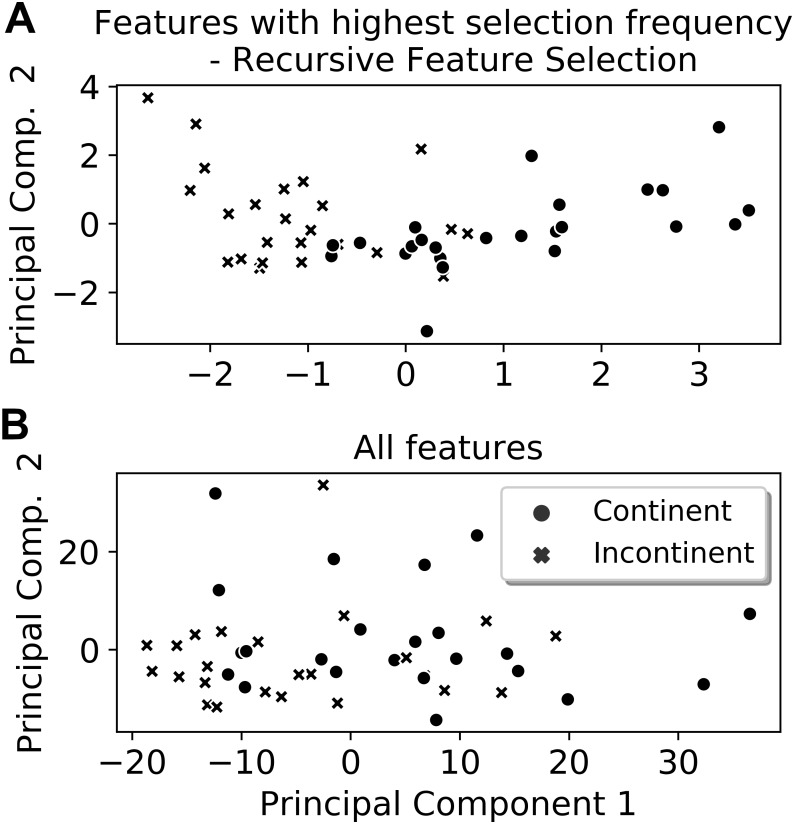
Of the classifiers employed, there was not one that outperformed the others; however, k-NN presented statistical inferiority in one of the maneuvers. The best result was obtained through the application of recursive feature elimination on the features extracted from all the maneuvers, resulting in 77.1% test accuracy, 74.1% precision, and 83.3 recall, using SVM. Moreover, the best feature subset, obtained by observing the selection frequency of every single feature during the application of branch and bound, was directly employed on the classification, thus reaching 95.8% accuracy. Although not at the level required by an automatic system, the results show the potential use of pelvic floor pressure distribution profiles data and provide insights into the pelvic floor functioning aspects that contribute to urinary incontinence.
通过一种新型的仪器化不可变形探头获得的盆底压力分布曲线,被用作特征提取、选择和分类方法的输入,以测试其在客观评估女性尿失禁自动诊断系统中的潜力。我们测试了不同特征选择方法和不同分类器的性能,并试图确定在控尿和尿失禁女性之间具有最大区分能力的特征组。
用于评估的可用数据包括从24名控尿和24名尿失禁女性在进行四种盆底动作时获得的阴道内时空压力曲线:最大收缩动作、瓦尔萨尔瓦动作、耐力动作和波动动作。特征提取以先前关于阴道管压力曲线特征的研究为指导,在该研究中对提取的特征进行了重复性测试。特征选择是通过排序方法和完整的非穷举子集搜索算法(分支定界法和递归特征消除法)相结合来实现的。测试了三种分类器:k近邻(k-NN)、支持向量机和逻辑回归。
在所使用的分类器中,没有一个比其他分类器表现更好;然而,k-NN在其中一个动作中表现出统计学上的劣势。通过对从所有动作中提取的特征应用递归特征消除法获得了最佳结果,使用支持向量机时,测试准确率为77.1%,精确率为74.1%,召回率为83.3%。此外,通过观察分支定界法应用过程中每个特征的选择频率获得的最佳特征子集,直接用于分类,从而达到了95.8%的准确率。尽管未达到自动系统所需的水平,但结果显示了盆底压力分布曲线数据的潜在用途,并为导致尿失禁的盆底功能方面提供了见解。