Korea Institute of Geoscience and Mineral Resources, Daejeon, 34132, South Korea.
Department of Environmental and Marine Science, Hanyang University, Ansan 15588, South Korea.
Sci Adv. 2019 Dec 11;5(12):eaax8203. doi: 10.1126/sciadv.aax8203. eCollection 2019 Dec.
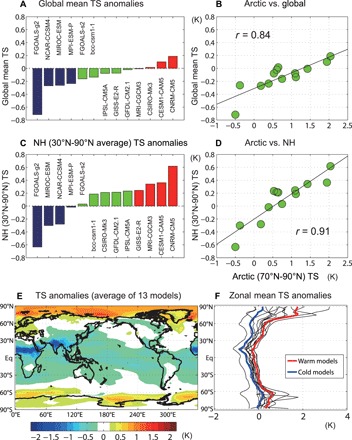
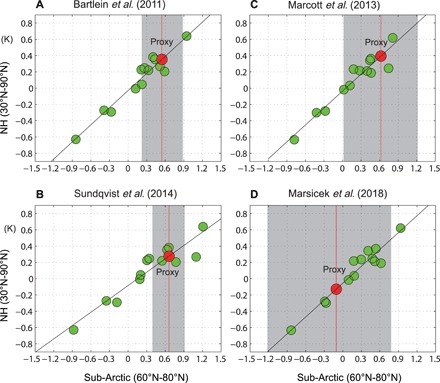
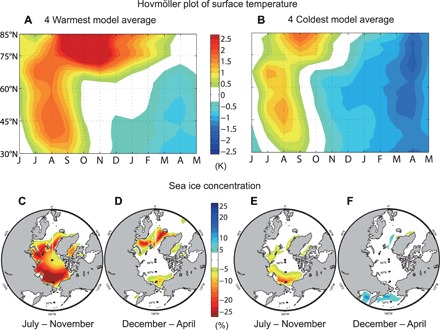
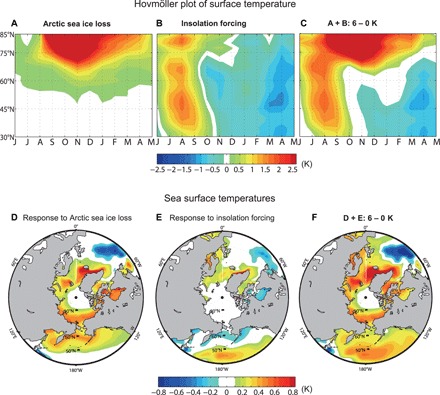
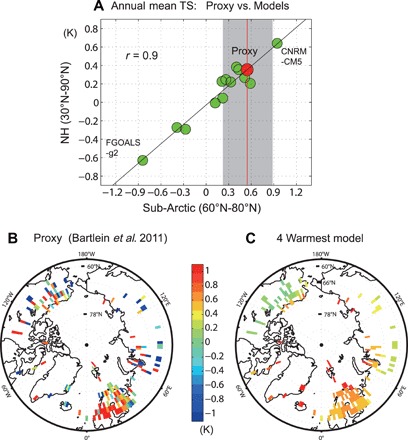
The Holocene thermal maximum was characterized by strong summer solar heating that substantially increased the summertime temperature relative to preindustrial climate. However, the summer warming was compensated by weaker winter insolation, and the annual mean temperature of the Holocene thermal maximum remains ambiguous. Using multimodel mid-Holocene simulations, we show that the annual mean Northern Hemisphere temperature is strongly correlated with the degree of Arctic amplification and sea ice loss. Additional model experiments show that the summer Arctic sea ice loss persists into winter and increases the mid- and high-latitude temperatures. These results are evaluated against four proxy datasets to verify that the annual mean northern high-latitude temperature during the mid-Holocene was warmer than the preindustrial climate, because of the seasonally rectified temperature increase driven by the Arctic amplification. This study offers a resolution to the "Holocene temperature conundrum", a well-known discrepancy between paleo-proxies and climate model simulations of Holocene thermal maximum.
全新世热最大值的特点是夏季太阳辐射强烈,导致夏季气温相对于工业化前气候大幅升高。然而,夏季变暖被冬季太阳辐射减弱所补偿,因此全新世热最大值的年平均温度仍然存在争议。利用多模式中全新世模拟,我们表明北半球年平均温度与北极放大和海冰损失的程度密切相关。额外的模型实验表明,夏季北极海冰的损失会持续到冬季,并增加中高纬度的温度。这些结果与四个代理数据集进行了评估,以验证中全新世的年平均北极高纬度温度高于工业化前气候,这是由于北极放大驱动的季节修正温度升高所致。本研究解决了“全新世温度难题”,这是古代理由和全新世热最大值气候模型模拟之间的一个著名差异。