Chen Chengyu, Geng Qun, Sun Dongfeng, Hu Wensi, Zhong Chenxi, Fan Limin, Song Xiaoming
Department of Thoracic Surgery, The First Affiliated Hospital of Shandong First Medical University, Jinan, People's Republic of China.
Department of Ultrasound Diagnosis and Treatment, Shandong Provincial Hospital, Shandong University, Jinan, People's Republic of China.
Onco Targets Ther. 2019 Dec 10;12:10739-10747. doi: 10.2147/OTT.S222332. eCollection 2019.
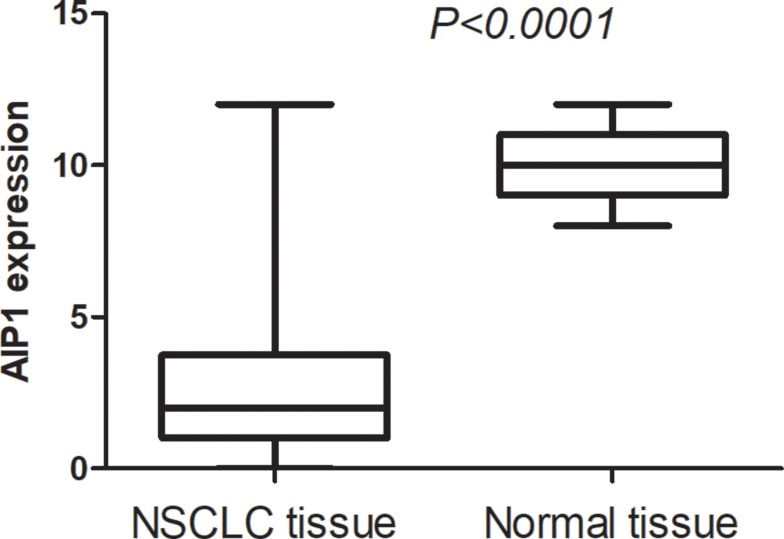
To investigate the expression of tumor suppressor protein ASK1-interacting protein-1 (AIP1) in cancer tissues of patients with early-stage non-small cell lung cancer (NSCLC) and its correlation with tumor progression, tumor angiogenesis and prognosis.
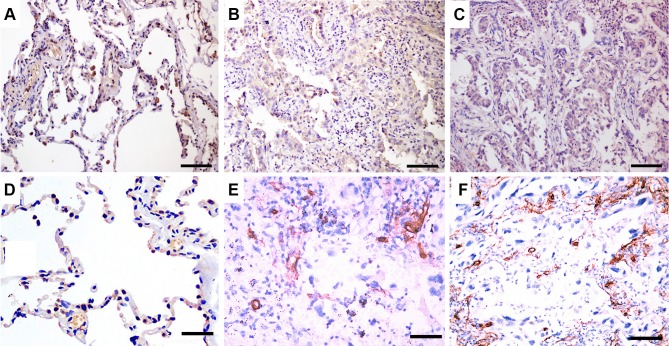
A total of 136 patients with stage I NSCLC who underwent radical resection of lung cancer in Qianfoshan Hospital of Shandong Province from January 2011 to December 2011 were enrolled. Immunohistochemistry was used to detect AIP1 protein in tumor tissues. Vascular endothelial CD34 immunohistochemical staining was used to count intratumoral microvessel density (MVD). SPSS 19.0 software was used to analyze the relationship between AIP1 protein expression and clinicopathological features, tumor angiogenesis and prognosis.
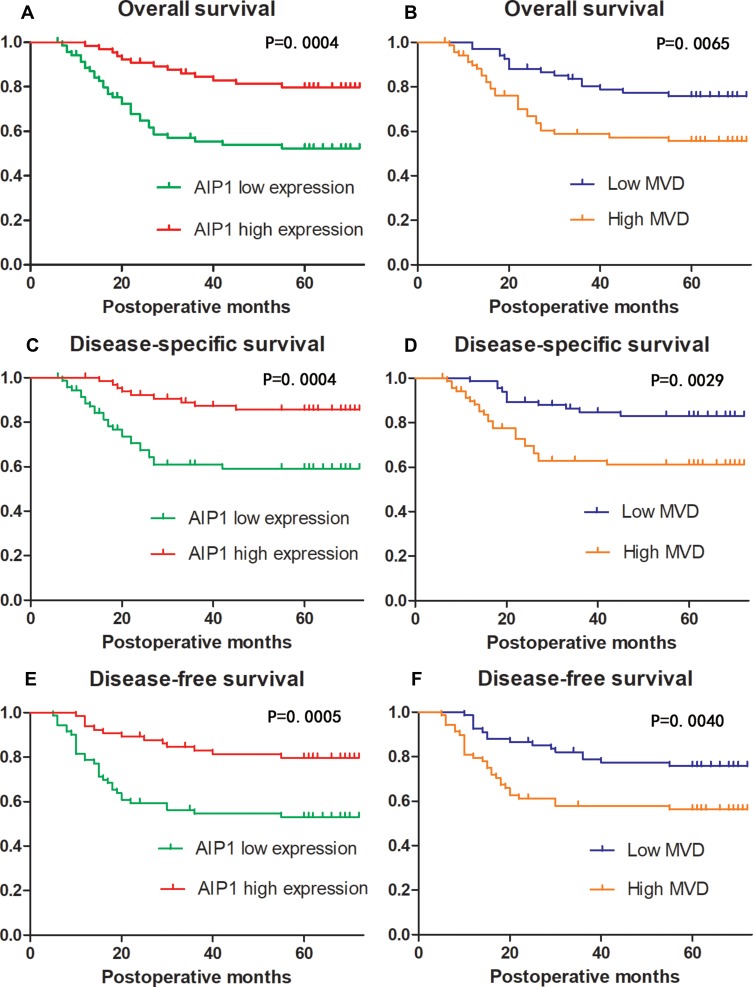
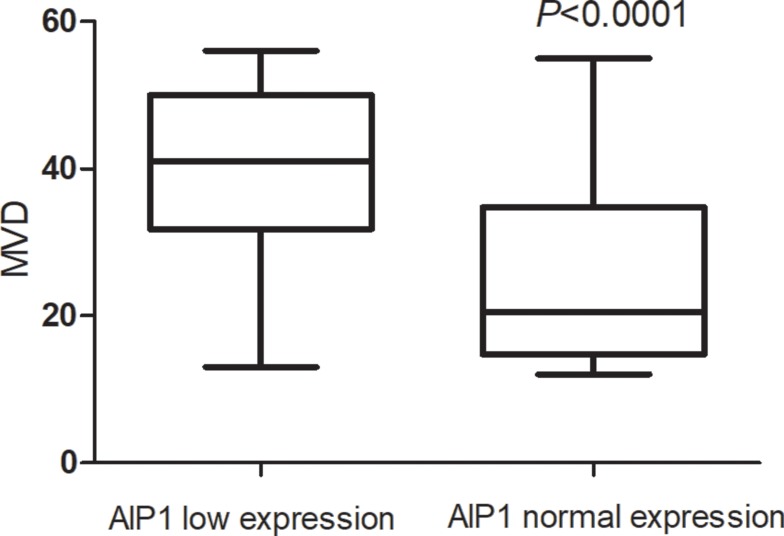
Low expression of AIP1 was more common in tumor tissues with high MVD, and patients with low expression of AIP1 were more likely to have tumor recurrence. Multivariate analysis showed that low expression of AIP1 had predictive value for overall survival, disease-free survival, and disease-specific survival.
Downregulation of AIP1 protein expression is associated with lung cancer progression, tumor angiogenesis and poor prognosis. Consequently, AIP1 may prove to be an important predictor of recovery from lung cancer and could become a new therapeutic target for lung cancer treatment.
探讨抑癌蛋白ASK1相互作用蛋白1(AIP1)在早期非小细胞肺癌(NSCLC)患者癌组织中的表达及其与肿瘤进展、肿瘤血管生成和预后的相关性。
选取2011年1月至2011年12月在山东省千佛山医院接受肺癌根治性切除术的136例I期NSCLC患者。采用免疫组织化学法检测肿瘤组织中AIP1蛋白。采用血管内皮CD34免疫组织化学染色计数肿瘤内微血管密度(MVD)。应用SPSS 19.0软件分析AIP1蛋白表达与临床病理特征、肿瘤血管生成和预后的关系。
AIP1低表达在MVD高的肿瘤组织中更为常见,AIP1低表达的患者更易发生肿瘤复发。多因素分析显示,AIP1低表达对总生存、无病生存和疾病特异性生存具有预测价值。
AIP1蛋白表达下调与肺癌进展、肿瘤血管生成及预后不良相关。因此,AIP1可能是肺癌康复的重要预测指标,并可能成为肺癌治疗的新靶点。