Sun Dongfeng, Chen Chengyu, Hu Wensi, Zhong Chenxi, Fan Limin, Song Xiaoming, Gai Zhibo
Department of Thoracic Surgery, Shandong Provincial Qianfoshan Hospital, Shandong University, Jinan 250014, People's Republic of China,
Department of Thoracic Surgery, Shanghai Chest Hospital, Shanghai JiaoTong University, Shanghai 200030, People's Republic of China.
Onco Targets Ther. 2018 Nov 1;11:7699-7707. doi: 10.2147/OTT.S178131. eCollection 2018.
To investigate the expression of tumor suppressor protein ASK1-interacting protein-1 (AIP1) in human esophageal squamous cell carcinoma (ESCC) and its role in tumor progression, angiogenesis, and prognosis.
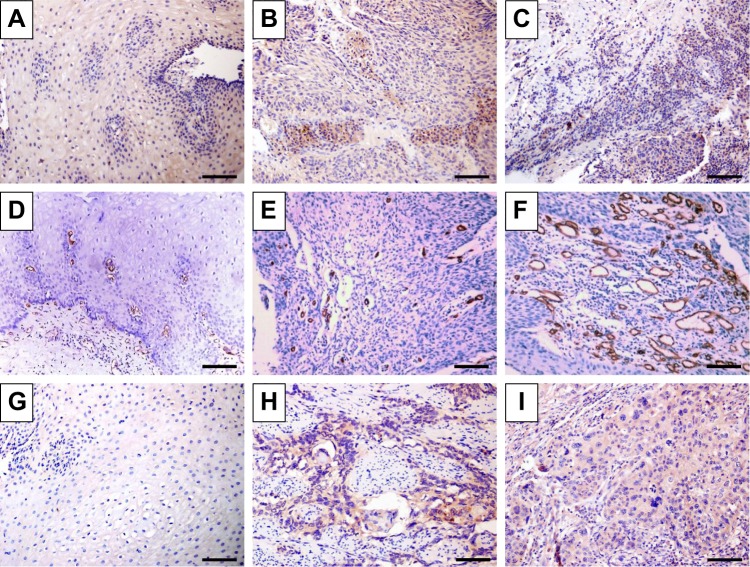
A total of 117 biopsy samples were obtained from ESCC patients. None of the patients had distant metastasis before surgery, and did not receive preoperative chemotherapy or radiotherapy. Immunohistochemistry was used to detect the expression of AIP1 protein and vascular endothelial growth factor receptor 2 (VEGFR2) in ESCC specimens collected from 117 patients who underwent esophageal cancer radical surgery. Microvessel density (MVD) was evaluated by immunohistochemical staining of vascular endothelial CD34. The correlation between AIP1 protein and clinicopathological characteristics, tumor angiogenesis, and prognosis was analyzed.
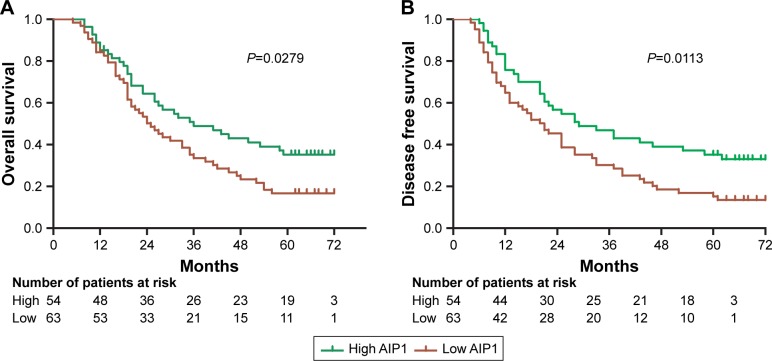
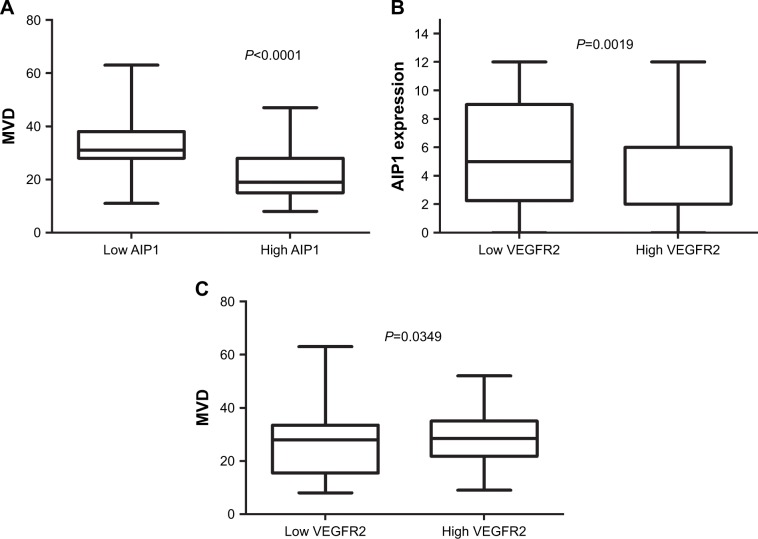
The downregulation of AIP1 protein in esophageal carcinoma tissues was detected in 63 cases. This downregulation significantly correlated with lymph node metastasis, clinicopathological staging, and tumor MVD (<0.05). Survival analysis showed that ESCC patients with a low expression of AIP1, a high expression of VEGFR2, and a high level of MVD had a lower 5-year survival rate (<0.05). Multivariate analysis confirmed that the downregulation of AIP1 significantly affected patient survival.
The downregulation of AIP1 correlated with ESCC progression, tumor angiogenesis, and poor prognosis. AIP1 could be a promising biomarker for predicting ESCC prognosis and a potential target for anti-angiogenic therapy.
探讨肿瘤抑制蛋白ASK1相互作用蛋白1(AIP1)在人食管鳞状细胞癌(ESCC)中的表达及其在肿瘤进展、血管生成和预后中的作用。
从ESCC患者中获取117份活检样本。所有患者术前均无远处转移,且未接受术前化疗或放疗。采用免疫组织化学法检测117例行食管癌根治术患者的ESCC标本中AIP1蛋白和血管内皮生长因子受体2(VEGFR2)的表达。通过血管内皮CD34免疫组织化学染色评估微血管密度(MVD)。分析AIP1蛋白与临床病理特征、肿瘤血管生成和预后之间的相关性。
63例食管癌组织中检测到AIP1蛋白下调。这种下调与淋巴结转移、临床病理分期和肿瘤MVD显著相关(<0.05)。生存分析表明,AIP1低表达、VEGFR2高表达和MVD高水平的ESCC患者5年生存率较低(<0.05)。多因素分析证实AIP1下调显著影响患者生存。
AIP1下调与ESCC进展、肿瘤血管生成和不良预后相关。AIP1可能是预测ESCC预后的有前景的生物标志物,也是抗血管生成治疗的潜在靶点。