Wang Linlin, Ren Aiguo, Tian Tian, Li Nan, Cao Xuanye, Zhang Peng, Jin Lei, Li Zhiwen, Shen Yan, Zhang Bo, Finnell Richard H, Lei Yunping
Institute of Reproductive and Child Health, National Health Commission Health Key Laboratory of Reproductive Health, Department of Epidemiology and Biostatistics, School of Public Health, Peking University Health Science Center, Beijing, China.
Center for Precision Environmental Health, Department of Molecular and Cellular Biology, Baylor College of Medicine, Houston, TX, United States.
Front Neurosci. 2019 Nov 29;13:1285. doi: 10.3389/fnins.2019.01285. eCollection 2019.
Anencephaly is a lethal neural tube defect (NTD). Although variants in several genes have been implicated in the development of anencephaly, a more complete picture of variants in the genome, especially variants (DNVs), remains unresolved. We aim to identify DNVs that play an important role in the development of anencephaly by performing whole-exome DNA sequencing (WES) of proband-parent trios.
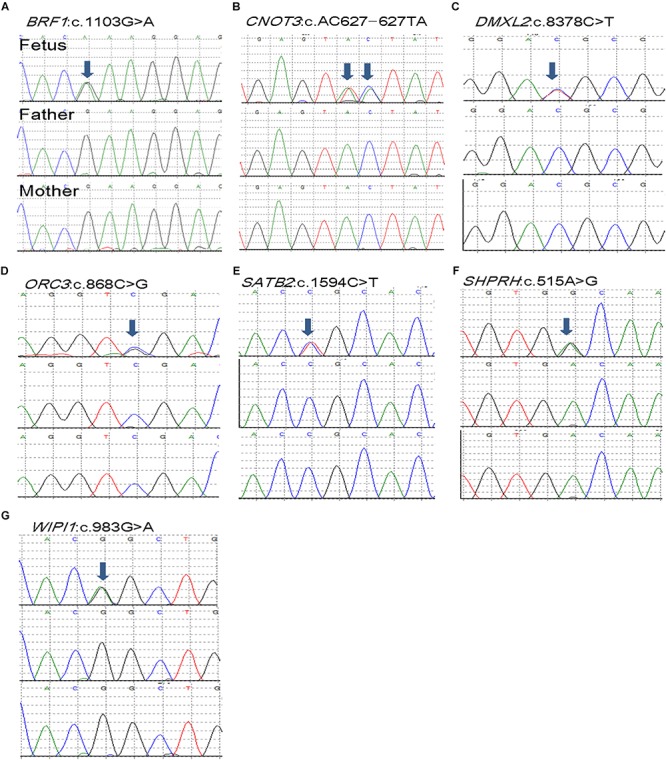
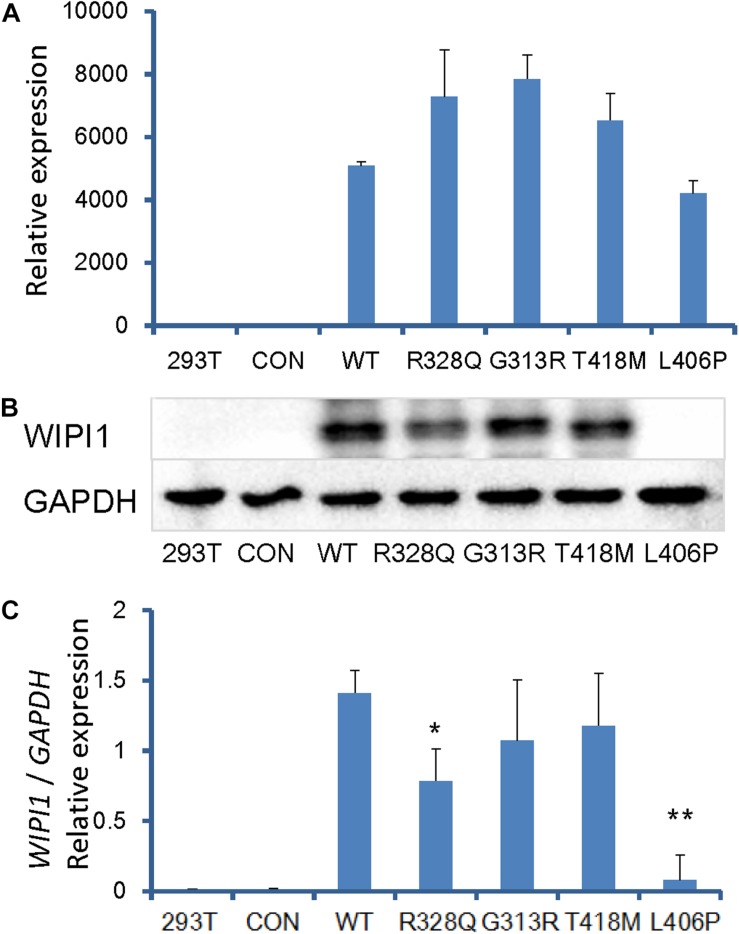
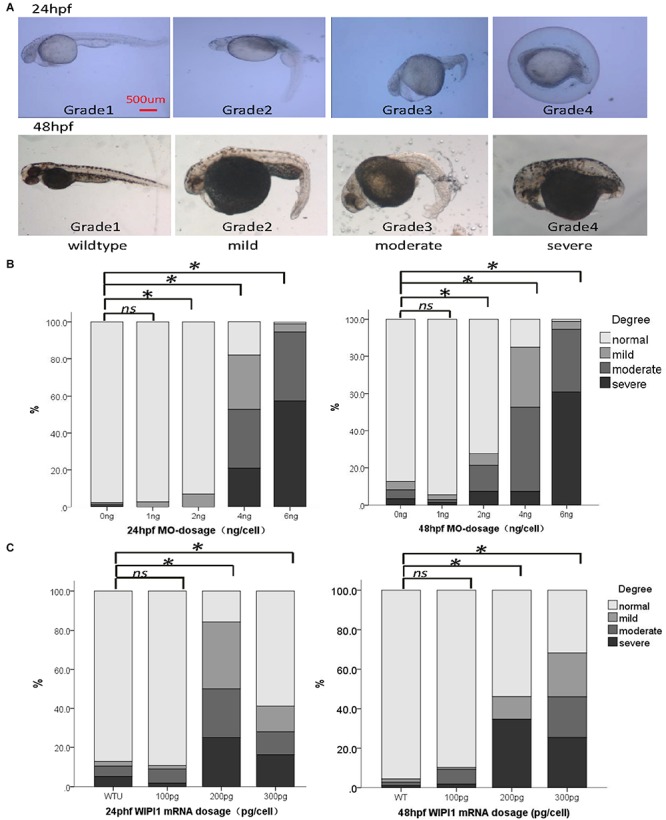
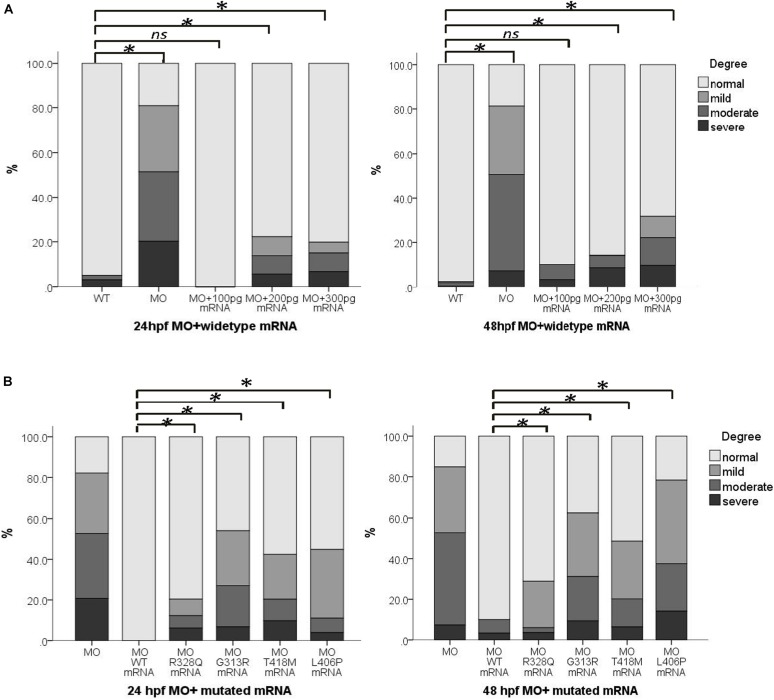
A total of 13 DNVs were identified in 8 anencephaly trios by WES, including two loss of function (LoF) variants detected in pLI > 0.9 genes (, c.2629_2633del, and , p.Y1907X). Damaging DNVs were identified in 61.5% (8/13) of the anencephalic cases. Independent validation was conducted in an additional 502 NTD cases. Gene inactivation using targeted morpholino antisense oligomers and rescue assays were conducted in zebrafish, and transfection expression in HEK293T cells. Four DNVs in four cases were identified and predicted to alter protein function, including p.R328Q in WD repeat domain phosphoinositide-interacting 1 (WIPI1). Three variants, p.G313R, p.T418M, and p.L406P, in the WIPI1 gene were identified from the independent replication cohort consisting of 502 cases. Functional analysis suggested that the p.L406P and p.R328Q variants most likely displayed loss-of-function effects during embryonic development.
damaging variants are the main culprit for majority of anencephalic cases. Missense variants in WIPI1 may play a role in the genetic etiology of anencephaly, and LoF variants in and may also contribute to anencephaly. These findings add to our existing understanding of the genetic mechanisms of NTD formation.
无脑儿是一种致命的神经管缺陷(NTD)。尽管多个基因的变异与无脑儿的发生有关,但基因组变异,尤其是新发变异(DNV)的全貌仍未明确。我们旨在通过对先证者-父母三联体进行全外显子组DNA测序(WES),来鉴定在无脑儿发生中起重要作用的DNV。
通过WES在8个无脑儿三联体中总共鉴定出13个DNV,包括在pLI>0.9的基因( ,c.2629_2633del,以及 ,p.Y1907X)中检测到的两个功能丧失(LoF)变异。在61.5%(8/13)的无脑儿病例中鉴定出有害的DNV。在另外502例NTD病例中进行了独立验证。在斑马鱼中使用靶向吗啉代反义寡核苷酸进行基因失活和拯救试验,并在HEK293T细胞中进行转染表达。在四个病例中鉴定出四个DNV,并预测其会改变蛋白质功能,包括WD重复结构域磷酸肌醇相互作用蛋白1(WIPI1)中的p.R328Q。从由502例病例组成的独立复制队列中鉴定出WIPI1基因中的三个变异,即p.G313R、p.T418M和p.L406P。功能分析表明,p.L406P和p.R328Q变异在胚胎发育过程中最有可能表现出功能丧失效应。
有害变异是大多数无脑儿病例的主要原因。WIPI1中的错义变异可能在无脑儿的遗传病因中起作用,并且 和 中的LoF变异也可能导致无脑儿。这些发现加深了我们对NTD形成遗传机制的现有理解。