Zha Lingyan, Liu Wenke, Zhang Yubin, Zhou Chengbo, Shao Mingjie
Institute of Environment and Sustainable Development in Agriculture, Chinese Academy of Agricultural Sciences, Beijing, China.
Key Lab of Energy Conservation and Waste Management of Agricultural Structures, Ministry of Agriculture and Rural Affairs, Beijing, China.
Front Plant Sci. 2019 Nov 6;10:1440. doi: 10.3389/fpls.2019.01440. eCollection 2019.
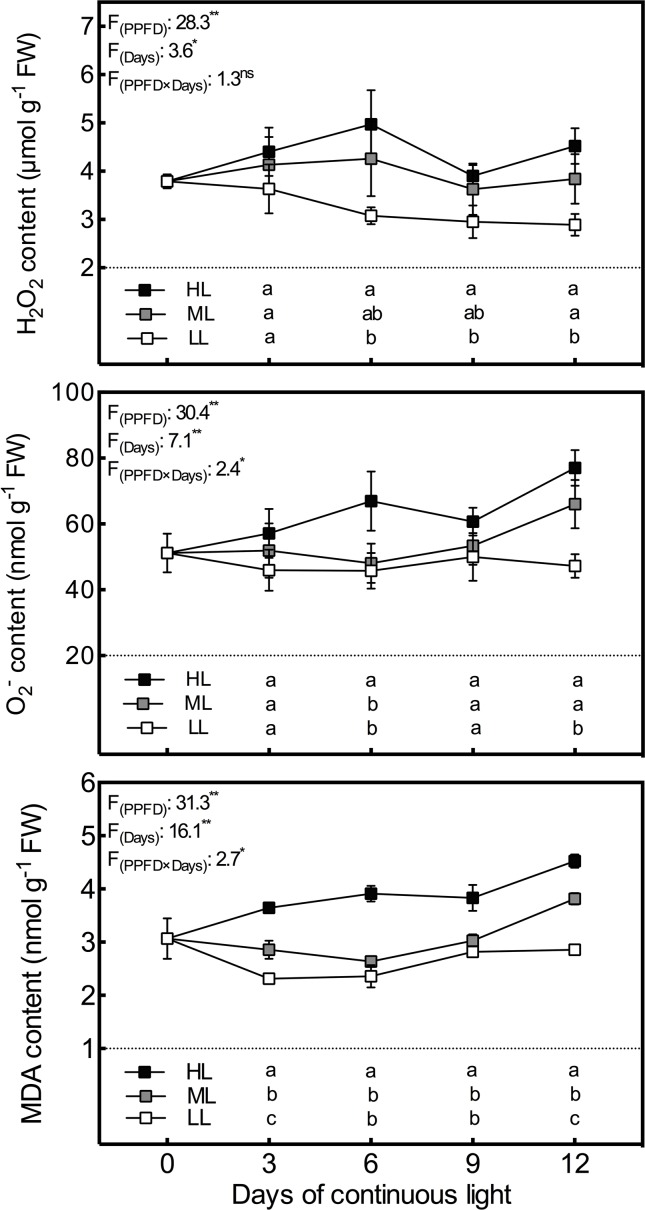
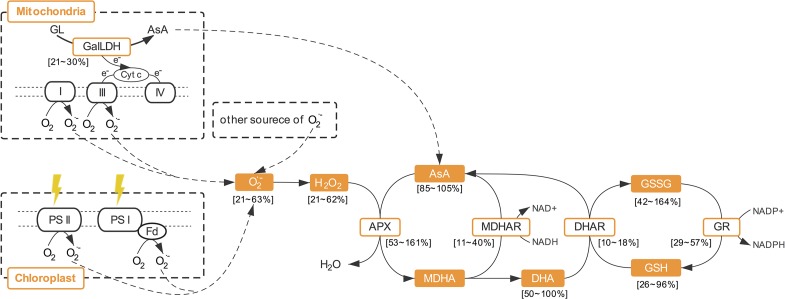
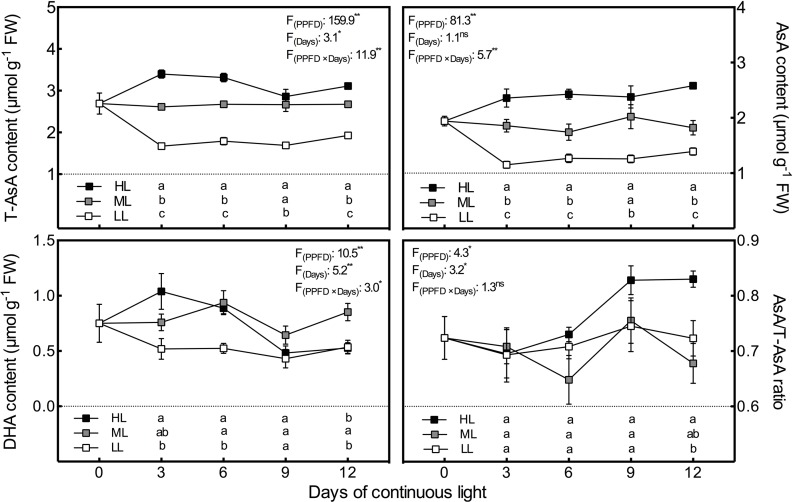
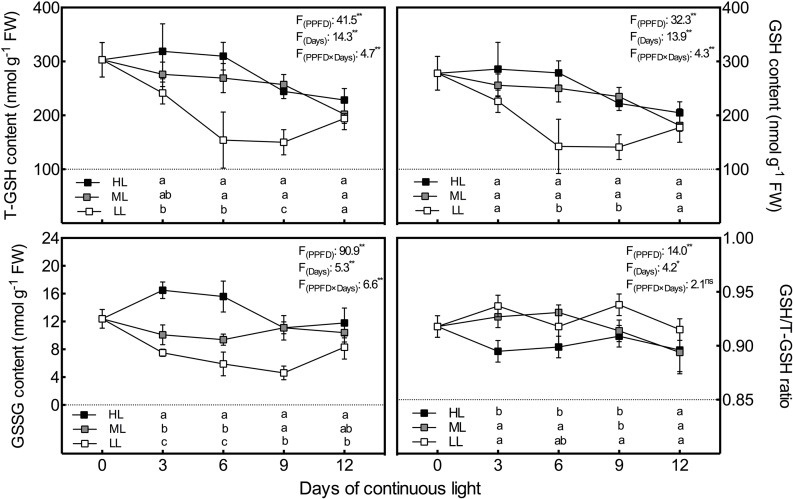
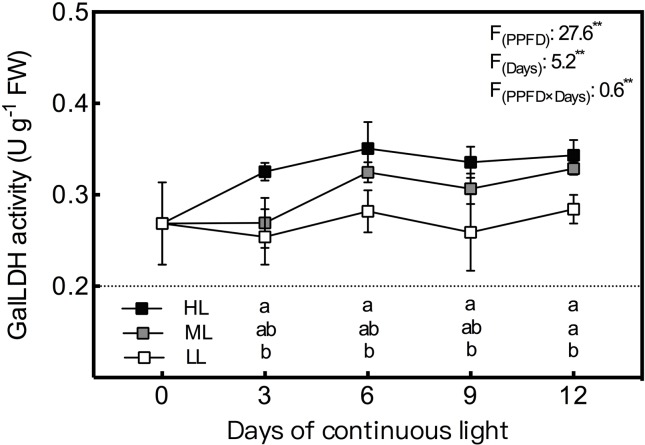
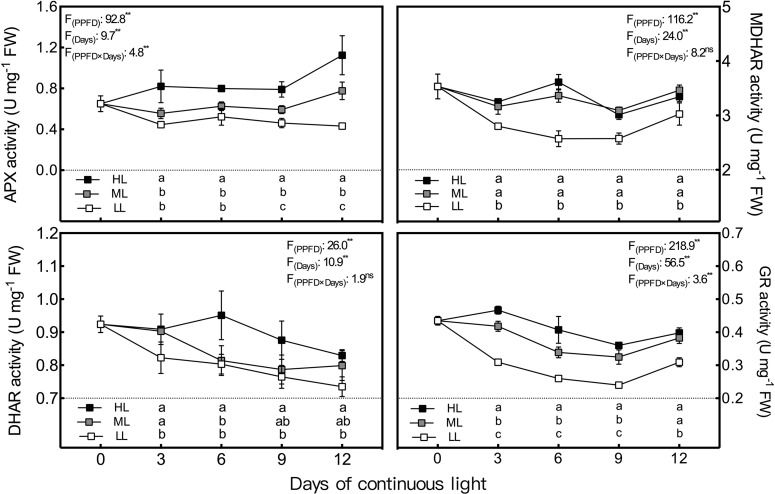
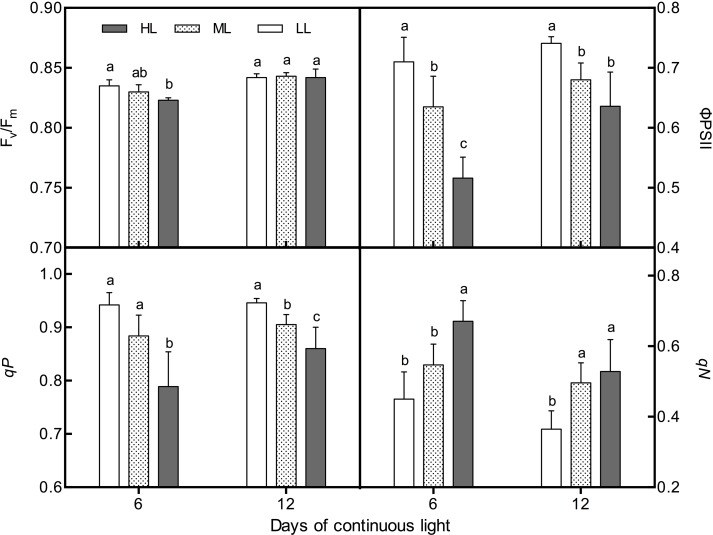
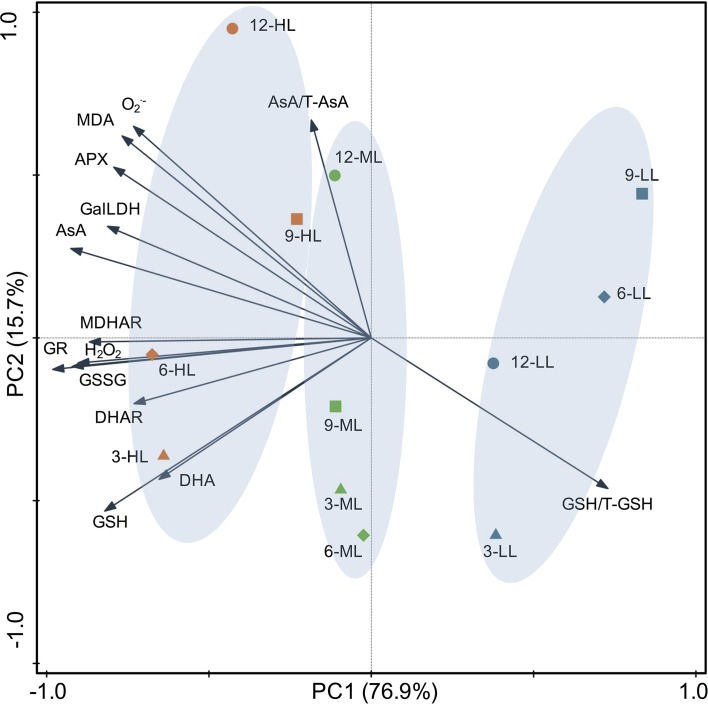
In this study, specific dynamic changes in growth, oxidative stress, ascorbate metabolism, and chlorophyll fluorescence were monitored during 12 days in lettuce plants exposed to continuous light (CL) of different intensities: low light (LL, 100 μmol·m·s), medium light (ML, 200 μmol·m·s), and high light (HL, 300 μmol·m·s). Lettuce plants grown under CL of higher light intensity gained greater biomass, dry weight ratio, root/shoot ratio, and specific leaf FW, but not leaf area. Both the reactive oxygen species (ROS) production and the lipid peroxidation degree, measured in terms of the malondialdehyde (MDA) levels, were progressively enhanced by increasing the light intensity of CL. Overall, the pool sizes of ascorbate (AsA) and glutathione, as well as the activities of enzymes involved in AsA metabolism, had positive correlations with light intensity under CL. Ascorbate peroxidase and dehydroascorbate reductase presented the maximal and minimal responses to light intensity, respectively, among all the studied enzymes. After 6 days under CL, ML and HL intensity caused reversible photoinhibition, represented by lower values of maximum quantum efficiency ( / ), effective quantum yield (ΦPSII), and photochemical quenching (qP) and a higher value of non-photochemical quenching (qN). However, this photoinhibition recovered on day 12 with increasing of / , ΦPSII, and qP. Taken together, under ML and HL conditions, greater AsA level could help maintain photosynthetic efficiency by elevating excess excitation energy dissipation, though ROS accumulation and lipid peroxidation could not be prevented in the long-term. Likewise, there was no dark period under LL condition, but no photooxidative stress was observed in lettuce. Thus, it is concluded that photooxidative stress induced by CL can be attributed to excessive daily light integral instead of circadian asynchrony.
在本研究中,监测了生菜植株在12天内暴露于不同强度连续光照(CL)下的生长、氧化应激、抗坏血酸代谢和叶绿素荧光的特定动态变化:低光照(LL,100 μmol·m⁻²·s⁻¹)、中等光照(ML,200 μmol·m⁻²·s⁻¹)和高光照(HL,300 μmol·m⁻²·s⁻¹)。在较高光照强度的CL下生长的生菜植株获得了更大的生物量、干重比、根/茎比和比叶鲜重,但叶面积没有增加。以丙二醛(MDA)水平衡量的活性氧(ROS)产生和脂质过氧化程度,随着CL光照强度的增加而逐渐增强。总体而言,在CL条件下,抗坏血酸(AsA)和谷胱甘肽的库大小以及参与AsA代谢的酶的活性与光照强度呈正相关。在所有研究的酶中,抗坏血酸过氧化物酶和脱氢抗坏血酸还原酶分别对光照强度呈现最大和最小响应。在CL处理6天后,ML和HL强度导致可逆性光抑制,表现为最大量子效率(Fv/Fm)、有效量子产量(ΦPSII)和光化学猝灭(qP)值较低,以及非光化学猝灭(qN)值较高。然而,随着Fv/Fm、ΦPSII和qP在第12天的增加,这种光抑制得到恢复。综上所述,在ML和HL条件下,较高的AsA水平可以通过提高过剩激发能的耗散来帮助维持光合效率,尽管从长期来看无法防止ROS积累和脂质过氧化。同样,在LL条件下没有黑暗期,但生菜中未观察到光氧化应激。因此,得出结论,CL诱导的光氧化应激可归因于每日过量的光积分而非昼夜节律失调。