
系统水平分析NalD 突变,这是急性铜绿假单胞菌感染中反复出现的快速耐药驱动因素。
Systems-level analysis of NalD mutation, a recurrent driver of rapid drug resistance in acute Pseudomonas aeruginosa infection.
机构信息
Program for Computational and Systems Biology, Memorial Sloan-Kettering Cancer Center, New York, New York, United States of America.
Department of Biological Sciences, Duquesne University, Pittsburgh, Pennsylvania, United States of America.
出版信息
PLoS Comput Biol. 2019 Dec 20;15(12):e1007562. doi: 10.1371/journal.pcbi.1007562. eCollection 2019 Dec.
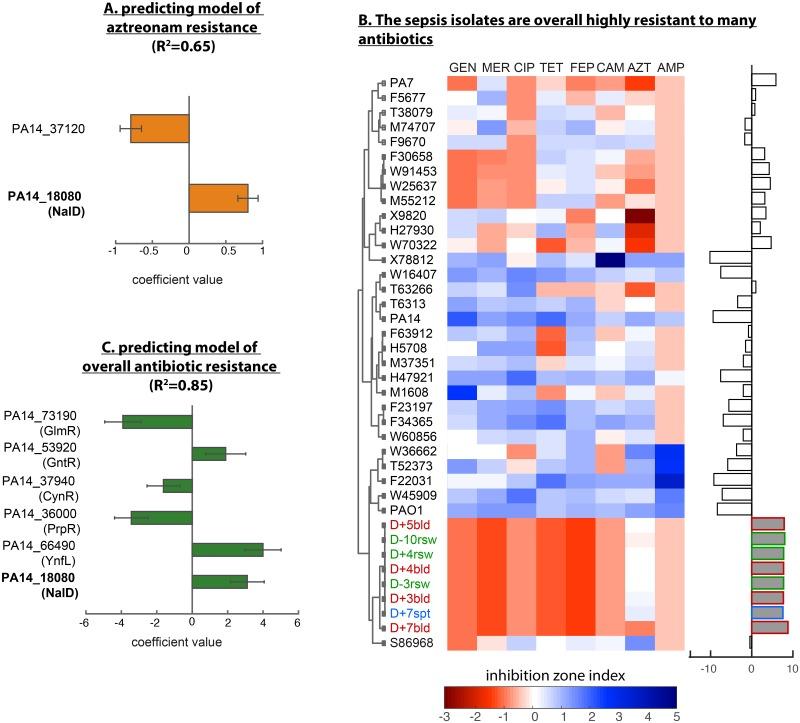
Pseudomonas aeruginosa, a main cause of human infection, can gain resistance to the antibiotic aztreonam through a mutation in NalD, a transcriptional repressor of cellular efflux. Here we combine computational analysis of clinical isolates, transcriptomics, metabolic modeling and experimental validation to find a strong association between NalD mutations and resistance to aztreonam-as well as resistance to other antibiotics-across P. aeruginosa isolated from different patients. A detailed analysis of one patient's timeline shows how this mutation can emerge in vivo and drive rapid evolution of resistance while the patient received cancer treatment, a bone marrow transplantation, and antibiotics up to the point of causing the patient's death. Transcriptomics analysis confirmed the primary mechanism of NalD action-a loss-of-function mutation that caused constitutive overexpression of the MexAB-OprM efflux system-which lead to aztreonam resistance but, surprisingly, had no fitness cost in the absence of the antibiotic. We constrained a genome-scale metabolic model using the transcriptomics data to investigate changes beyond the primary mechanism of resistance, including adaptations in major metabolic pathways and membrane transport concurrent with aztreonam resistance, which may explain the lack of a fitness cost. We propose that metabolic adaptations may allow resistance mutations to endure in the absence of antibiotics and could be targeted by future therapies against antibiotic resistant pathogens.
铜绿假单胞菌是人类感染的主要原因之一,它可以通过 NalD 的突变获得对抗生素氨曲南的耐药性,NalD 是细胞外排的转录抑制剂。在这里,我们将临床分离株的计算分析、转录组学、代谢建模和实验验证相结合,发现 NalD 突变与对氨曲南的耐药性以及对其他抗生素的耐药性之间存在很强的关联,这些耐药性是由来自不同患者的铜绿假单胞菌引起的。对一位患者时间线的详细分析表明,这种突变如何在体内出现,并在患者接受癌症治疗、骨髓移植和抗生素治疗的情况下,导致耐药性迅速进化,直至导致患者死亡。转录组学分析证实了 NalD 作用的主要机制——失活突变导致 MexAB-OprM 外排系统的组成性过表达——这导致了对氨曲南的耐药性,但令人惊讶的是,在没有抗生素的情况下,它没有适应性成本。我们使用转录组学数据来约束一个基因组规模的代谢模型,以研究除主要耐药机制之外的变化,包括与氨曲南耐药性同时发生的主要代谢途径和膜转运的适应性,这可能解释了缺乏适应性成本的原因。我们提出,代谢适应可能使耐药突变在没有抗生素的情况下得以持续,并可能成为针对抗药性病原体的未来治疗方法的目标。




 Zotero 插件