School of Biological Sciences, Georgia Institute of Technology, Atlanta, GA 30332.
Emory-Children's Cystic Fibrosis Center, Atlanta, GA 30332.
Proc Natl Acad Sci U S A. 2018 May 29;115(22):E5125-E5134. doi: 10.1073/pnas.1717525115. Epub 2018 May 14.
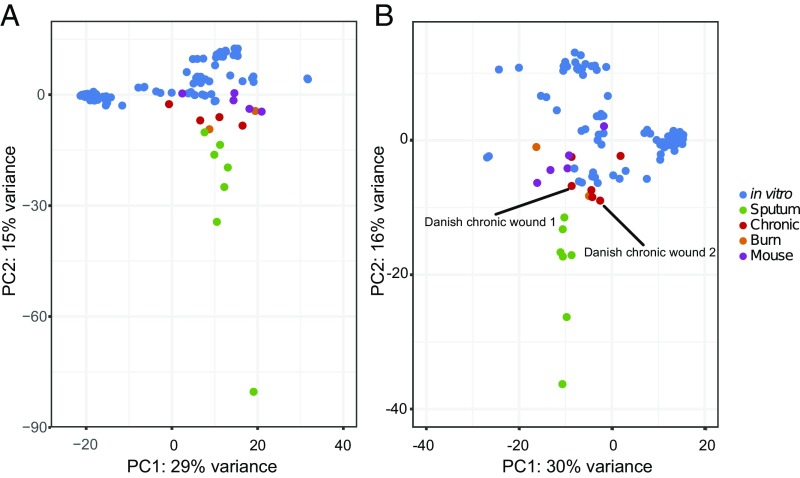
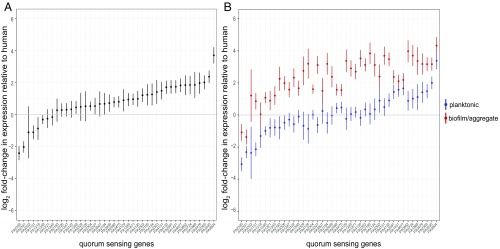
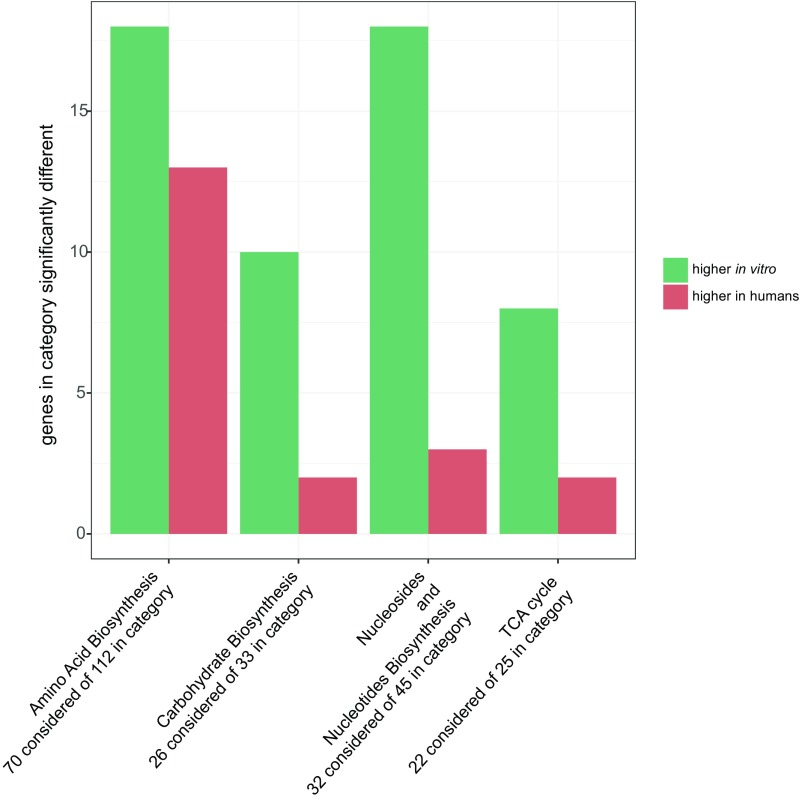
Laboratory experiments have uncovered many basic aspects of bacterial physiology and behavior. After the past century of mostly in vitro experiments, we now have detailed knowledge of bacterial behavior in standard laboratory conditions, but only a superficial understanding of bacterial functions and behaviors during human infection. It is well-known that the growth and behavior of bacteria are largely dictated by their environment, but how bacterial physiology differs in laboratory models compared with human infections is not known. To address this question, we compared the transcriptome of during human infection to that of in a variety of laboratory conditions. Several pathways, including the bacterium's primary quorum sensing system, had significantly lower expression in human infections than in many laboratory conditions. On the other hand, multiple genes known to confer antibiotic resistance had substantially higher expression in human infection than in laboratory conditions, potentially explaining why antibiotic resistance assays in the clinical laboratory frequently underestimate resistance in patients. Using a standard machine learning technique known as support vector machines, we identified a set of genes whose expression reliably distinguished in vitro conditions from human infections. Finally, we used these support vector machines with binary classification to force mouse infection transcriptomes to be classified as human or in vitro. Determining what differentiates our current models from clinical infections is important to better understand bacterial infections and will be necessary to create model systems that more accurately capture the biology of infection.
实验室实验揭示了许多细菌生理学和行为的基本方面。在过去一个世纪的大部分体外实验之后,我们现在详细了解了细菌在标准实验室条件下的行为,但对细菌在人类感染期间的功能和行为只有肤浅的了解。众所周知,细菌的生长和行为在很大程度上取决于其环境,但实验室模型与人类感染相比,细菌生理学有何不同尚不清楚。为了解决这个问题,我们比较了 在人类感染期间和在各种实验室条件下的转录组。包括细菌主要群体感应系统在内的几个途径在人类感染中的表达明显低于许多实验室条件。另一方面,许多已知赋予抗生素耐药性的基因在人类感染中的表达明显高于实验室条件,这可能解释了为什么临床实验室中的抗生素耐药性检测经常低估患者的耐药性。我们使用一种称为支持向量机的标准机器学习技术,确定了一组其表达可可靠地区分体外条件和人类感染的基因。最后,我们使用这些支持向量机进行二进制分类,迫使 小鼠感染转录组被分类为人类或体外。确定我们当前的模型与临床感染的区别对于更好地了解细菌感染很重要,并且有必要创建更准确地捕捉感染生物学的模型系统。