Albrich Werner C, Rassouli Frank, Waldeck Frederike, Berger Christoph, Baty Florent
Division Infectious Diseases and Hospital Epidemiology, Cantonal Hospital St. Gallen, St. Gallen, Switzerland.
Department of Pulmonary and Sleep Medicine, Cantonal Hospital St. Gallen, St. Gallen, Switzerland.
Front Med (Lausanne). 2019 Dec 5;6:286. doi: 10.3389/fmed.2019.00286. eCollection 2019.
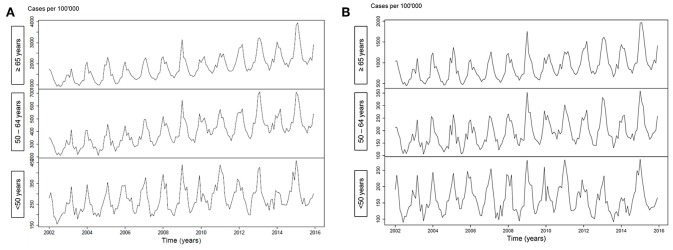
Pneumococcal pneumonia is a disease of the extremes of age. However, as other traditional risk factors for pneumococcal pneumonia also increase with older age, it is unclear if older age itself should be an indication for pneumococcal vaccination. Therefore, we assessed the effect of age on risk for hospitalization for pneumonia and for pneumococcal pneumonia. Using a national hospitalization dataset, all patients ≥16 years hospitalized in a Swiss hospital with a diagnosis of pneumonia or pneumococcal pneumonia between 2002 and 2015 were included. Multivariable logistic regression analysis was used to test the association between age (≥50 or ≥65 years) and hospitalization for pneumonia or pneumococcal pneumonia after adjusting for pneumococcal vaccine indications. Similar analyses were performed for effect of age on length of stay (LOS) and mortality. Among a total of 17,619,016 hospitalizations a diagnosis of pneumonia was present in 421,760 (2.4%) and a diagnosis of pneumococcal pneumonia in 21,610 (0.12%). Age ≥50 years (OR: 3.52 and 2.12, respectively; for both <0.001) and age ≥65 years (OR: 2.98 and 1.80, respectively; for both <0.001) as well as most Swiss pneumococcal vaccine indications were independent predictors of hospitalization with a pneumonia and pneumococcal pneumonia diagnosis, respectively. Older age with both age cut-offs were associated with increased LOS (≥50 years: aRR: 1.19 and 1.24, respectively; age ≥65 years: aRR: 1.60 and 1.20, respectively; < 0.001 for all) and mortality (≥50 years: aOR: 4.73 and 2.84, respectively; age ≥65 years: aOR: 2.38 and 2.69, respectively, < 0.001 for all) in patients with a pneumonia and pneumococcal pneumonia diagnosis, respectively. The effects of pneumococcal vaccine indications decreased with older age. The incidences of hospitalizations with a pneumonia diagnosis and a pneumococcal pneumonia diagnosis increased significantly from the pre-vaccine era to the PCV7 era and the PCV13 era ( for trend for both analyses <0.001). This study confirms the Swiss indications for pneumococcal vaccination as independent risk factors for pneumonia hospitalizations. Older age itself should be considered as an additional vaccine indication. Pneumonia and pneumococcal pneumonia in adults have increased despite pneumococcal vaccination in children.
肺炎球菌肺炎是一种好发于年龄两端的疾病。然而,由于其他肺炎球菌肺炎的传统危险因素也随年龄增长而增加,目前尚不清楚年龄本身是否应作为肺炎球菌疫苗接种的指征。因此,我们评估了年龄对肺炎住院风险和肺炎球菌肺炎住院风险的影响。利用一个全国性住院数据集,纳入了2002年至2015年间在瑞士一家医院住院且诊断为肺炎或肺炎球菌肺炎的所有≥16岁患者。多变量逻辑回归分析用于检验年龄(≥50岁或≥65岁)与在调整肺炎球菌疫苗接种指征后肺炎或肺炎球菌肺炎住院之间的关联。对年龄对住院时间(LOS)和死亡率的影响进行了类似分析。在总共17619016次住院中,421760例(2.4%)诊断为肺炎,21610例(0.12%)诊断为肺炎球菌肺炎。年龄≥50岁(OR分别为3.52和2.12;均<0.001)和年龄≥65岁(OR分别为2.98和1.80;均<0.001)以及大多数瑞士肺炎球菌疫苗接种指征分别是肺炎和肺炎球菌肺炎诊断住院的独立预测因素。两个年龄切点的高龄均与肺炎和肺炎球菌肺炎诊断患者的住院时间延长(≥50岁:aRR分别为1.19和1.24;年龄≥65岁:aRR分别为1.60和1.20;均<0.001)和死亡率增加(≥50岁:aOR分别为4.73和2.84;年龄≥65岁:aOR分别为2.38和2.69;均<0.001)相关。肺炎球菌疫苗接种指征的影响随年龄增长而降低。从疫苗接种前时代到PCV7时代和PCV13时代,肺炎诊断住院和肺炎球菌肺炎诊断住院的发生率显著增加(两项分析的趋势均<0.001)。本研究证实了瑞士肺炎球菌疫苗接种指征是肺炎住院的独立危险因素。年龄本身应被视为额外的疫苗接种指征。尽管儿童接种了肺炎球菌疫苗,但成人肺炎和肺炎球菌肺炎仍有所增加。