Department of Health Statistics, Second Military Medical University, Shanghai, China.
Department of Clinical Pharmacy, Shanghai General Hospital, School of Medicine, Shanghai Jiaotong University, Shanghai, China.
BMJ Open. 2019 Dec 22;9(12):e031240. doi: 10.1136/bmjopen-2019-031240.
Members living in the same household tend to share some similar behaviours and environment. We want to quantitatively assess the associations of chronic conditions to investigate the concordance of disease status among the household members.
Shanghai, China.
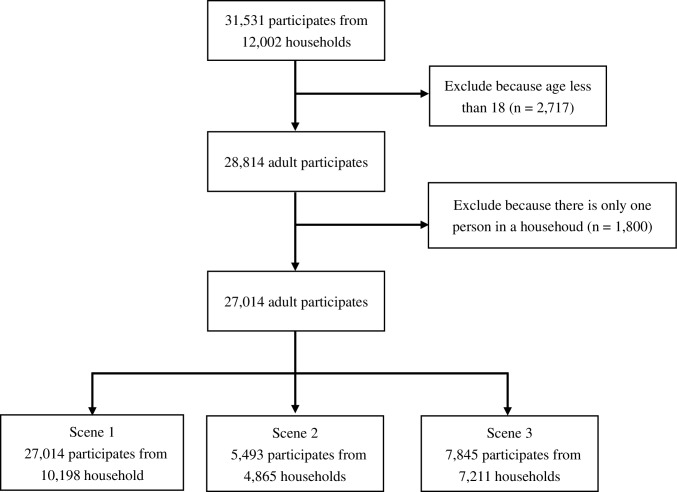
Our data were from the fifth Health Service Survey in Shanghai in 2013. 12 002 households with 31 531 residents were selected in this survey by using a three-stage, stratified, random sampling method.
Five highly prevalent chronic conditions, namely hypertension, diabetes, ischaemic heart disease (IHD), cerebrovascular disease (CVD) and obesity were chosen. The generalised estimating equations (GEE) model was used to estimate the associations adjusted for age, gender, education status, health insurance status, smoking and drinking. Using a subsample of adult children with parents' chronic conditions as the key risk factor and a subsample of wives with the chronic conditions of the husband as key risk factor, we reran our GEE models to explore chronic condition concordance within these relationships.
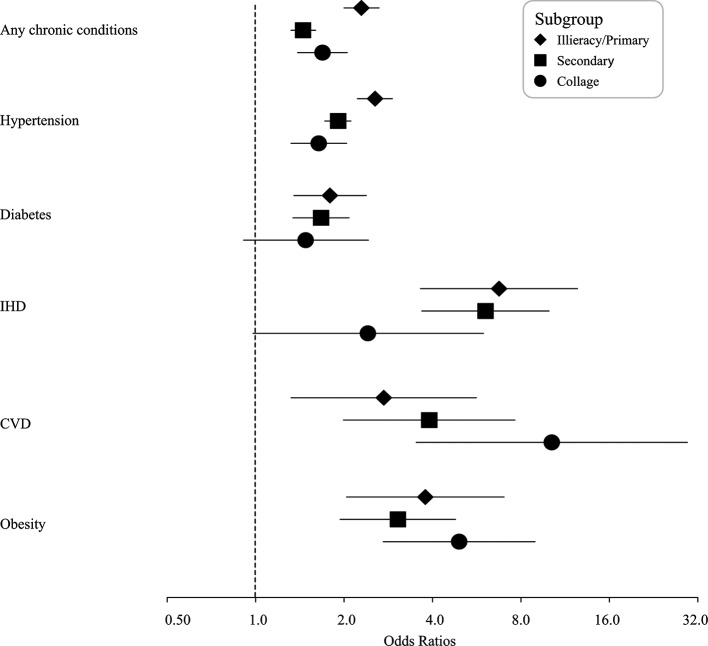
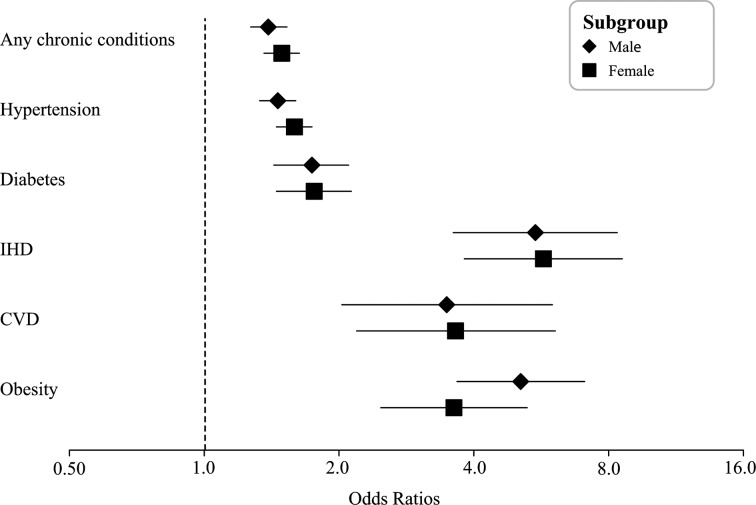
A total of 10 198 households with 27 010 adult participants were included. Using all adult household members, we found positive statistically significant associations between one's chronic conditions and the same disease status of their household members (hypertension (OR=3.26, 95% CI 3.02 to 3.52); diabetes (OR=1.68, 95% CI 1.40 to 2.01); IHD (OR=5.31, 95% CI 3.56 to 7.92); CVD (OR=3.40, 95% CI 1.99 to 5.80); obesity (OR=3.41, 95% CI 2.34 to 4.96)). The results of analysing ad-child subsample and spouse subsample also showed similar associations. Moreover, the potential concordance of different chronic conditions was found between hypertension and diabetes.
We found chronic condition concordance within households. This study provides evidence that the chronic conditions of other members of a household may be a significant risk factor for a household member's own health.
居住在同一家庭中的成员往往具有一些相似的行为和环境。我们希望定量评估慢性疾病之间的关联,以调查家庭成员之间疾病状况的一致性。
中国上海。
我们的数据来自 2013 年上海第五次卫生服务调查。采用三阶段、分层、随机抽样方法,从该调查中选择了 12002 户家庭,共 31531 名居民。
选择了五种常见的慢性疾病,即高血压、糖尿病、缺血性心脏病(IHD)、脑血管疾病(CVD)和肥胖。使用广义估计方程(GEE)模型,根据年龄、性别、教育状况、健康保险状况、吸烟和饮酒情况调整关联。使用有父母慢性疾病的成年子女作为关键风险因素的亚样本和有丈夫慢性疾病的妻子作为关键风险因素的亚样本,我们重新运行 GEE 模型,以探索这些关系中慢性疾病的一致性。
共纳入 10198 户家庭,27010 名成年参与者。使用所有成年家庭成员,我们发现一个人的慢性疾病与家庭成员相同疾病状态之间存在统计学上显著的正相关(高血压(OR=3.26,95%CI 3.02 至 3.52);糖尿病(OR=1.68,95%CI 1.40 至 2.01);IHD(OR=5.31,95%CI 3.56 至 7.92);CVD(OR=3.40,95%CI 1.99 至 5.80);肥胖(OR=3.41,95%CI 2.34 至 4.96))。分析子女亚样本和配偶亚样本的结果也显示出类似的关联。此外,还发现了高血压和糖尿病之间不同慢性疾病的潜在一致性。
我们发现家庭内部存在慢性疾病一致性。这项研究提供了证据,表明家庭其他成员的慢性疾病可能是家庭成员自身健康的一个重要危险因素。