Kress Kevin, Weiler Ulrike, Schmucker Sonja, Čandek-Potokar Marjeta, Vrecl Milka, Fazarinc Gregor, Škrlep Martin, Batorek-Lukač Nina, Stefanski Volker
Department of Behavioral Physiology of Livestock, Institute of Animal Science, University of Hohenheim, Garbenstraße 17, 70599 Stuttgart, Germany.
KIS-Agricultural Institute of Slovenia, Hacquetova ulica 17, 1000 Ljubljana, Slovenia.
Animals (Basel). 2019 Dec 21;10(1):27. doi: 10.3390/ani10010027.
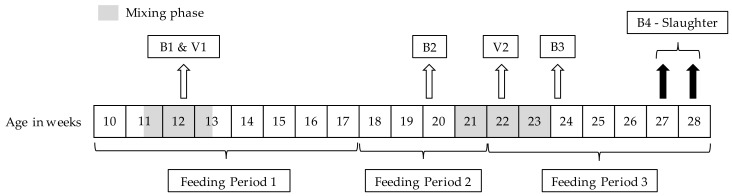
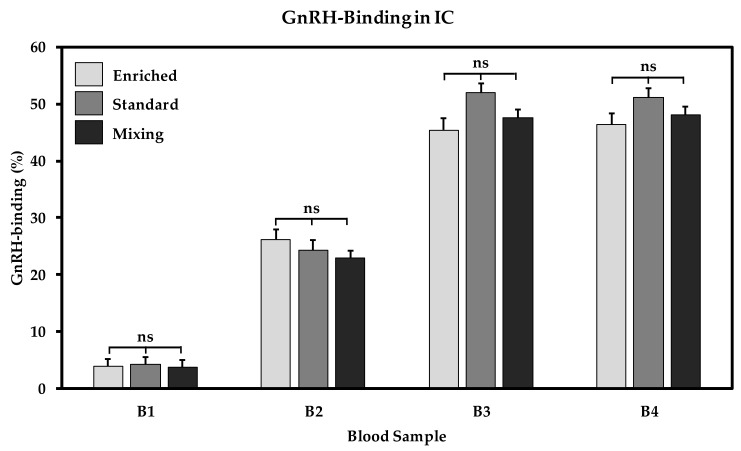
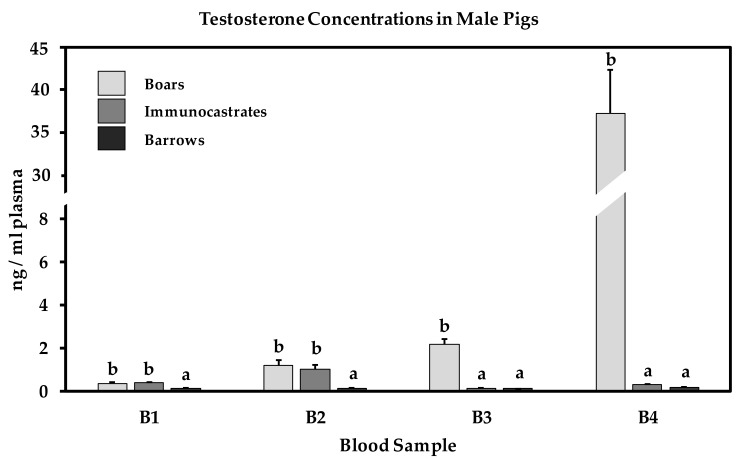
Immunocastration is a sustainable alternative to piglet castration but faces limited market acceptance. The phenomenon of non-responders has not to date been examined in detail, but adverse and stressful housing conditions (e.g., mixing of groups) might impair the success of vaccinations. Therefore, we evaluated the influence of housing conditions on the immune response after two Improvac vaccinations at an age of 12 and 22 weeks, respectively. Boars, immunocastrates and barrows ( = 48 each) were assigned to three different housing conditions ( = 36 enriched, = 36 standard = 72 repeated social mixing). Immune response was quantified by measuring GnRH-binding and its consequences for testosterone concentrations, development of the genital tract and boar taint. Growth performance was evaluated via average daily gain (ADG). GnRH-binding and testosterone levels revealed that immunocastration reliably suppressed testicular functions after the 2nd vaccination. Housing conditions did not modify testicular function but influenced ADG as animals under mixing grew slower than those under enriched conditions. Gonadal status had only a slight impact on ADG except in immunocastrates, which showed a temporarily higher ADG after the 2nd vaccination. The results show that immunocastration is a reliable procedure under different housing conditions and competitive in terms of growth performance.
免疫去势是仔猪去势的一种可持续替代方法,但市场接受度有限。迄今为止,尚未对无反应者现象进行详细研究,但恶劣和应激的饲养条件(如混群)可能会损害疫苗接种的效果。因此,我们评估了饲养条件对分别在12周龄和22周龄进行两次英帕罗(Improvac)疫苗接种后免疫反应的影响。公猪、免疫去势猪和阉猪(各48头)被分配到三种不同的饲养条件下(36头饲养在丰富环境中,36头饲养在标准环境中,72头经历重复的社会混群)。通过测量促性腺激素释放激素(GnRH)结合情况及其对睾酮浓度、生殖道发育和公猪异味的影响来量化免疫反应。通过平均日增重(ADG)评估生长性能。GnRH结合情况和睾酮水平表明,免疫去势在第二次疫苗接种后可靠地抑制了睾丸功能。饲养条件并未改变睾丸功能,但影响了ADG,因为混群饲养的动物比饲养在丰富环境中的动物生长得慢。性腺状态对ADG的影响较小,免疫去势猪除外,其在第二次疫苗接种后暂时表现出较高的ADG。结果表明,免疫去势在不同饲养条件下是一种可靠的方法,并且在生长性能方面具有竞争力。