Mitoma Hiroshi, Manto Mario, Gandini Jordi
Medical Education Promotion Center, Tokyo Medical University, Tokyo 160-0023, Japan.
Service de Neurologie, Unité des Ataxies Cérébelleuses, CHU-Charleroi, 6000 Charleroi, Belgium.
Brain Sci. 2019 Dec 23;10(1):11. doi: 10.3390/brainsci10010011.
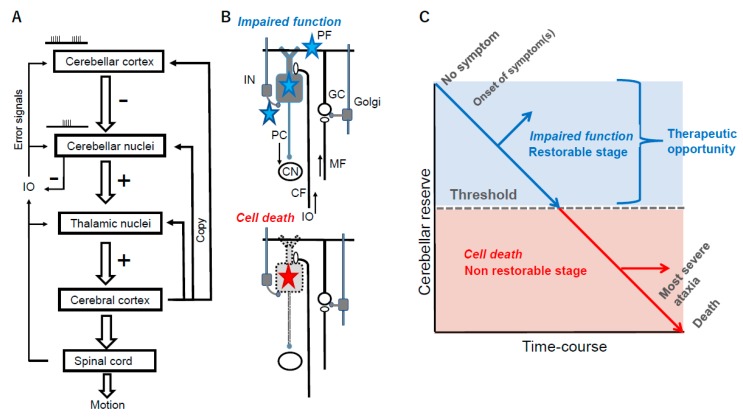
Various etiopathologies affect the cerebellum, resulting in the development of cerebellar ataxias (CAs), a heterogeneous group of disorders characterized clinically by movement incoordination, affective dysregulation, and cognitive dysmetria. Recent progress in clinical and basic research has opened the door of the ''era of therapy" of CAs. The therapeutic rationale of cerebellar diseases takes into account the capacity of the cerebellum to compensate for pathology and restoration, which is collectively termed cerebellar reserve. In general, treatments of CAs are classified into two categories: cause-cure treatments, aimed at arresting disease progression, and neuromodulation therapies, aimed at potentiating cerebellar reserve. Both forms of therapies should be introduced as soon as possible, at a time where cerebellar reserve is still preserved. Clinical studies have established evidence-based cause-cure treatments for metabolic and immune-mediated CAs. Elaborate protocols of rehabilitation and non-invasive cerebellar stimulation facilitate cerebellar reserve, leading to recovery in the case of controllable pathologies (metabolic and immune-mediated CAs) and delay of disease progression in the case of uncontrollable pathologies (degenerative CAs). Furthermore, recent advances in molecular biology have encouraged the development of new forms of therapies: the molecular targeting therapy, which manipulates impaired RNA or proteins, and the neurotransplantation therapy, which delays cell degeneration and facilitates compensatory functions. The present review focuses on the therapeutic rationales of these recently developed therapeutic modalities, highlighting the underlying pathogenesis.
多种病因病理影响小脑,导致小脑共济失调(CA)的发生,这是一组异质性疾病,临床特征为运动不协调、情感调节障碍和认知辨距不良。临床和基础研究的最新进展开启了CA“治疗时代”的大门。小脑疾病的治疗原理考虑到小脑补偿病理和恢复的能力,这统称为小脑储备。一般来说,CA的治疗分为两类:病因治疗,旨在阻止疾病进展;神经调节疗法,旨在增强小脑储备。这两种治疗形式都应在小脑储备仍得以保留时尽早引入。临床研究已经确立了针对代谢性和免疫介导性CA的循证病因治疗方法。精心制定的康复方案和非侵入性小脑刺激可促进小脑储备,在可控病理(代谢性和免疫介导性CA)的情况下实现恢复,在不可控病理(退行性CA)的情况下延缓疾病进展。此外,分子生物学的最新进展推动了新治疗形式的发展:分子靶向治疗,可操控受损的RNA或蛋白质;神经移植治疗,可延缓细胞变性并促进代偿功能。本综述重点关注这些最新开发的治疗方式的治疗原理,并突出其潜在发病机制。