Institute of Medical Science, University of Toronto, Toronto, Canada; Toronto General Hospital Research Institute, University Health Network, Toronto, Canada.
Toronto General Hospital Research Institute, University Health Network, Toronto, Canada.
Mol Cell Proteomics. 2020 Mar;19(3):501-517. doi: 10.1074/mcp.RA119.001858. Epub 2019 Dec 26.
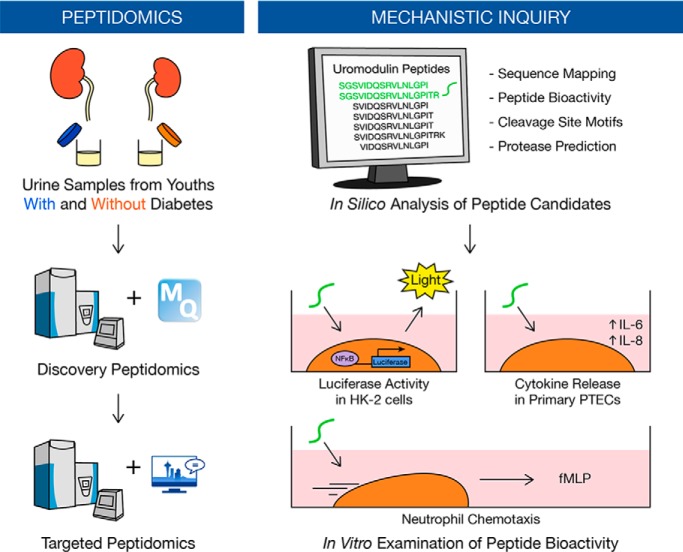
Chronic hyperglycemia is known to disrupt the proteolytic milieu, initiating compensatory and maladaptive pathways in the diabetic kidney. Such changes in intrarenal proteolysis are captured by the urinary peptidome. To elucidate the early kidney response to chronic hyperglycemia, we conducted a peptidomic investigation into urines from otherwise healthy youths with type 1 diabetes and their non-diabetic peers using unbiased and targeted mass spectrometry-based techniques. This cross-sectional study included two separate cohorts for the discovery ( = 30) and internal validation ( = 30) of differential peptide excretion. Peptide bioactivity was predicted using PeptideRanker and subsequently verified Proteasix and the Nephroseq database were used to identify putative proteases responsible for peptide generation and examine their expression in diabetic nephropathy. A total of 6550 urinary peptides were identified in the discovery analysis. We further examined the subset of 162 peptides, which were quantified across all thirty samples. Of the 15 differentially excreted peptides ( < 0.05), seven derived from a C-terminal region (SGSVIDQSRVLNLGPITRK) of uromodulin, a kidney-specific protein. Increased excretion of five uromodulin peptides was replicated in the validation cohort using parallel reaction monitoring ( < 0.05). One of the validated peptides (SGSVIDQSRVLNLGPI) activated NFκB and AP-1 signaling, stimulated cytokine release, and enhanced neutrophil migration analyses highlighted several potential proteases such as hepsin, meprin A, and cathepsin B to be responsible for generating these peptides. In summary, we identified a urinary signature of uromodulin peptides associated with early type 1 diabetes before clinical manifestations of kidney disease and discovered novel bioactivity of uromodulin peptides Our present findings lay the groundwork for future studies to validate peptide excretion in larger and broader populations, to investigate the role of bioactive uromodulin peptides in high glucose conditions, and to examine proteases that cleave uromodulin.
慢性高血糖已知会破坏蛋白水解环境,在糖尿病肾脏中启动代偿和适应不良途径。这种肾内蛋白水解的变化被尿肽组捕获。为了阐明慢性高血糖对肾脏的早期反应,我们使用无偏和靶向质谱技术对 1 型糖尿病和非糖尿病同龄健康青年的尿液进行了肽组学研究。这项横断面研究包括两个独立的队列,用于发现(= 30)和内部验证(= 30)差异肽排泄。使用 PeptideRanker 预测肽的生物活性,随后使用 Proteasix 和 Nephroseq 数据库验证,以鉴定负责肽生成的潜在蛋白酶,并检查它们在糖尿病肾病中的表达。在发现分析中鉴定了 6550 种尿肽。我们进一步研究了所有 30 个样本中都有定量的 162 个肽的子集。在 15 个差异排泄的肽中(< 0.05),有 7 个来自尿调蛋白的 C 端区域(SGSVIDQSRVLNLGPITRK),尿调蛋白是一种肾脏特异性蛋白。使用平行反应监测在验证队列中复制了 5 种尿调蛋白肽的排泄增加(< 0.05)。验证的肽之一(SGSVIDQSRVLNLGPI)激活 NFκB 和 AP-1 信号通路,刺激细胞因子释放,并增强中性粒细胞迁移。分析突出了几种潜在的蛋白酶,如组织蛋白酶 B、糜蛋白酶 A 和组织蛋白酶 B,它们负责生成这些肽。总之,我们在糖尿病肾病临床表现之前,鉴定了与 1 型糖尿病早期相关的尿调蛋白肽的尿特征,并发现了尿调蛋白肽的新生物活性。我们目前的发现为未来更大和更广泛人群中验证肽排泄、研究高葡萄糖条件下生物活性尿调蛋白肽的作用以及检查切割尿调蛋白的蛋白酶奠定了基础。