Medical Radiation Physics, Department of Nuclear Medicine, Ulm University, Ulm, Germany.
Department of Nuclear Medicine, Ulm University, Ulm, Germany.
Sci Rep. 2019 Dec 27;9(1):20041. doi: 10.1038/s41598-019-56603-8.
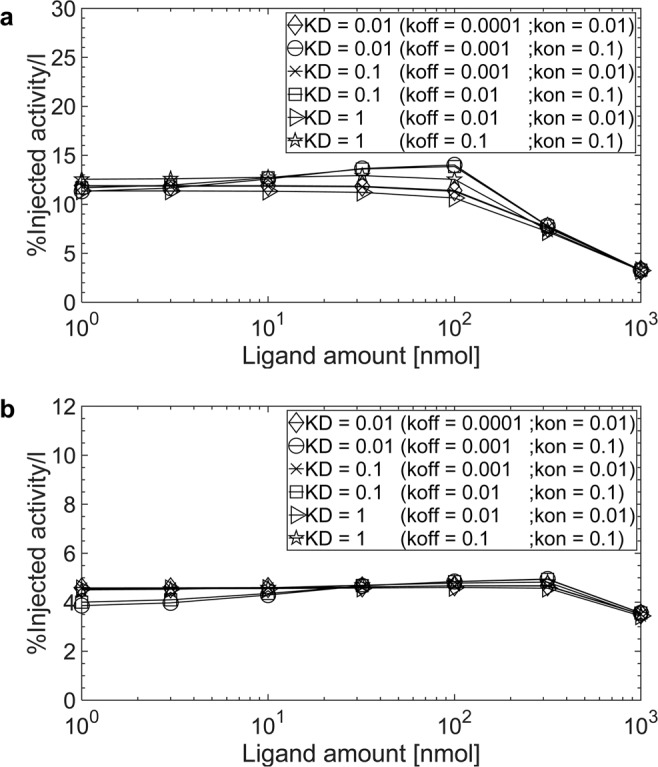
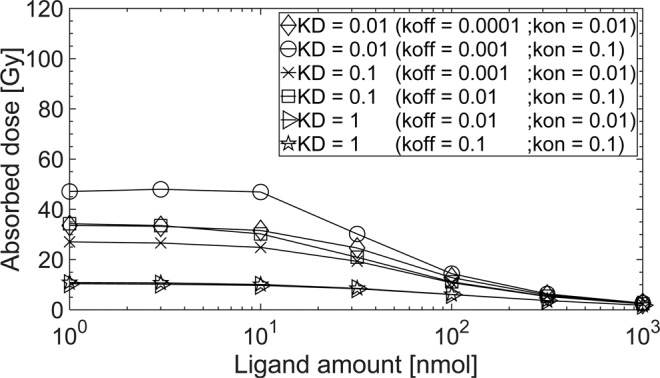
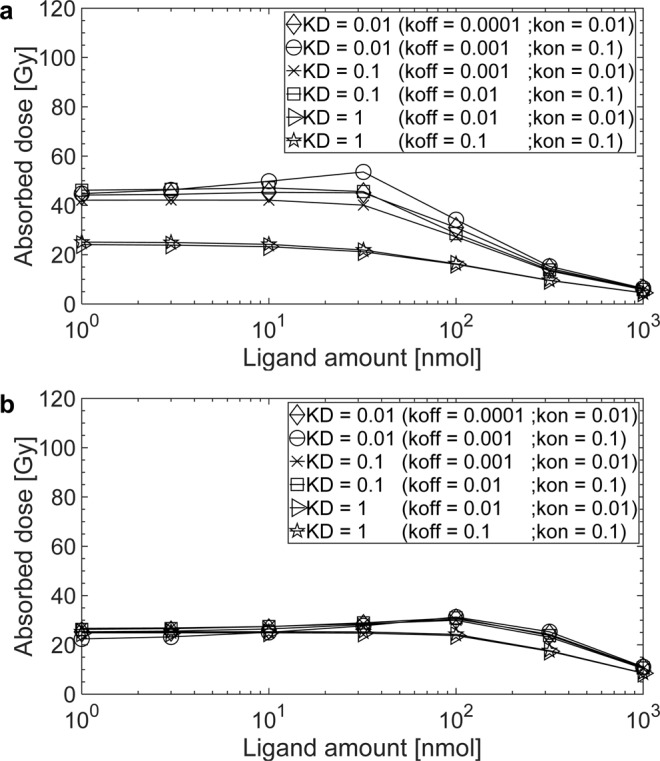
The aim of this work was to investigate the effect of ligand amount, affinity and internalization of prostate-specific membrane antigen (PSMA)-specific ligands on the activity concentrations for PET/CT imaging and on the absorbed doses for therapy. A physiologically-based pharmacokinetic (PBPK) model for PSMA-specific ligands was implemented. Thirteen virtual patients with metastatic castration-resistant prostate cancer were analysed. Simulations were performed for different combinations of association rates k (0.1-0.01 L/nmol/min), dissociation rates k (0.1-0.0001 min), internalization rates λ (0.01-0.0001 min) and ligand amounts (1-1000 nmol). For imaging the activity was normalized to volume and injected activity (Ga-PSMA at 1 h). For therapy the absorbed dose was calculated for 7.3 ± 0.3 GBq Lu-PSMA. The effect of the investigated parameters on therapy were larger compared to imaging. For imaging, the combination of properties leading to the highest tumour uptake was k = 0.1 L/nmol/min, k = 0.01 min for typical ligand amounts (1-10 nmol). For therapy, the higher the internalization rate, the larger was the required ligand amount for optimal tumour-to-kidney ratios. The higher the affinity, the more important was the choice of the optimal ligand amount. PBPK modelling provides insight into the pharmacokinetics of PSMA-specific ligands. Further in silico and in vivo studies are required to verify the influence of the analysed parameters.
本研究旨在探讨配体数量、亲和力和前列腺特异性膜抗原(PSMA)特异性配体内化对正电子发射断层扫描/计算机断层扫描(PET/CT)成像的活性浓度和治疗吸收剂量的影响。我们建立了 PSMA 特异性配体的生理基于药代动力学(PBPK)模型。分析了 13 例转移性去势抵抗性前列腺癌的虚拟患者。针对不同的结合速率 k(0.1-0.01 L/nmol/min)、离解速率 k(0.1-0.0001 min)、内化速率 λ(0.01-0.0001 min)和配体数量(1-1000 nmol)组合进行了模拟。对于成像,活性与体积和注入的活性(Ga-PSMA 1 h)进行了归一化。对于治疗,计算了 7.3±0.3GBq Lu-PSMA 的吸收剂量。与成像相比,所研究参数对治疗的影响更大。对于成像,导致肿瘤摄取最高的特性组合是 k=0.1 L/nmol/min,k=0.01 min,对于典型的配体量(1-10 nmol)。对于治疗,内化率越高,为获得最佳肿瘤与肾脏比值所需的配体量越大。亲和力越高,选择最佳配体量就越重要。PBPK 模型为 PSMA 特异性配体的药代动力学提供了深入了解。需要进一步的计算机模拟和体内研究来验证所分析参数的影响。