Foscolou Alexandra, D'Cunha Nathan M, Naumovski Nenad, Tyrovolas Stefanos, Rallidis Loukianos, Matalas Antonia-Leda, Polychronopoulos Evangelos, Sidossis Labros S, Panagiotakos Demosthenes
Department of Nutrition and Dietetics, School of Health Science and Education, Harokopio University, 17671 Kallithea, Attica, Greece.
Faculty of Health, University of Canberra, Bruce 2617, Australia.
Brain Sci. 2019 Dec 26;10(1):14. doi: 10.3390/brainsci10010014.
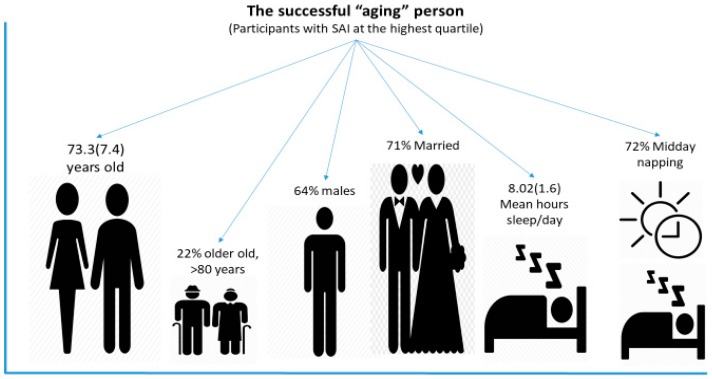
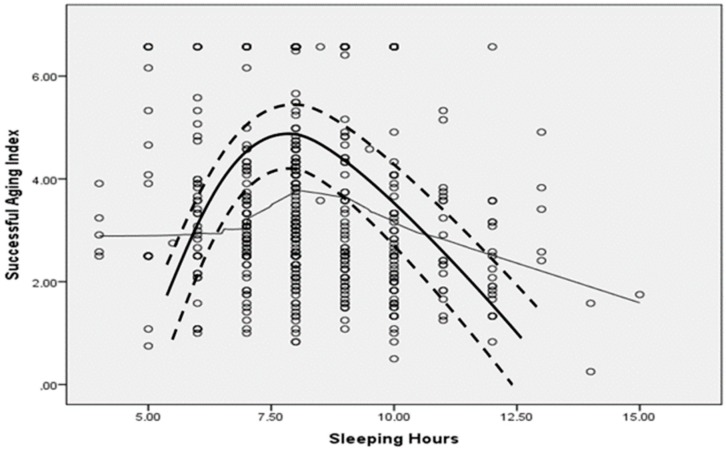
The aim of the present study was to investigate the association between midday napping, sleeping hours, and successful aging among 2564 older (65+ years) individuals living in the insular Mediterranean region. Anthropometric, clinical, and socio-demographic characteristics, dietary habits, and lifestyle parameters were derived through standard procedures, while successful aging was evaluated using the validated Successful Aging Index (SAI; range 0-10). Of the 2564 participants, 74% reported midday napping. The SAI score was 2.9/10 for non-midday nappers vs. 3.5/10 for midday nappers ( 0.001). Midday nappers were more likely to be physically active ( = 0.01) and to have higher adherence to the Mediterranean diet ( = 0.02) compared to non-midday nappers. In a fully adjusted model, midday nappers had 6.7% higher SAI score compared to the rest ( < 0.001), and the effect of midday napping was more prominent among males and participants 80+ years of age. Further analysis indicated a significant U-shaped trend between sleeping hours/day and SAI score < 0.001), with 8-9 h total of sleep/day, midday napping included, proposed as optimal in achieving the best SAI score. Midday napping seems to be a beneficial habit that should be promoted and encouraged in older people.
本研究旨在调查地中海岛屿地区2564名65岁及以上老年人的午睡、睡眠时间与成功老龄化之间的关联。通过标准程序获取人体测量、临床和社会人口学特征、饮食习惯及生活方式参数,同时使用经过验证的成功老龄化指数(SAI;范围为0至10)评估成功老龄化情况。在2564名参与者中,74%的人报告有午睡习惯。非午睡者的SAI评分为2.9/10,午睡者为3.5/10(P<0.001)。与非午睡者相比,午睡者更有可能身体活跃(P=0.01)且对地中海饮食的依从性更高(P=0.02)。在一个完全调整的模型中,午睡者的SAI评分比其他人高6.7%(P<0.001),午睡的影响在男性和80岁及以上的参与者中更为显著。进一步分析表明,每天睡眠时间与SAI评分之间存在显著的U型趋势(P<0.001),建议包括午睡在内的每日总睡眠时间为8至9小时,以实现最佳的SAI评分。午睡似乎是一种有益的习惯,应该在老年人中推广和鼓励。