Department of Nutrition and Dietetics, School of Health Sciences and Education, Harokopio University, 17676 Athens, Greece.
First Cardiology Clinic, Medical School, National and Kapodistrian University of Athens, Hippokration Hospital, 15772 Athens, Greece.
Nutrients. 2023 Dec 20;16(1):12. doi: 10.3390/nu16010012.
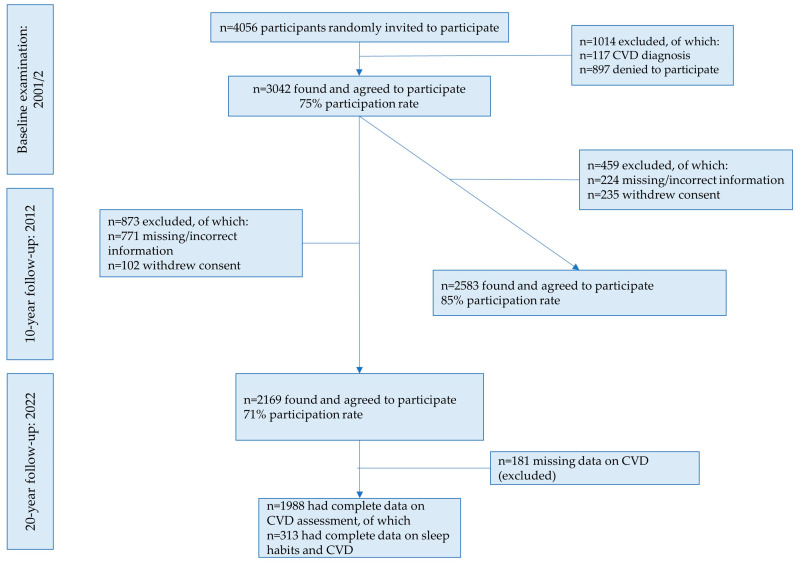
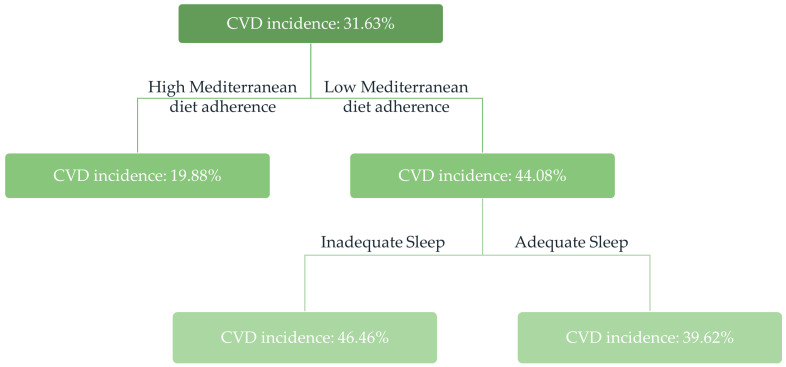
The relationship between diet, sleep duration and cardiovascular disease (CVD) has not been well understood. The aim of the present study was to test the potential modifying role of sleep duration in the association between adherence to the Mediterranean-type diet (MD) and CVD risk. The study consisted of = 313 initially free-of-CVD adults, from the ATTICA cohort study (2002-2022), with available information on sleep habits. Sleep habits were categorized as inadequate and adequate sleep duration (< or ≥7 h/day, respectively). In multi-adjusted analysis, MD adherence was inversely associated with CVD risk [Hazard Ratio-HR per 1/55 in MedDietScore: 0.80, 95% Confidence Interval-CI: 0.65, 0.98]. A significant interaction between sleep duration and MedDietScore was observed ( < 0.001). In subgroup analysis, the protective association between MD adherence and CVD risk was found only in participants who slept adequately, i.e., >7 h/day [HR:0.80, 95%CI: 0.65, 0.98]. Those who had a high adherence to the MD along with adequate sleep habits, had a 70% reduced 20-year CVD risk [HR:0.30, 95%CI: 0.11, 0.80], compared to those who had a low MD adherence and inadequate sleep habits. Sleep duration should be a part of an individual's lifestyle, together with dietary and other habits, to effectively evaluate CVD risk for future events.
饮食、睡眠时长与心血管疾病(CVD)之间的关系尚未得到充分理解。本研究旨在检验睡眠时长在坚持地中海式饮食(MD)与 CVD 风险之间关联中的潜在调节作用。研究纳入了 ATTICA 队列研究(2002-2022 年)中最初无 CVD 的 313 名成年人,这些参与者有睡眠习惯相关信息。将睡眠习惯分为睡眠时长不足和充足(分别为 < 或 ≥7 小时/天)。在多因素调整分析中,MD 依从性与 CVD 风险呈负相关[每增加 1/55 分 MedDietScore 的 HR:0.80,95%CI:0.65,0.98]。观察到睡眠时长与 MedDietScore 之间存在显著的交互作用( < 0.001)。在亚组分析中,仅在睡眠充足(即 >7 小时/天)的参与者中,MD 依从性与 CVD 风险之间存在保护性关联[HR:0.80,95%CI:0.65,0.98]。那些坚持 MD 饮食且睡眠习惯良好的人,20 年 CVD 风险降低 70%[HR:0.30,95%CI:0.11,0.80],而那些 MD 依从性低且睡眠习惯差的人则风险较高。睡眠时长应该与饮食和其他习惯一起成为个体生活方式的一部分,以便有效评估未来 CVD 风险。