University of Illinois, Champaign, United States.
Sci Rep. 2019 Dec 30;9(1):20258. doi: 10.1038/s41598-019-56238-9.
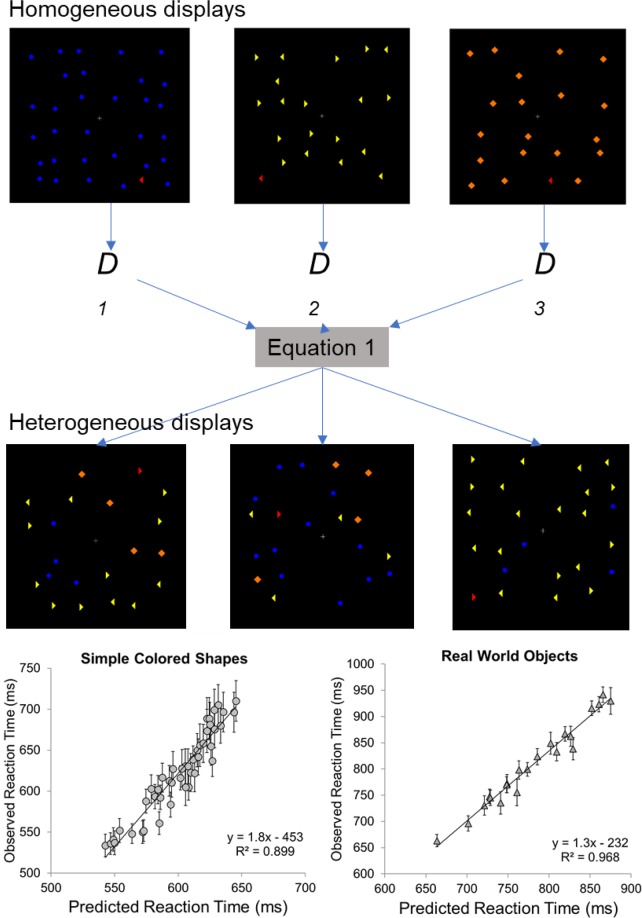
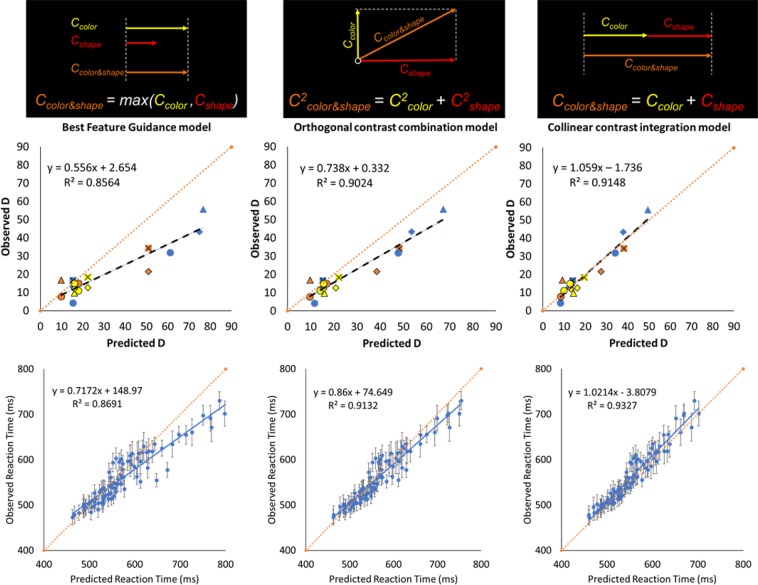
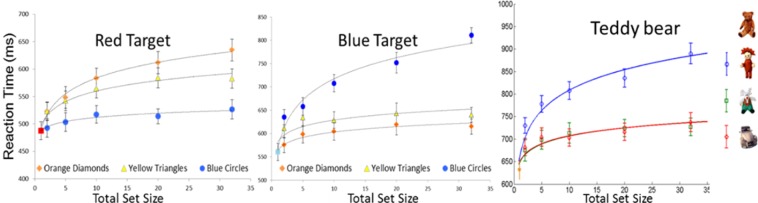
Objects in a scene can be distinct from one another along a multitude of visual attributes, such as color and shape, and the more distinct an object is from its surroundings, the easier it is to find it. However, exactly how this distinctiveness advantage arises in vision is not well understood. Here we studied whether and how visual distinctiveness along different visual attributes (color and shape, assessed in four experiments) combine to determine an object's overall distinctiveness in a scene. Unidimensional distinctiveness scores were used to predict performance in six separate experiments where a target object differed from distractor objects along both color and shape. Results showed that there is mathematical law determining overall distinctiveness as the simple sum of the distinctiveness scores along each visual attribute. Thus, the brain must compute distinctiveness scores independently for each visual attribute before summing them into the overall score that directs human attention.
场景中的物体可以在多种视觉属性(如颜色和形状)上彼此区分,并且一个物体与其周围环境的区别越大,就越容易找到它。然而,视觉上的这种独特性优势是如何产生的还不是很清楚。在这里,我们研究了不同视觉属性(颜色和形状,在四个实验中评估)的独特性是否以及如何结合起来决定场景中物体的整体独特性。使用单维独特性得分来预测六个单独实验中的表现,其中目标物体在颜色和形状上与干扰物体不同。结果表明,存在一种数学定律来确定整体独特性,即每个视觉属性的独特性得分的简单总和。因此,大脑在将它们相加到指导人类注意力的整体得分之前,必须分别计算每个视觉属性的独特性得分。