Civil and Environmental Engineering, Technion IIT, Haifa, 32000, Israel.
The Inter-University Institute for Marine Sciences, POB 469, Eilat, 88103, Israel.
Sci Rep. 2019 Dec 30;9(1):20337. doi: 10.1038/s41598-019-56311-3.
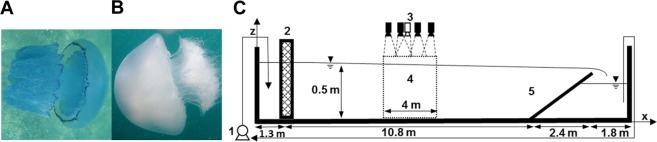
Jellyfish locomotion and orientation have been studied in the past both in the laboratory, testing mostly small jellyfish, and in the field, where it was impossible to control the seawater currents. Utilizing an outdoor water flume, we tested the locomotion of jellyfish when swimming against and with currents of up to 4.5 cm s. We used adult jellyfish from two of the most abundant species in the eastern Mediterranean, Rhopilema nomadica and Rhizostoma pulmo, and measured their pulsation frequency and swimming speed relative to the water. While pulsation frequency was not affected by the water velocity, jellyfish swam faster against the current than with it. This finding suggests that jellyfish possess a sensory ability, whose mechanism is currently unknown, enabling them to gauge the flow and react to it, possibly in order to reduce the risk of stranding.
过去,人们在实验室里对水母的运动和定位进行了研究,主要测试的是小水母,而在野外,人们无法控制海流。利用一个户外水槽,我们测试了水母在与水流(最大速度可达 4.5 厘米/秒)对抗和顺流游动时的运动情况。我们使用了来自东地中海两种最丰富的物种——海月水母和大西洋海刺水母的成年水母,并测量了它们相对于水的脉动频率和游泳速度。虽然脉动频率不受水流速度的影响,但水母在逆流中比顺流中游得更快。这一发现表明,水母具有一种感觉能力,其机制目前尚不清楚,使它们能够感知水流并对其做出反应,可能是为了降低搁浅的风险。