Biotherapy Center, State Key Laboratory of Oncology in South China, Collaborative Innovation Center for Cancer Medicine, Sun Yat-sen University Cancer Center, Guangzhou, 510060, Guangdong, People's Republic of China.
Department of Orthopedics, Guangdong Provincial People's Hospital, Guangdong Academy of Medical Sciences, Guangzhou, 510060, Guangdong, People's Republic of China.
World J Surg Oncol. 2020 Jan 4;18(1):6. doi: 10.1186/s12957-019-1775-5.
Acral and mucosal melanomas are rarely seen in Caucasians but common in China. There are limited data on the recurrence characteristics for these patients. This study aimed to identify the recurrence pattern for localized melanoma in China, especially acral and mucosal subtypes.
Patients with localized melanoma who underwent radical resection between January 1999 and December 2014 in southern China were retrospectively reviewed. Survival and annual recurrence hazard were analyzed by Kaplan-Meier method and hazard function, respectively.
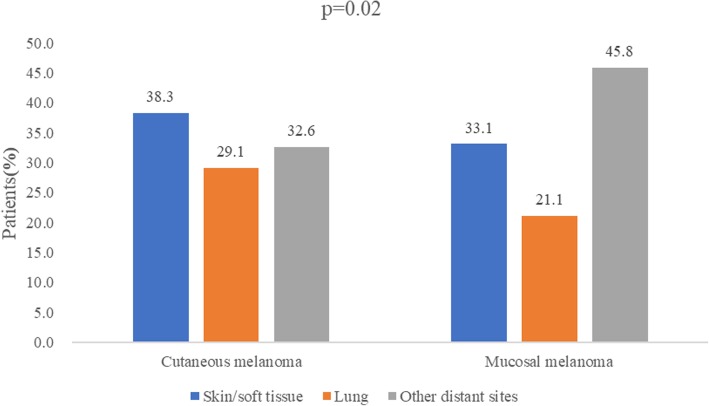
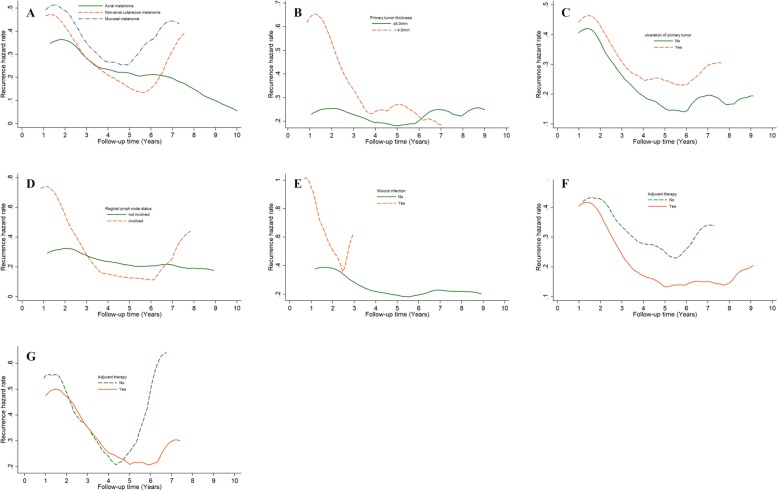
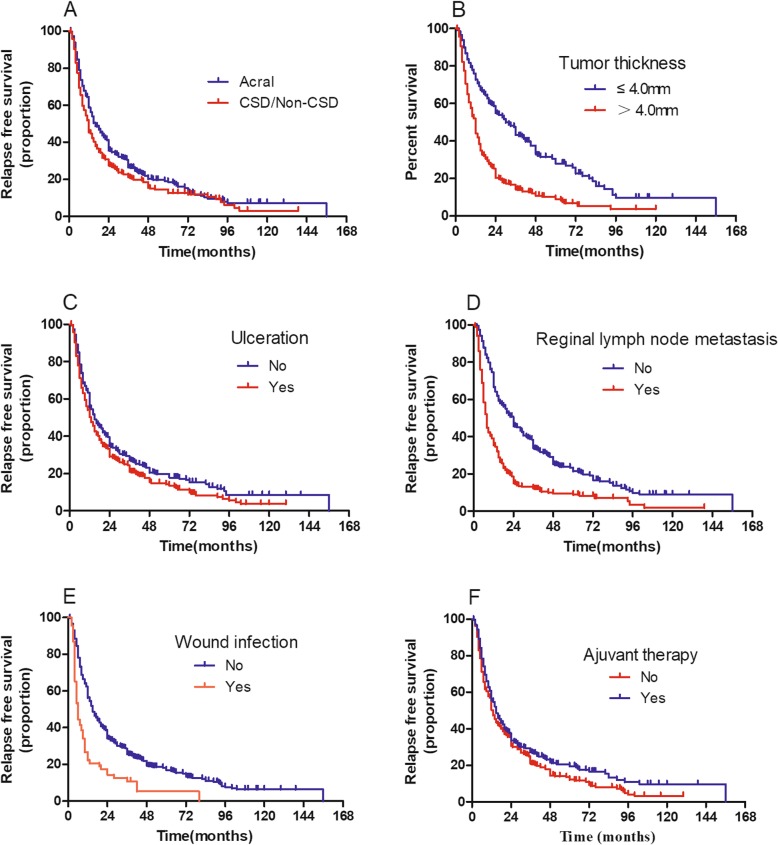
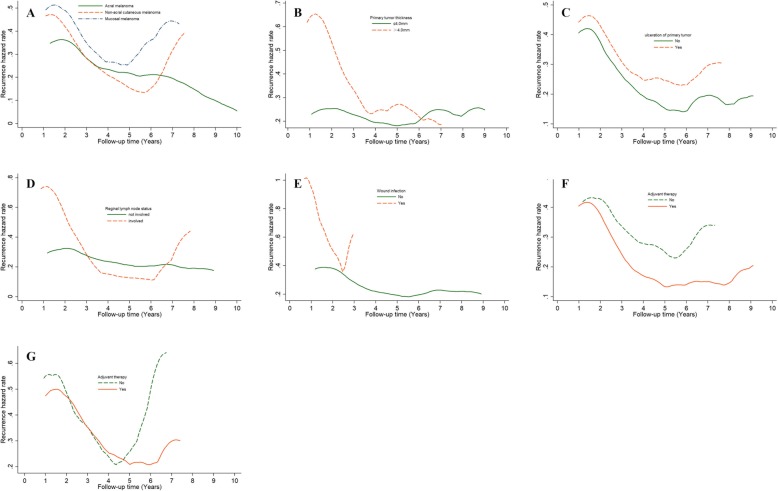
Totally, 1012 patients were included (acral melanoma 400; chronic sun-induced damage (CSD)/non-CSD melanoma 314; mucosal melanoma 298). Recurrence was recorded in 808 patients (localized 14.1%; regional 29.6%, and distant 56.3%). Mucosal melanoma had local and M1c stage recurrence more frequently than cutaneous melanoma, but less frequent regional node relapse. There was no difference in recurrent site distribution between acral and CSD/non-CSD melanoma. The annual recurrence hazard curve for the entire cohort showed a double-peaked pattern with the first major peak in the second year after surgery and the second peak near the seventh year. Mucosal melanoma had a higher recurrence risk than cutaneous melanoma. Acral melanoma had a lower flat recurrence peak than CSD/non-CSD melanoma. Tumor thickness > 4.0 mm, ulceration, positive regional nodes, and wound infection were associated with a higher recurrence risk in cutaneous melanoma. Adjuvant therapy reduced the recurrence risk of cutaneous melanoma but not of mucosal melanoma.
This is a large cohort about the rule of recurrence risk in acral and mucosal melanoma and will provide an initial framework for development of surveillance and adjuvant strategy for Chinese melanoma patients.
肢端和黏膜黑色素瘤在白种人中罕见,但在中国很常见。关于这些患者的复发特征,数据有限。本研究旨在确定中国局限性黑色素瘤,尤其是肢端和黏膜亚型的复发模式。
回顾性分析了 1999 年 1 月至 2014 年 12 月在中国南方接受根治性切除术的局限性黑色素瘤患者。采用 Kaplan-Meier 法和风险函数分别分析生存和年复发风险。
共纳入 1012 例患者(肢端黑色素瘤 400 例;慢性阳光诱导损伤(CSD)/非 CSD 黑色素瘤 314 例;黏膜黑色素瘤 298 例)。808 例患者(局部 14.1%,区域 29.6%,远处 56.3%)出现复发。黏膜黑色素瘤的局部和 M1c 期复发较皮肤黑色素瘤更为常见,但区域淋巴结复发较少。肢端和 CSD/非 CSD 黑色素瘤的复发部位分布无差异。全队列的年复发风险曲线呈双峰模式,第一个高峰出现在术后第二年,第二个高峰出现在第七年附近。黏膜黑色素瘤的复发风险高于皮肤黑色素瘤。肢端黑色素瘤的复发高峰较 CSD/非 CSD 黑色素瘤低平。肿瘤厚度>4.0 mm、溃疡、阳性区域淋巴结和伤口感染与皮肤黑色素瘤的高复发风险相关。辅助治疗降低了皮肤黑色素瘤的复发风险,但对黏膜黑色素瘤没有影响。
这是一项关于肢端和黏膜黑色素瘤复发风险规律的大型队列研究,将为中国黑色素瘤患者的监测和辅助治疗策略的制定提供初步框架。