García-Chagollán Mariel, Ledezma-Lozano Iris Yolanda, Hernández-Bello Jorge, Sánchez-Hernández Pedro Ernesto, Gutiérrez-Ureña Sergio Ramón, Muñoz-Valle José Francisco
Instituto de Investigación en Ciencias Biomédicas, Centro Universitario de Ciencias de la Salud, Universidad de Guadalajara, Guadalajara, México.
Laboratorio de Inmunología, Centro Universitario de Ciencias de la Salud, Universidad de Guadalajara, Guadalajara, México.
J Clin Lab Anal. 2020 May;34(5):e23188. doi: 10.1002/jcla.23188. Epub 2020 Jan 6.
T-cell activation pathways have been proposed as trigger mechanisms in the pathogenesis of rheumatoid arthritis (RA). CD28 and CTLA-4 play major roles in regulating the stimulatory and inhibitory co-signals in T cells.
To analyze the association between soluble and surface expression of CD28 and CTLA-4 with the clinical parameters of RA patients.
A total of 35 RA patients classified as early RA (n = 14), chronic RA (n = 14), and untreated RA (n = 7), as well as 7 age- and sex-matched control subjects (CS) were included. Surface expression of CD28 and CTLA-4 on T cells was evaluated by flow cytometry. Soluble levels of CD28 (sCD28), CTLA-4 (sCTLA-4), and anti-CCP antibodies were measured by ELISA.
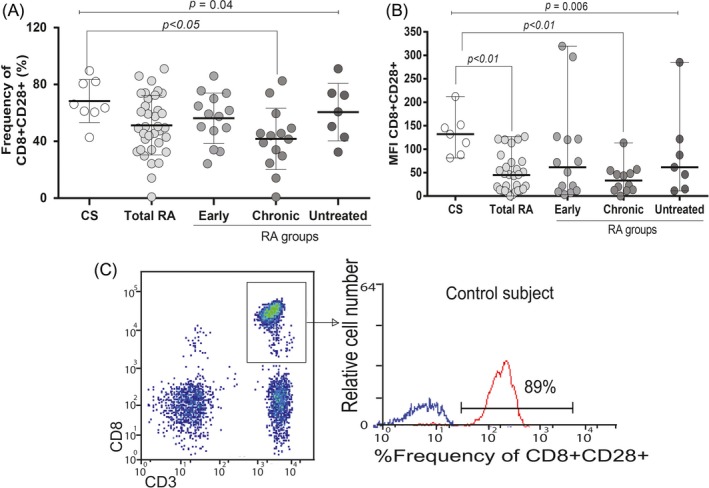
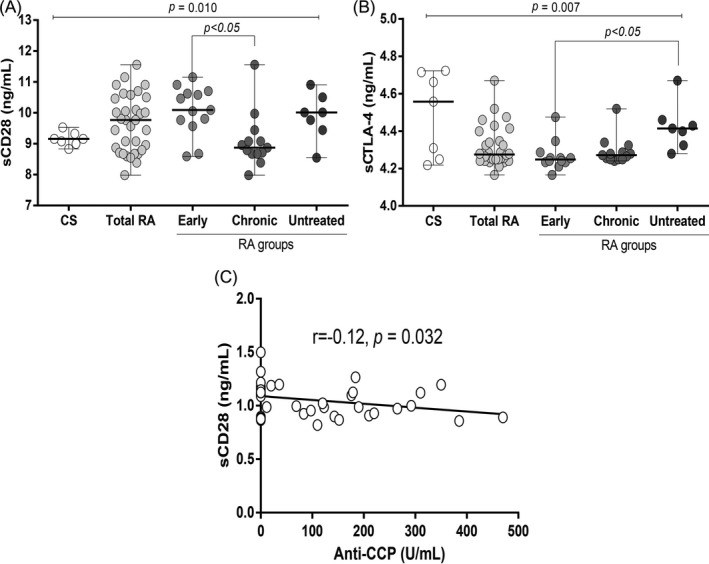
A significant lower percentage of CD8 + T cells positive to CD28 (CS = 64.9% vs RA = 42.7%, P = .04), and diminished surface expression of CD28 (CS: MFI = 122.9 vs RA: MFI = 33.1, P = .006), were found in chronic RA patients compared to CS. Higher sCD28 were observed in early RA patients compared with chronic RA patients (P < .05). sCTLA-4 was found increased in untreated RA patients compared to early RA patients (P < .05). sCD28 concentration correlated with anti-CCP levels (rho = -0.12; P = .032). The soluble and surface expressions of CTLA-4 were not associated with RA clinical parameters.
In RA, the percentage of CD8 + CD28+ T cells decreases and expresses fewer membrane CD28 than CS. sCD28 levels are lower in chronic RA and are associated negatively with anti-CCP levels. sCTLA 4 levels are lower in early RA patients than in untreated RA patients.
T细胞激活途径被认为是类风湿关节炎(RA)发病机制中的触发机制。CD28和CTLA-4在调节T细胞的共刺激和共抑制信号中起主要作用。
分析CD28和CTLA-4的可溶性及表面表达与RA患者临床参数之间的关联。
共纳入35例RA患者,分为早期RA组(n = 14)、慢性RA组(n = 14)和未治疗RA组(n = 7),以及7名年龄和性别匹配的对照受试者(CS)。通过流式细胞术评估T细胞上CD28和CTLA-4的表面表达。采用ELISA法检测CD28(sCD28)、CTLA-4(sCTLA-4)和抗环瓜氨酸肽抗体的可溶性水平。
与CS相比,慢性RA患者中CD8 + T细胞CD28阳性百分比显著降低(CS = 64.9% vs RA = 42.7%,P = 0.04),且CD28的表面表达减少(CS:平均荧光强度[MFI] = 122.9 vs RA:MFI = 33.1,P = 0.006)。与慢性RA患者相比,早期RA患者的sCD28水平更高(P < .05)。与早期RA患者相比,未治疗RA患者的sCTLA-4水平升高(P < .05)。sCD28浓度与抗环瓜氨酸肽水平相关(rho = -0.12;P = 0.032)。CTLA-4的可溶性和表面表达与RA临床参数无关。
在RA中,CD8 + CD28 + T细胞百分比降低,且膜CD28表达低于CS。慢性RA患者的sCD28水平较低,且与抗环瓜氨酸肽水平呈负相关。早期RA患者的sCTLA-4水平低于未治疗RA患者。