School of Nursing, Midwifery and Paramedicine, Curtin University, Perth, Western Australia 6102, Australia, Centre for Nursing Research, Sir Charles Gairdner Hospital, Perth, Western Australia 6009, Australia.
Discipline of Nursing, College of Science, Health, Engineering & Education, Murdoch University, Perth, Western Australia 6150, Australia, Centre for Nursing Research, Sir Charles Gairdner Hospital, Perth, Western Australia 6009, Australia.
Clin Interv Aging. 2019 Dec 18;14:2223-2237. doi: 10.2147/CIA.S211424. eCollection 2019.
Falls remain an important problem for older people in hospital, particularly those with high falls risk. This mixed methods study investigated the association between multiple bed moves and falls during hospitalisation of older patients identified as a fall risk, as well as safety of ward environments, and staff person-centredness and level of inter-professional collaboration.
Patients aged ≥70 years, admitted through the Emergency Department (ED) and identified at high fall risk, who were admitted to four target medical wards, were followed until discharge or transfer to a non-study ward. Hospital administrative data (falls, length of stay [LoS], and bed moves) were collected. Ward environmental safety audits were conducted on the four wards, and staff completed person-centredness of care, and interprofessional collaboration surveys. Staff focus groups and patient interviews provided additional qualitative data about bed moves.
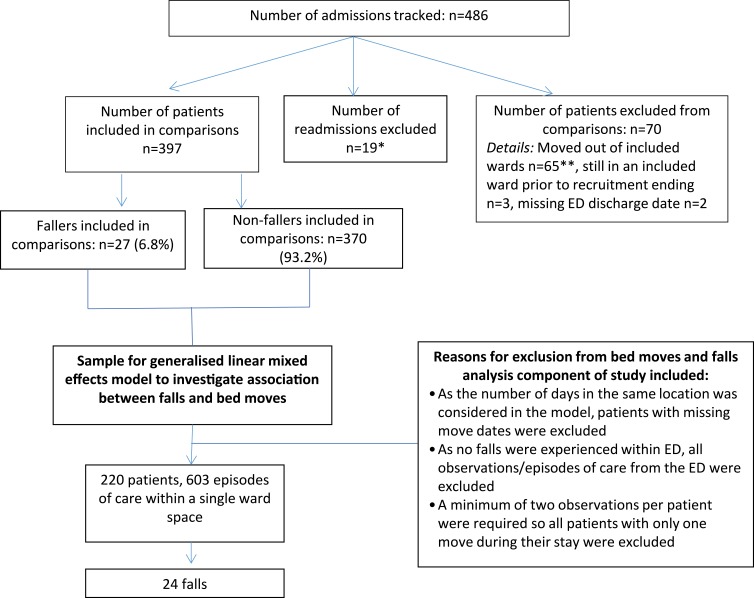
From 486 ED tracked admissions, 397 patient records were included in comparisons between those who fell and those who did not [27 fallers/370 non-fallers (mean 84.8 years, SD 7.2; 57.4% female)]. During hospitalisation, patients experienced one to eight bed moves (mean 2.0, SD 1.2). After adjusting for LoS, the number of bed moves after the move to the initial admitting ward was significantly associated with experiencing a fall (OR 1.56, 95% CI 1.11-2.18). Ward environments had relatively few falls hazards identified, and staff surveys indicated components of person-centredness of care and interprofessional collaboration were rated as good overall, and comparable to other reported hospital data. Staff focus groups identified poor communication between discharging and admitting wards, and staff time pressures around bed moves as factors potentially increasing falls risk for involved patients. Patients reported bed moves increased their stress during an already challenging time.
Patients who are at high risk for falls admitted to hospital have an increased risk of falling associated with every additional bed move. Strategies are needed to minimise bed moves for patients who are at high risk for falls.
跌倒仍然是医院老年人面临的一个重要问题,特别是那些有高跌倒风险的人。本混合方法研究调查了在识别为跌倒高风险的老年患者住院期间,多次床位移动与跌倒之间的关联,以及病房环境的安全性,以及工作人员以患者为中心的程度和跨专业合作的水平。
年龄≥70 岁,通过急诊部(ED)入院并被确定为高跌倒风险的患者,被收治到四个目标内科病房,直到出院或转至非研究病房。收集医院行政数据(跌倒、住院时间[LoS]和床位移动)。对四个病房进行了病房环境安全审核,工作人员完成了以患者为中心的护理和跨专业合作调查。工作人员焦点小组和患者访谈提供了有关床位移动的额外定性数据。
从 486 名 ED 跟踪入院患者中,将 397 名患者记录与跌倒患者和未跌倒患者(平均 84.8 岁,标准差 7.2;57.4%为女性)进行了比较。在住院期间,患者经历了 1 到 8 次床位移动(平均 2.0,标准差 1.2)。调整 LoS 后,移动到初始收治病房后的床位移动次数与跌倒经历显著相关(OR 1.56,95%CI 1.11-2.18)。病房环境中发现的跌倒危险相对较少,工作人员调查表明,以患者为中心的护理和跨专业合作的各个组成部分总体上被评为良好,与其他报告的医院数据相当。工作人员焦点小组确定了转科和收治病区之间沟通不畅,以及工作人员在床位移动方面的时间压力是增加相关患者跌倒风险的潜在因素。患者报告说床位移动增加了他们在已经具有挑战性的时期的压力。
住院的高跌倒风险患者每增加一次床位移动,跌倒的风险就会增加。需要采取策略来减少高跌倒风险患者的床位移动。