
受情感驱动:代表个人生活事件的情感概念会引发与矢状面和侧面空间-效价关联相结合的自由执行步骤。
Moved by Emotions: Affective Concepts Representing Personal Life Events Induce Freely Performed Steps in Line With Combined Sagittal and Lateral Space-Valence Associations.
作者信息
Fernández Susana Ruiz, Kastner Lydia, Cervera-Torres Sergio, Müller Jennifer, Gerjets Peter
机构信息
FOM Hochschule für Öekonomie & Management, Essen, Germany.
Leibniz-Institut für Wissensmedien, Tübingen, Germany.
出版信息
Front Psychol. 2019 Dec 11;10:2787. doi: 10.3389/fpsyg.2019.02787. eCollection 2019.
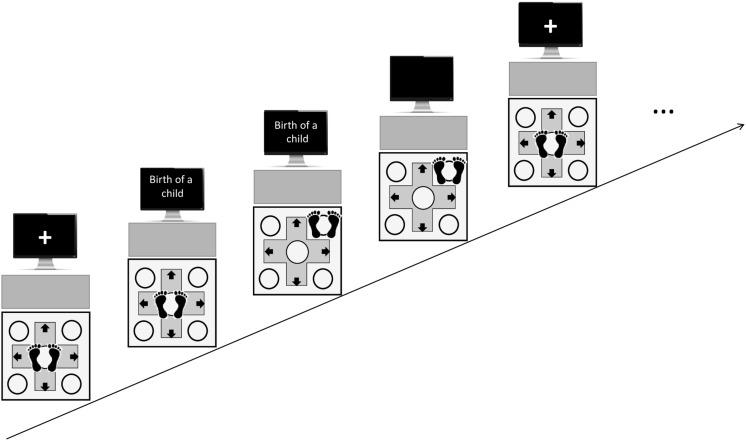
Embodiment approaches to cognition and emotion have put forth the idea that the way we think and talk about affective events often recruits spatial information that stems, to some extent, from our bodily experiences. For example, metaphorical expressions such as "being someone's right hand" or "leaving something bad behind" convey affectivity associated with the lateral and sagittal dimensions of space. Action tendencies associated with affect such as the directional fluency of hand movements (dominant right hand-side - positive; non-dominant left hand-side - negative) and approach-avoidance behaviors (forward - positive; backwards - negative) might be mechanisms supporting such associations. Against this background, experimental research has investigated whether positive and negative words are freely allocated into space (e.g., close or far from one's body) or resonate with congruent (vs. incongruent) predefined manual actions usually performed by joysticks or button presses (e.g., positive - right; negative - left, or vice versa). However, to date, it is unclear how the processing of affective concepts resonate with directional actions of the whole body, the more if such actions are performed freely within a context enabling both, lateral and sagittal movements. Accordingly, 67 right-handed participants were to freely step on an 8-response pad (front, back, right, left, front-right, front-left, back-right, or back-left) after being presented in front of them valence-laden personal life-events submitted before the task (e.g., words or sentences such as "graduation" or "birth of a child"). The most revealing finding of this study indicates that approach-avoidance behaviors and space-valence associations across laterality are interwoven during whole body step actions: Positive events induced steps highly biased to front-right whereas negative events induced steps highly biased to back-left.
认知与情感的具身化方法提出了这样一种观点,即我们思考和谈论情感事件的方式常常会调用在一定程度上源于身体体验的空间信息。例如,诸如“是某人的得力助手”或“把不好的事情抛在脑后”这样的隐喻表达传达了与空间的横向和矢状维度相关的情感。与情感相关的行动倾向,如手部动作的方向流畅性(优势右手侧——积极;非优势左手侧——消极)以及趋近-回避行为(向前——积极;向后——消极)可能是支持这种关联的机制。在此背景下,实验研究调查了积极和消极词汇是被随意分配到空间中(例如,离身体近或远),还是与通常通过操纵杆或按键执行的一致(与不一致)的预定义手动动作产生共鸣(例如,积极——右;消极——左,反之亦然)。然而,迄今为止,尚不清楚情感概念的处理如何与全身的定向动作产生共鸣,尤其是当这些动作在一个允许横向和矢状运动的情境中自由执行时。因此,67名右利手参与者在看到呈现在他们面前的任务前提交的充满情感的个人生活事件(例如,“毕业”或“孩子出生”这样的单词或句子)后,要自由地踩在一个有8种响应的踏板上(前、后、右、左、右前、左前、右后或左后)。这项研究最具启发性的发现表明,在全身踏步动作中,趋近-回避行为与横向的空间-效价关联是相互交织的:积极事件引发的踏步高度偏向于右前,而消极事件引发的踏步高度偏向于左后。


 Zotero 插件