Hu Yanling, Tan Chaoliang, Lin Xin, Lai Zhuangchai, Zhang Xiao, Lu Qipeng, Feng Ning, Yang Dongliang, Weng Lixing
School of Electrical and Control Engineering, Nanjing Polytechnic Institute, Nanjing, China.
Jiangsu Key Laboratory for Biosensors, Institute of Advanced Materials (IAM), Nanjing University of Posts and Telecommunications, Nanjing, China.
Front Chem. 2019 Dec 6;7:844. doi: 10.3389/fchem.2019.00844. eCollection 2019.
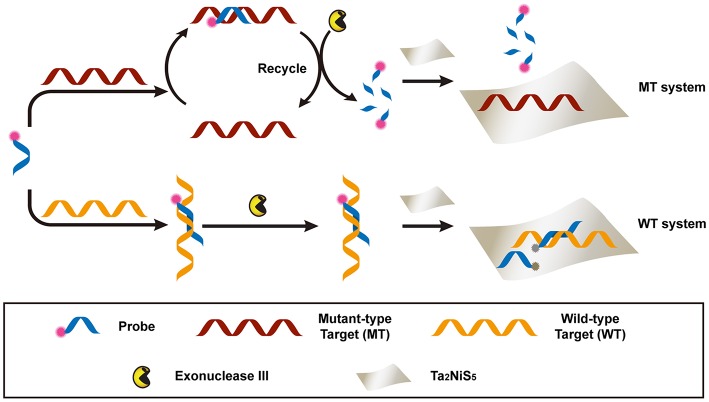
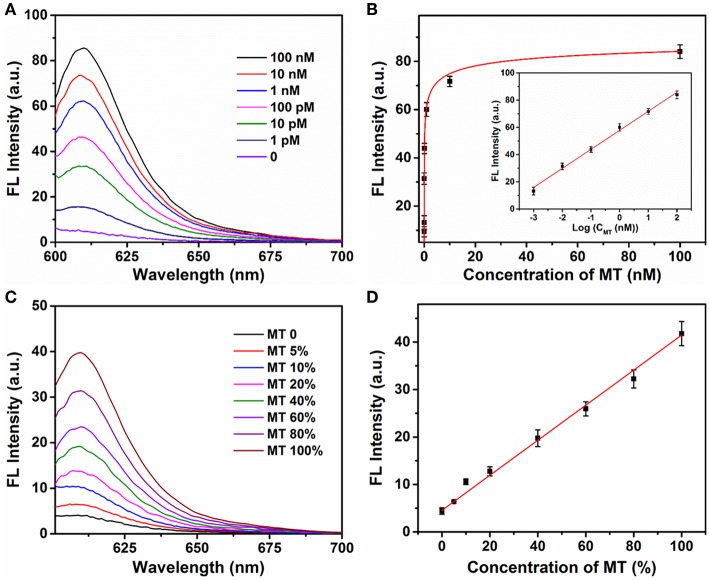
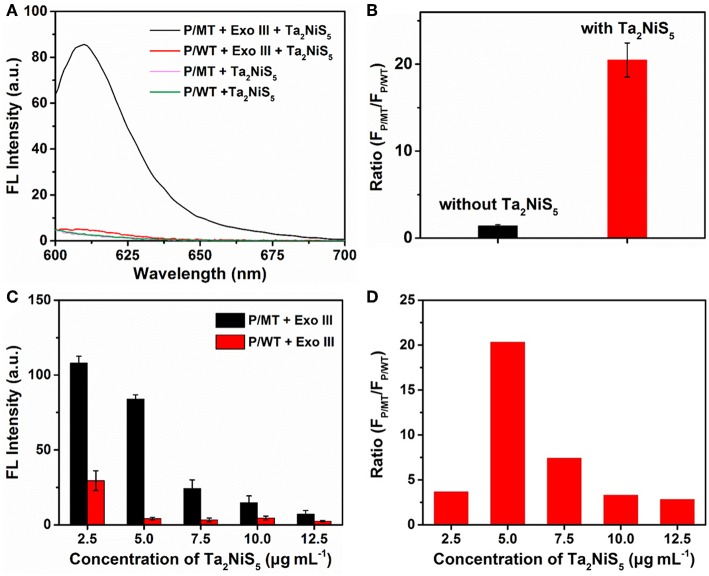
Herein, we report that the ternary chalcogenide nanosheet exhibits different affinity toward oligonucleotides with different lengths and efficiently quenches the fluorescence of dye-labeled DNA probes. Based on these findings, as a proof-of-concept application, the ternary chalcogenide nanosheet is used as a target cyclic amplification biosensor, showing high specificity in discriminating single-base mismatch. This simple strategy is fast and sensitive for the single nucleotide polymorphism detection. Ultralow detection limit of unlabeled target (250 fM) and high discrimination ratio (5%) in the mixture of perfect match (mutant-type) and single-base mismatch (wild-type) target are achieved. This sensing method is extensively compatible for the single nucleotide polymorphism detection in clinical samples, making it a promising tool for the mutation-based clinical diagnostic and genomic research.
在此,我们报道三元硫属化物纳米片对不同长度的寡核苷酸表现出不同的亲和力,并能有效淬灭染料标记的DNA探针的荧光。基于这些发现,作为概念验证应用,三元硫属化物纳米片被用作目标循环放大生物传感器,在区分单碱基错配方面显示出高特异性。这种简单的策略对单核苷酸多态性检测快速且灵敏。实现了未标记目标的超低检测限(250 fM)以及完美匹配(突变型)和单碱基错配(野生型)目标混合物中的高区分率(5%)。这种传感方法在临床样本的单核苷酸多态性检测中具有广泛的兼容性,使其成为基于突变的临床诊断和基因组研究的有前途的工具。