Sánchez Romano Javier, Grund Lisa, Obiegala Anna, Nymo Ingebjørg H, Ancin-Murguzur Francisco Javier, Li Hong, Król Nina, Pfeffer Martin, Tryland Morten
Arctic Infection Biology, Department of Arctic and Marine Biology, UiT The Arctic University of Norway, Tromsø, Norway.
Zoo Duisburg AG, Duisburg, Germany.
Front Vet Sci. 2019 Dec 20;6:461. doi: 10.3389/fvets.2019.00461. eCollection 2019.
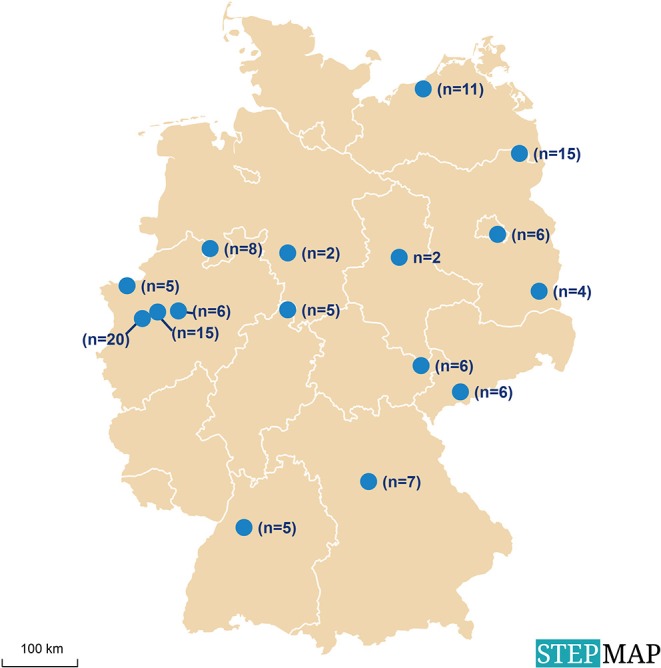
Captive reindeer in German zoos and wildlife parks live outside their natural geographic range and are exposed to a variety of viral, bacterial and protozoan pathogens, some host-specific and some which they are not exposed to in their native habitat. Reindeer blood samples and ticks collected in 2013 from 123 reindeer at 16 different zoological facilities were available from a previous study. The aims of this study were to assess the serological status of these animals with regards to various microorganisms as well as to test ticks () and blood samples for the presence of spp. DNA in order to evaluate the exposure of captive reindeer in Germany to a variety of pathogens. A total of 119 or 118 serum samples were screened (ELISA) and antibodies were detected (seropositive/tested, prevalence, confidence interval) against alphaherpesvirus (24/119, 20.3%, CI: 13.9-28.3), bluetongue virus (BTV; 4/119, 3.4%, CI: 1.0-8.7), malignant catarrhal fever related gammaherpesvirus (MCFV-related gammaherpesvirus; 7/119, 5.9%, CI: 2.7-11.9), pestivirus (5/118, 4.2%, CI: 1.6-9.8), Schmallenberg virus (SBV; 70/118, 59.3%, CI: 50.3-67.8), smooth spp. (1/118; 0.9%, CI: 0-5.1), (5/118, 4.2%, CI: 1.6-9.8), and (62/119, 52.1%, CI: 43.2-60.9). These results suggested the exposure of reindeer to all tested pathogens. Moreover, real-time PCR for targeting the partial gene was performed on DNA extracted from whole blood samples from reindeer ( = 123) and from ticks ( = 49) collected from 22 reindeer in seven different facilities. In addition to the real-time PCR, a semi-nested PCR for the partial gene, and a nested PCR targeting the partial 16S rRNA gene were performed. DNA of was detected in 17 reindeer (13.8%) and 15 ticks (30.6%). Three of the five reindeer with ticks having DNA also had such DNA in blood. These results indicate that captive reindeer can be exposed to several ruminant pathogens that they hitherto had no known exposure to through their natural geographical distribution and habitats as shown for -borne BTV and SBV. Further, captive reindeer may serve as reservoir hosts for pathogens circulating in local domestic, captive, and wild ruminant species and populations and arthropod vectors.
德国动物园和野生动物园里的圈养驯鹿生活在其自然地理分布范围之外,接触到各种病毒、细菌和原生动物病原体,有些是宿主特异性的,有些是它们在原生栖息地未曾接触过的。2013年从16个不同动物园设施的123只驯鹿身上采集的驯鹿血样和蜱虫可用于一项先前的研究。本研究的目的是评估这些动物针对各种微生物的血清学状态,以及检测蜱虫和血样中是否存在 spp. DNA,以评估德国圈养驯鹿对各种病原体的接触情况。共筛选了119份或118份血清样本(酶联免疫吸附测定),并检测到针对甲型疱疹病毒(24/119,20.3%,置信区间:13.9 - 28.3)、蓝舌病毒(BTV;4/119,3.4%,置信区间:1.0 - 8.7)、恶性卡他热相关γ疱疹病毒(MCFV相关γ疱疹病毒;7/119,5.9%,置信区间:2.7 - 11.9)、瘟病毒(5/118,4.2%,置信区间:1.6 - 9.8)、施马伦贝格病毒(SBV;70/1