Massachusetts General Hospital, Boston, MA, USA.
Dana Farber Cancer Institute ECOG-ACRIN Biostatistics Center, Boston, MA, USA.
J Natl Cancer Inst. 2020 Oct 1;112(10):1021-1029. doi: 10.1093/jnci/djz245.
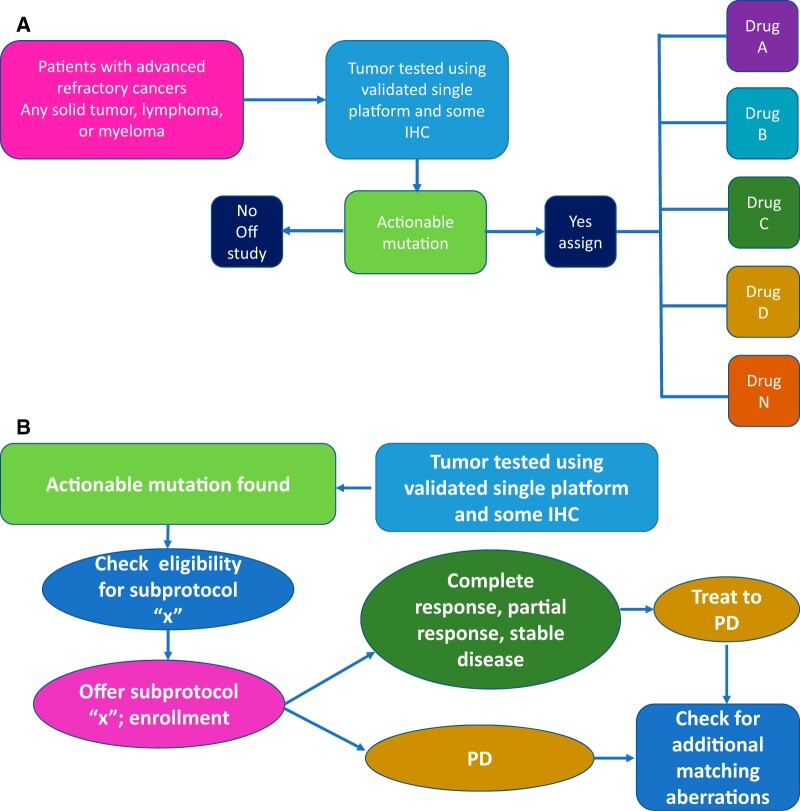
The proportion of tumors of various histologies that may respond to drugs targeted to molecular alterations is unknown. NCI-MATCH, a collaboration between ECOG-ACRIN Cancer Research Group and the National Cancer Institute, was initiated to find efficacy signals by matching patients with refractory malignancies to treatment targeted to potential tumor molecular drivers regardless of cancer histology.
Trial development required assumptions about molecular target prevalence, accrual rates, treatment eligibility, and enrollment rates as well as consideration of logistical requirements. Central tumor profiling was performed with an investigational next-generation DNA-targeted sequencing assay of alterations in 143 genes, and protein expression of protein expression of phosphatase and tensin homolog, mutL homolog 1, mutS homolog 2, and RB transcriptional corepressor 1. Treatments were allocated with a validated computational platform (MATCHBOX). A preplanned interim analysis evaluated assumptions and feasibility in this novel trial.
At interim analysis, accrual was robust, tumor biopsies were safe (<1% severe events), and profiling success was 87.3%. Actionable molecular alteration frequency met expectations, but assignment and enrollment lagged due to histology exclusions and mismatch of resources to demand. To address this lag, we revised estimates of mutation frequencies, increased screening sample size, added treatments, and improved assay throughput and efficiency (93.9% completion and 14-day turnaround).
The experiences in the design and implementation of the NCI-MATCH trial suggest that profiling from fresh tumor biopsies and assigning treatment can be performed efficiently in a large national network trial. The success of such trials necessitates a broad screening approach and many treatment options easily accessible to patients.
可能对靶向分子改变的药物有反应的各种组织学肿瘤的比例尚不清楚。NCI-MATCH 是 ECOG-ACRIN 癌症研究组与美国国家癌症研究所之间的合作项目,旨在通过匹配对潜在肿瘤分子驱动因素有反应的药物的难治性恶性肿瘤患者,找到疗效信号,而不论癌症组织学如何。
试验开发需要对分子靶标流行率、入组率、治疗资格和入组率做出假设,同时还需要考虑后勤要求。中央肿瘤分析采用了一种新的下一代 DNA 靶向测序分析,检测 143 个基因中的改变,以及磷酸酶和张力蛋白同源物、MutL 同源物 1、MutS 同源物 2 和 RB 转录核心阻遏物 1 的蛋白表达。治疗方案采用了经过验证的计算平台(MATCHBOX)进行分配。一项预先计划的中期分析评估了该新型试验中的假设和可行性。
中期分析时,入组情况稳健,肿瘤活检安全(<1%严重事件),且分析成功率为 87.3%。可操作的分子改变频率符合预期,但由于组织学排除和资源与需求不匹配,分配和入组滞后。为了解决这个问题,我们修改了突变频率的估计值,增加了筛选样本量,增加了治疗方法,并提高了检测的通量和效率(完成率为 93.9%,周转时间为 14 天)。
NCI-MATCH 试验的设计和实施经验表明,从新鲜肿瘤活检中进行分析并分配治疗可以在大型国家网络试验中高效进行。此类试验的成功需要广泛的筛选方法和患者易于获得的多种治疗选择。