• 文献检索
  • 文档翻译
  • 深度研究
  • 学术资讯
  • Suppr Zotero 插件Zotero 插件
  • 邀请有礼
  • 套餐&价格
  • 历史记录
应用&插件
Suppr Zotero 插件Zotero 插件浏览器插件Mac 客户端Windows 客户端微信小程序
定价
高级版会员购买积分包购买API积分包
服务
文献检索文档翻译深度研究API 文档MCP 服务
关于我们
关于 Suppr公司介绍联系我们用户协议隐私条款
关注我们

Suppr 超能文献

核心技术专利:CN118964589B侵权必究
粤ICP备2023148730 号-1Suppr @ 2026

文献检索

告别复杂PubMed语法,用中文像聊天一样搜索,搜遍4000万医学文献。AI智能推荐,让科研检索更轻松。

立即免费搜索

文件翻译

保留排版,准确专业,支持PDF/Word/PPT等文件格式,支持 12+语言互译。

免费翻译文档

深度研究

AI帮你快速写综述,25分钟生成高质量综述,智能提取关键信息,辅助科研写作。

立即免费体验

唯一完整的铰接早期中新世变色龙头骨(肯尼亚鲁辛加岛)表明马达加斯加特有变色龙起源于非洲。

The only complete articulated early Miocene chameleon skull (Rusinga Island, Kenya) suggests an African origin for Madagascar's endemic chameleons.

机构信息

Department of Ecology, Laboratory of Evolutionary Biology, Faculty of Natural Sciences, Comenius University in Bratislava, 84215, Bratislava, Mlynská dolina, Slovakia.

Département Adaptation du Vivant, UMR 7179C.N.R.S/ Muséum National d'Histoire Naturelle, 55 rue Buffon, 75005, Paris, France.

出版信息

Sci Rep. 2020 Jan 10;10(1):109. doi: 10.1038/s41598-019-57014-5.

DOI:10.1038/s41598-019-57014-5
PMID:31924840
原文链接:https://pmc.ncbi.nlm.nih.gov/articles/PMC6954250/
Abstract

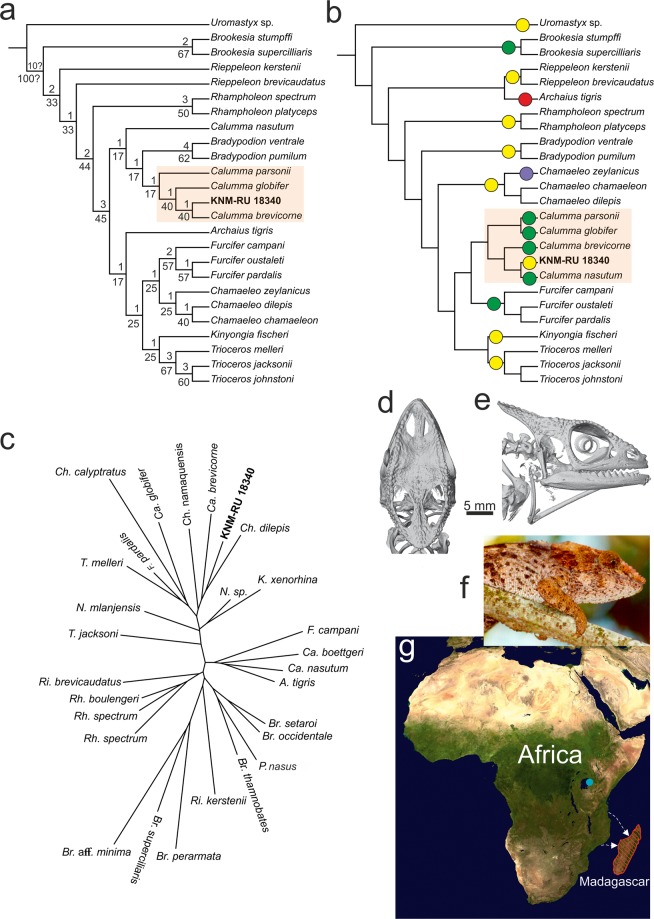
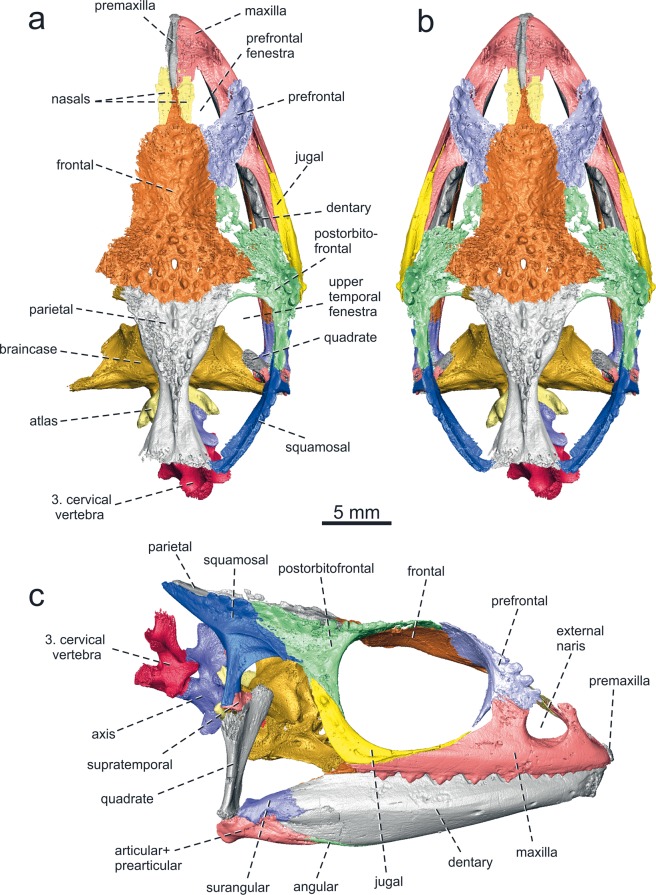
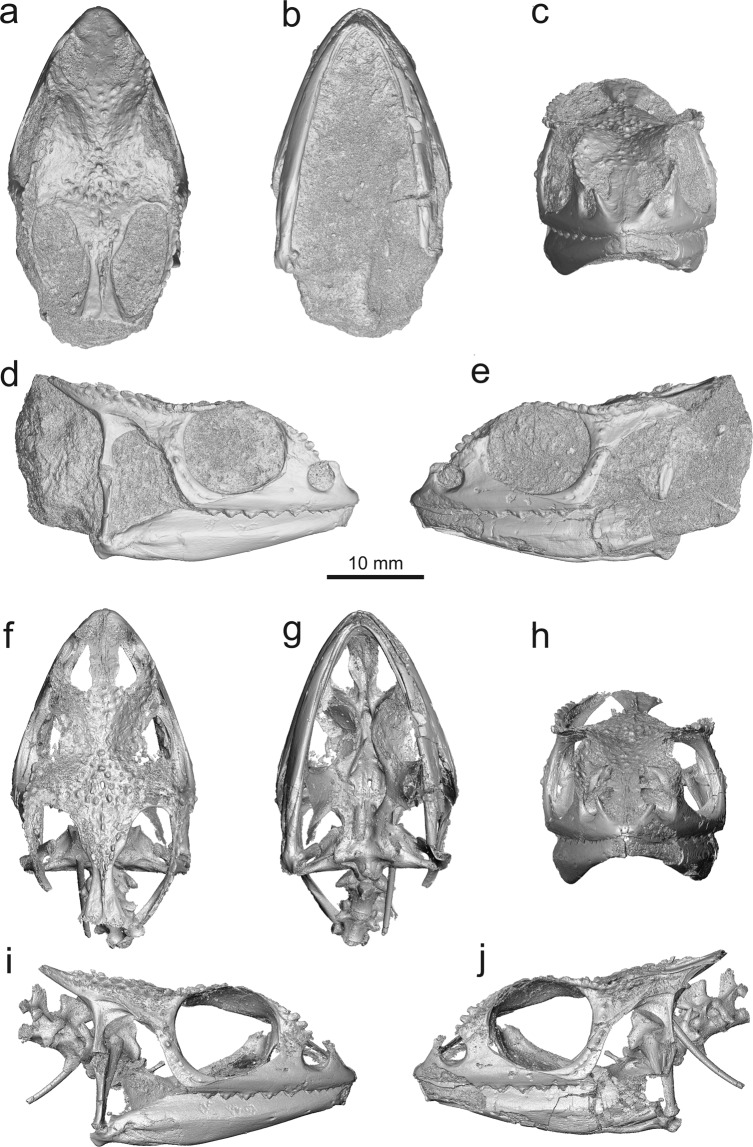
We here present the first detailed study of the specimen KNM-RU 18340 from Rusinga Island (Kenya), the only known complete early Miocene chameleon skull, using micro-CT. This specimen represents one of the oldest chameleon fossils ever recovered. For the first time, the skull bone internal surfaces, their sutures, and elements contained inside the rocky matrix are observed. Our morphological comparisons and phylogenetic analyses place this specimen confidently in the genus Calumma and a new species, Calumma benovskyi sp. nov., is erected for it. Since all species of this genus are endemic to Madagascar, this fossil uniquely demonstrates the existence of Calumma on continental Africa in the past. Our results challenge the long-held view that chameleons originated on Madagascar and dispersed over water to Africa, and provide a strong evidence of an African origin for some Malagasy lineages. The Oligocene-early Miocene dispersal to Madagascar, using oceanic currents that favoured eastward dispersal at that time, is a highly supported scenario matching the suggested dispersal of lemurs to this island. This is consistent with a previously suggested hypothesis based on molecular data.

摘要

我们在此首次利用微计算机断层扫描技术对来自肯尼亚鲁辛加岛(Rusinga Island)的 KNM-RU 18340 标本进行了详细研究,该标本是已知的唯一完整的早中新世变色龙头骨。该标本代表了迄今为止发现的最古老的变色龙化石之一。首次观察到了岩石基质内部的头骨骨内表面、它们的缝线和包含的元素。我们的形态比较和系统发育分析将该标本明确归入 Calumma 属,并为其建立了一个新种,Calumma benovskyi sp. nov.。由于该属的所有物种均为马达加斯加特有,因此该化石独一无二地证明了过去在非洲大陆上存在 Calumma。我们的研究结果挑战了变色龙起源于马达加斯加并通过水扩散到非洲的长期观点,并为一些马达加斯加谱系起源于非洲提供了有力证据。在当时有利于向东扩散的洋流的作用下,从中新世到上新世的向马达加斯加的扩散是一个得到高度支持的情景,与向该岛屿扩散的狐猴相匹配。这与基于分子数据的先前假设一致。
https://cdn.ncbi.nlm.nih.gov/pmc/blobs/30cd/6954250/bd6e747929b4/41598_2019_57014_Fig3_HTML.jpg
https://cdn.ncbi.nlm.nih.gov/pmc/blobs/30cd/6954250/43ef8cf7ec5b/41598_2019_57014_Fig1_HTML.jpg
https://cdn.ncbi.nlm.nih.gov/pmc/blobs/30cd/6954250/181fb6416f01/41598_2019_57014_Fig2_HTML.jpg
https://cdn.ncbi.nlm.nih.gov/pmc/blobs/30cd/6954250/bd6e747929b4/41598_2019_57014_Fig3_HTML.jpg
https://cdn.ncbi.nlm.nih.gov/pmc/blobs/30cd/6954250/43ef8cf7ec5b/41598_2019_57014_Fig1_HTML.jpg
https://cdn.ncbi.nlm.nih.gov/pmc/blobs/30cd/6954250/181fb6416f01/41598_2019_57014_Fig2_HTML.jpg
https://cdn.ncbi.nlm.nih.gov/pmc/blobs/30cd/6954250/bd6e747929b4/41598_2019_57014_Fig3_HTML.jpg

相似文献

1
The only complete articulated early Miocene chameleon skull (Rusinga Island, Kenya) suggests an African origin for Madagascar's endemic chameleons.唯一完整的铰接早期中新世变色龙头骨(肯尼亚鲁辛加岛)表明马达加斯加特有变色龙起源于非洲。
Sci Rep. 2020 Jan 10;10(1):109. doi: 10.1038/s41598-019-57014-5.
2
Fossil lemurs from Egypt and Kenya suggest an African origin for Madagascar's aye-aye.来自埃及和肯尼亚的化石狐猴表明马达加斯加狐猴的起源于非洲。
Nat Commun. 2018 Aug 21;9(1):3193. doi: 10.1038/s41467-018-05648-w.
3
First description of a fossil chamaeleonid from Greece and its relevance for the European biogeographic history of the group.希腊化石避役的首次描述及其对该类群欧洲生物地理历史的意义。
Naturwissenschaften. 2016 Feb;103(1-2):12. doi: 10.1007/s00114-016-1336-5. Epub 2016 Jan 28.
4
Eastward from Africa: palaeocurrent-mediated chameleon dispersal to the Seychelles islands.从非洲向东迁移:古洋流介导的变色龙扩散到塞舌尔群岛。
Biol Lett. 2011 Apr 23;7(2):225-8. doi: 10.1098/rsbl.2010.0701. Epub 2010 Sep 8.
5
Large-scale phylogeny of chameleons suggests African origins and Eocene diversification.大型变色龙系统发育研究表明其起源于非洲,并在始新世多样化。
Proc Biol Sci. 2013 Mar 27;280(1759):20130184. doi: 10.1098/rspb.2013.0184. Print 2013 May 22.
6
An amphisbaenian skull from the European miocene and the evolution of Mediterranean worm lizards.来自欧洲中新世的一种蚓蜥头骨与地中海蚓蜥的演化
PLoS One. 2014 Jun 4;9(6):e98082. doi: 10.1371/journal.pone.0098082. eCollection 2014.
7
Multiple Miocene Melastomataceae dispersal between Madagascar, Africa and India.中新世期间,野牡丹科植物多次在马达加斯加、非洲和印度之间扩散。
Philos Trans R Soc Lond B Biol Sci. 2004 Oct 29;359(1450):1485-94. doi: 10.1098/rstb.2004.1530.
8
First nearly complete skull of Gallotia auaritae (lower-middle Pleistocene, Squamata, Gallotiinae) and a morphological phylogenetic analysis of the genus Gallotia.下中新世加洛蒂亚奥瓦雷塔(Gallotia auaritae)的近乎完整头骨化石及加洛蒂亚属的形态系统发育分析
Sci Rep. 2019 Nov 12;9(1):16629. doi: 10.1038/s41598-019-52244-z.
9
Reconciling the origins of Africa, India and Madagascar with vertebrate dispersal scenarios.协调非洲、印度和马达加斯加的起源与脊椎动物扩散情况。
Folia Primatol (Basel). 2006;77(6):399-418. doi: 10.1159/000095388.
10
Mid-Cenozoic climate change, extinction, and faunal turnover in Madagascar, and their bearing on the evolution of lemurs.中生代中期的气候变化、灭绝和马达加斯加的动物群更替,及其对狐猴进化的影响。
BMC Evol Biol. 2020 Aug 8;20(1):97. doi: 10.1186/s12862-020-01628-1.

本文引用的文献

1
Fossil lemurs from Egypt and Kenya suggest an African origin for Madagascar's aye-aye.来自埃及和肯尼亚的化石狐猴表明马达加斯加狐猴的起源于非洲。
Nat Commun. 2018 Aug 21;9(1):3193. doi: 10.1038/s41467-018-05648-w.
2
A first possible chameleon from the late Miocene of India (the hominoid site of Haritalyangar): a tentative evidence for an Asian dispersal of chameleons.来自印度晚中新世(哈里塔利扬加尔类人猿遗址)的首例可能的变色龙:变色龙亚洲扩散的初步证据。
Naturwissenschaften. 2016 Dec;103(11-12):94. doi: 10.1007/s00114-016-1419-3. Epub 2016 Oct 29.
3
Multiple Loci and Complete Taxonomic Sampling Resolve the Phylogeny and Biogeographic History of Tenrecs (Mammalia: Tenrecidae) and Reveal Higher Speciation Rates in Madagascar's Humid Forests.
多个基因座和完整的分类采样解决了针鼹目(哺乳动物:针鼹科)的系统发育和生物地理学历史,并揭示了马达加斯加湿润森林中的更高的物种形成速率。
Syst Biol. 2016 Sep;65(5):890-909. doi: 10.1093/sysbio/syw034. Epub 2016 Apr 21.
4
First description of a fossil chamaeleonid from Greece and its relevance for the European biogeographic history of the group.希腊化石避役的首次描述及其对该类群欧洲生物地理历史的意义。
Naturwissenschaften. 2016 Feb;103(1-2):12. doi: 10.1007/s00114-016-1336-5. Epub 2016 Jan 28.
5
Systematic revision of the Malagasy chameleons Calumma boettgeri and C. linotum (Squamata: Chamaeleonidae).马达加斯加变色龙博氏巨变色龙(Calumma boettgeri)和林氏巨变色龙(C. linotum)的系统修订(有鳞目:避役科)
Zootaxa. 2015 Nov 25;4048(2):211-31. doi: 10.11646/zootaxa.4048.2.4.
6
Morphometric analysis of chameleon fossil fragments from the Early Pliocene of South Africa: a new piece of the chamaeleonid history.南非上新世早期变色龙化石碎片的形态测量分析:变色龙科历史的新片段。
Naturwissenschaften. 2015 Feb;102(1-2):1254. doi: 10.1007/s00114-014-1254-3. Epub 2015 Jan 21.
7
The atlas-axis complex in chamaeleonids (Squamata: Chamaeleonidae), with description of a new anatomical structure of the skull.变色龙(有鳞目:避役科)的寰枢复合体,兼论头骨一种新解剖结构的描述
Anat Rec (Hoboken). 2014 Mar;297(3):369-96. doi: 10.1002/ar.22859. Epub 2014 Jan 31.
8
Large-scale phylogeny of chameleons suggests African origins and Eocene diversification.大型变色龙系统发育研究表明其起源于非洲,并在始新世多样化。
Proc Biol Sci. 2013 Mar 27;280(1759):20130184. doi: 10.1098/rspb.2013.0184. Print 2013 May 22.
9
Spatial and temporal arrival patterns of Madagascar's vertebrate fauna explained by distance, ocean currents, and ancestor type.马达加斯加脊椎动物区系的时空到达模式由距离、洋流和祖先类型解释。
Proc Natl Acad Sci U S A. 2012 Apr 3;109(14):5352-7. doi: 10.1073/pnas.1113993109. Epub 2012 Mar 19.
10
Eastward from Africa: palaeocurrent-mediated chameleon dispersal to the Seychelles islands.从非洲向东迁移:古洋流介导的变色龙扩散到塞舌尔群岛。
Biol Lett. 2011 Apr 23;7(2):225-8. doi: 10.1098/rsbl.2010.0701. Epub 2010 Sep 8.