Martínez Lidia, Santoro Gonzalo, Merino Pablo, Accolla Mario, Lauwaet Koen, Sobrado Jesús, Sabbah Hassan, Pelaez Ramón J, Herrero Victor J, Tanarro Isabel, Agúndez Marcelino, Martín-Jimenez Alberto, Otero Roberto, Ellis Gary J, Joblin Christine, Cernicharo José, Martín-Gago José A
Instituto de Ciencia de Materiales de Madrid (ICMM-CSIC). Structure of Nanoscopic Systems Group. C/Sor Juana Inés de la Cruz 3, 28049 Cantoblanco, Madrid, Spain.
Instituto de Física Fundamental (IFF-CSIC). Group of Molecular Astrophysics, C/Serrano 123, 28006 Madrid, Spain.
Nat Astron. 2020 Jan;4(1):97-105. doi: 10.1038/s41550-019-0899-4. Epub 2019 Oct 21.
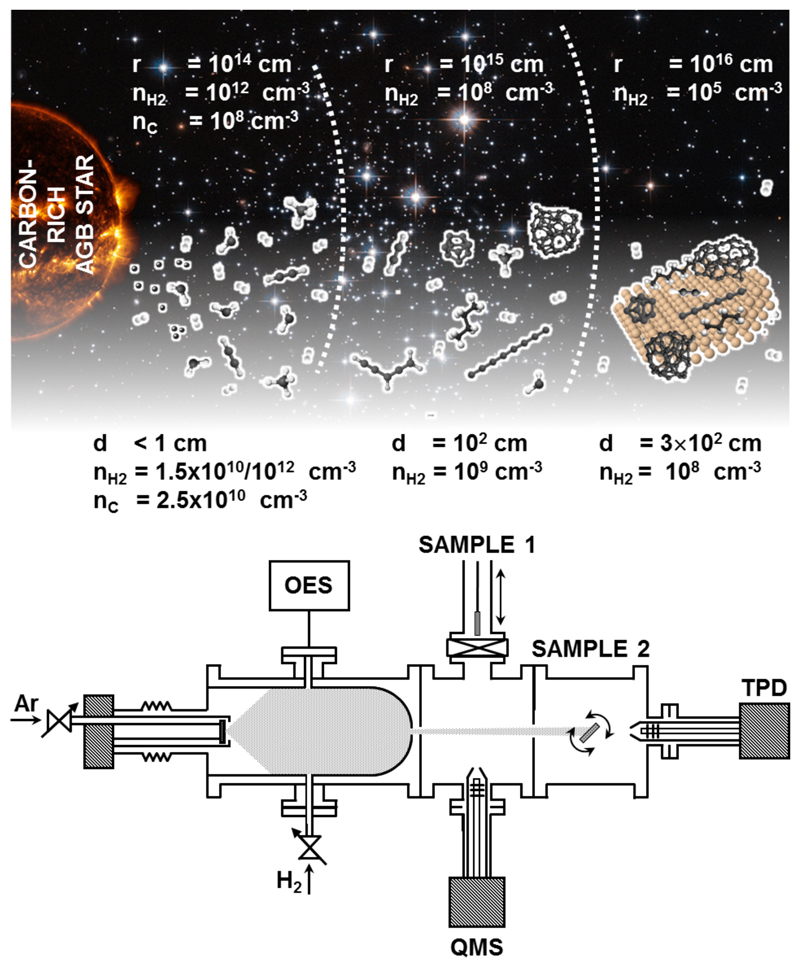
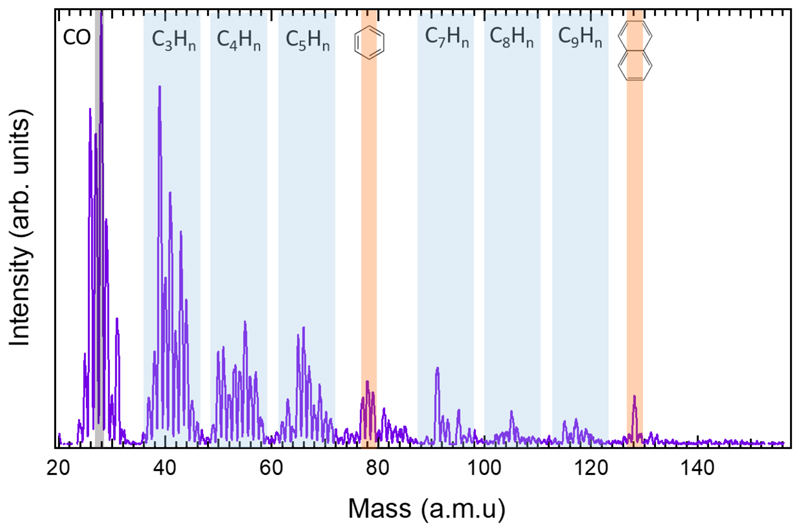
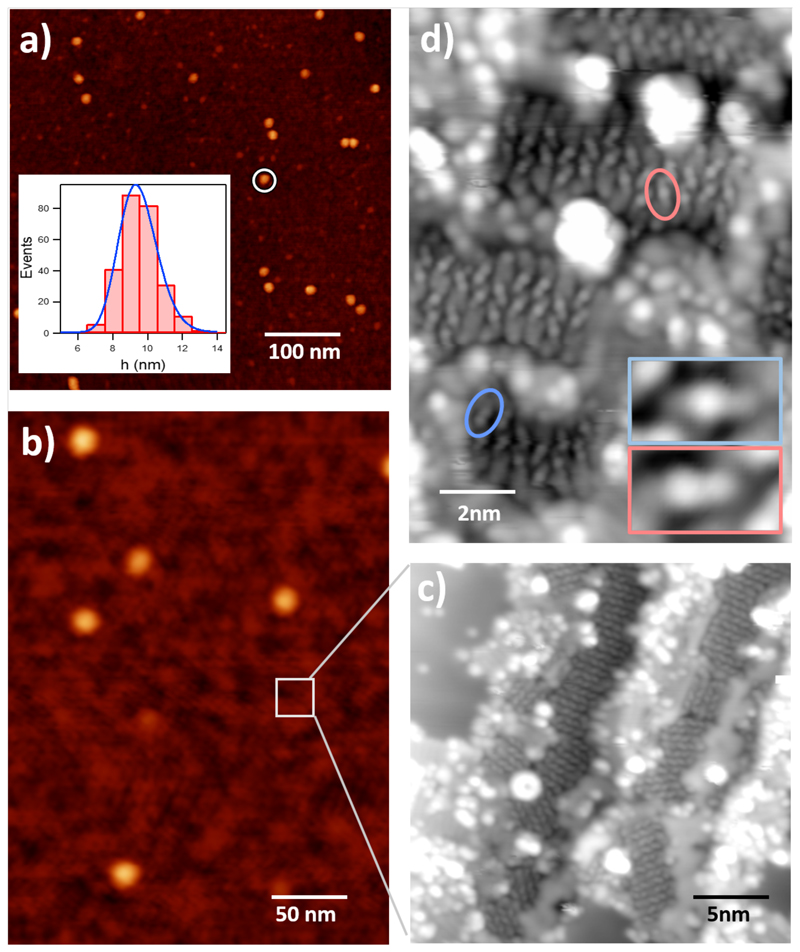
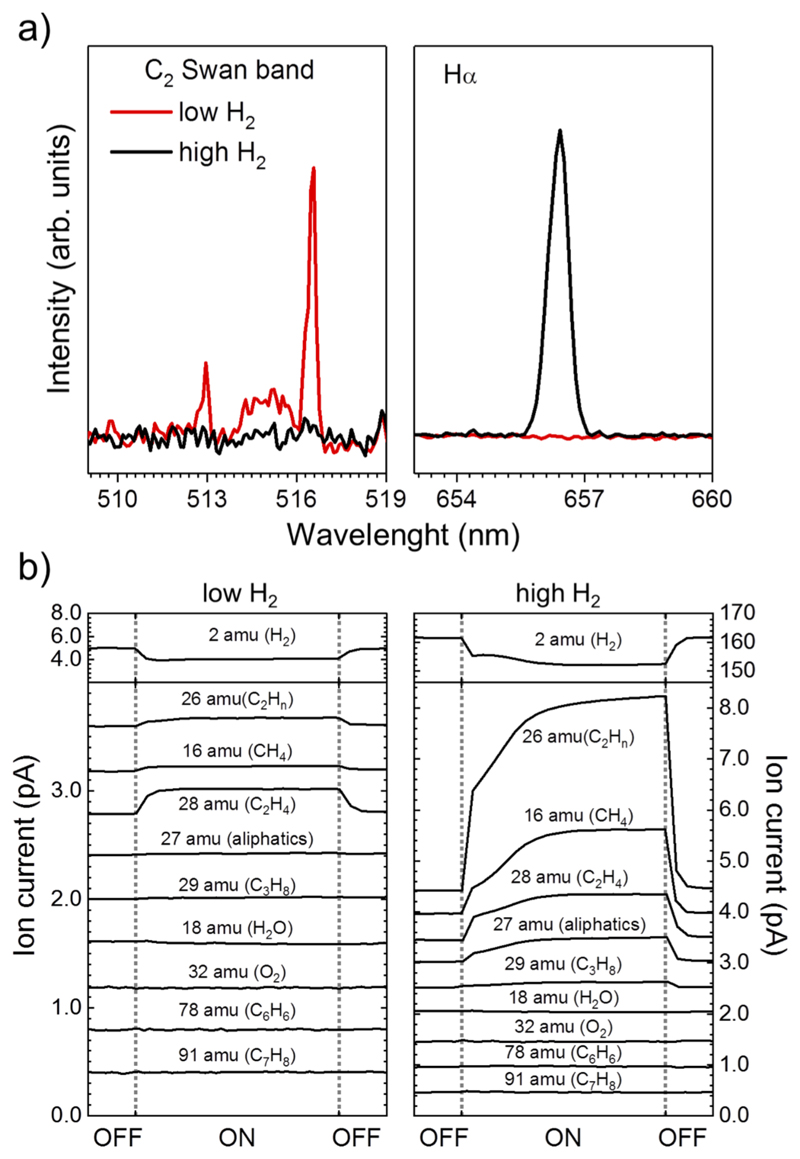
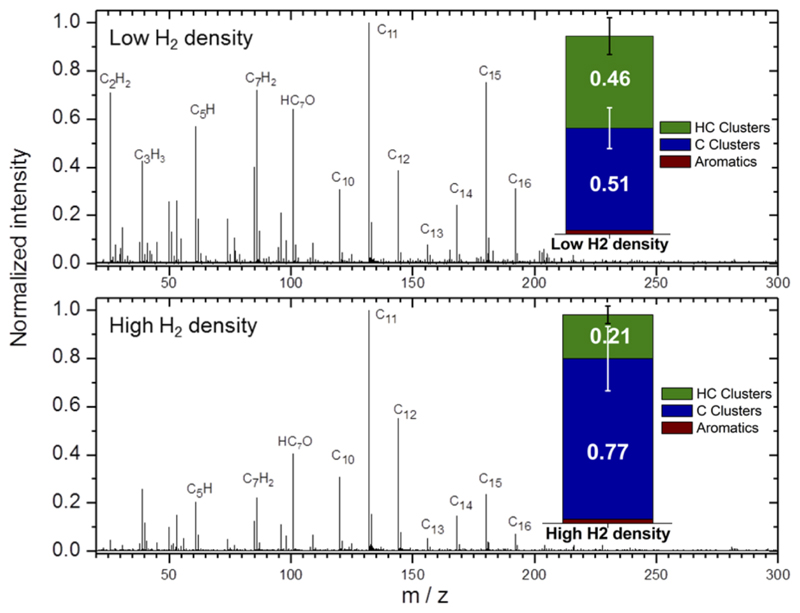
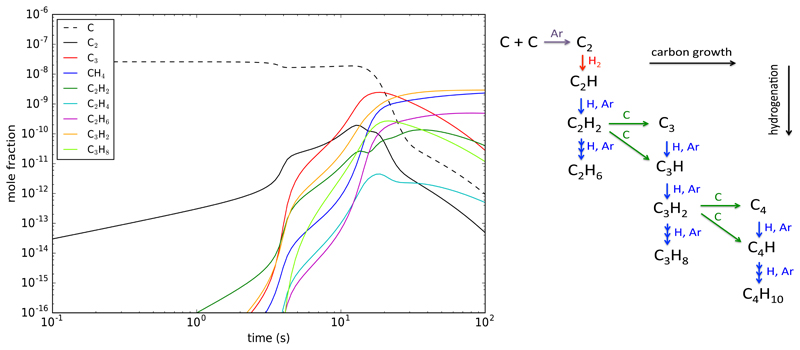
Evolved stars are a foundry of chemical complexity, gas and dust that provides the building blocks of planets and life, and dust nucleation first occurs in their photosphere. Despite their importance, the circumstellar regions enveloping these stars remain hidden to many observations, thus dust formation processes are still poorly understood. Laboratory astrophysics provides complementary routes to unveil these chemical processes, but most experiments rely on combustion or plasma decomposition of molecular precursors under physical conditions far removed from those in space. We have built an ultra-high vacuum machine combining atomic gas aggregation with advanced characterization techniques to reproduce and characterize the bottom-up dust formation process. We show that carbonaceous dust analogues formed from low-pressure gas-phase condensation of C atoms in a hydrogen atmosphere, in a C/H ratio similar to that reported for evolved stars, leads to the formation of amorphous C nanograins and aliphatic C-clusters. Aromatic species or fullerenes do not form effectively under these conditions, raising implications for the revision of the chemical mechanisms taking place in circumstellar envelopes.
演化后的恒星是化学复杂性、气体和尘埃的制造厂,这些物质为行星和生命提供了构成要素,而尘埃成核首先发生在它们的光球层。尽管它们很重要,但围绕这些恒星的星周区域在许多观测中仍然难以被发现,因此尘埃形成过程仍然知之甚少。实验室天体物理学提供了揭示这些化学过程的补充途径,但大多数实验依赖于在与太空条件相差甚远的物理条件下对分子前驱体进行燃烧或等离子体分解。我们建造了一台超高真空机器,将原子气体聚集与先进的表征技术相结合,以重现和表征自下而上的尘埃形成过程。我们表明,在氢气氛中由C原子的低压气相冷凝形成的碳质尘埃类似物,其C/H比与演化恒星的报道相似,会导致非晶态C纳米颗粒和脂肪族C团簇的形成。在这些条件下,芳香族物种或富勒烯不会有效形成,这对修正星周包层中发生的化学机制具有启示意义。