Department of Pharmacognosy, Phytochemistry and Phytotherapy, "Carol Davila" University of Medicine and Pharmacy, 020021 Bucharest, Romania.
Department of Biophysics, "Carol Davila" University of Medicine and Pharmacy, 020021 Bucharest, Romania.
Int J Mol Sci. 2020 Jan 8;21(2):401. doi: 10.3390/ijms21020401.
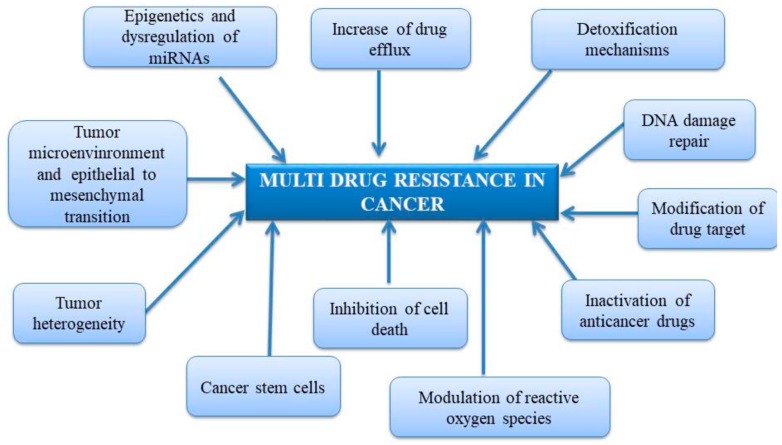
The aim of the manuscript is to discuss the influence of plant polyphenols in overcoming multidrug resistance in four types of solid cancers (breast, colorectal, lung and prostate cancer). Effective treatment requires the use of multiple toxic chemotherapeutic drugs with different properties and targets. However, a major cause of cancer treatment failure and metastasis is the development of multidrug resistance. Potential mechanisms of multidrug resistance include increase of drug efflux, drug inactivation, detoxification mechanisms, modification of drug target, inhibition of cell death, involvement of cancer stem cells, dysregulation of miRNAs activity, epigenetic variations, imbalance of DNA damage/repair processes, tumor heterogeneity, tumor microenvironment, epithelial to mesenchymal transition and modulation of reactive oxygen species. Taking into consideration that synthetic multidrug resistance agents have failed to demonstrate significant survival benefits in patients with different types of cancer, recent research have focused on beneficial effects of natural compounds. Several phenolic compounds (flavones, phenolcarboxylic acids, ellagitannins, stilbens, lignans, curcumin, etc.) act as chemopreventive agents due to their antioxidant capacity, inhibition of proliferation, survival, angiogenesis, and metastasis, modulation of immune and inflammatory responses or inactivation of pro-carcinogens. Moreover, preclinical and clinical studies revealed that these compounds prevent multidrug resistance in cancer by modulating different pathways. Additional research is needed regarding the role of phenolic compounds in the prevention of multidrug resistance in different types of cancer.
本文旨在探讨植物多酚克服四种实体瘤(乳腺癌、结直肠癌、肺癌和前列腺癌)多药耐药的影响。有效的治疗需要使用多种具有不同性质和靶点的毒性化疗药物。然而,癌症治疗失败和转移的一个主要原因是多药耐药的发展。多药耐药的潜在机制包括药物外排增加、药物失活、解毒机制、药物靶点修饰、细胞死亡抑制、癌症干细胞参与、miRNA 活性调控、表观遗传变化、DNA 损伤/修复过程失衡、肿瘤异质性、肿瘤微环境、上皮间质转化和活性氧的调节。考虑到合成多药耐药剂未能在不同类型的癌症患者中显示出显著的生存获益,最近的研究集中在天然化合物的有益作用上。几种酚类化合物(黄酮类、酚羧酸类、鞣花单宁类、芪类、木脂素类、姜黄素等)由于其抗氧化能力、抑制增殖、存活、血管生成和转移、调节免疫和炎症反应或失活前致癌物而作为化学预防剂。此外,临床前和临床研究表明,这些化合物通过调节不同途径来预防癌症中的多药耐药。需要进一步研究酚类化合物在不同类型癌症中预防多药耐药的作用。