From the Preventive Neurology Unit (B.M.J., A.J.N., G.G., R.D.), Wolfson Institute of Preventive Medicine, Barts and Queen Mary University of London; and Royal London Hospital (B.M.J., A.J.N., G.G., R.D.), Barts Health NHS Trust.
Neurol Neuroimmunol Neuroinflamm. 2020 Jan 14;7(2). doi: 10.1212/NXI.0000000000000662. Print 2020 Mar.
To update the causal estimates for the effects of adult body mass index (BMI), childhood BMI, and vitamin D status on multiple sclerosis (MS) risk.
We used 2-sample Mendelian randomization to determine causal estimates. Summary statistics for SNP associations with traits of interest were obtained from the relevant consortia. Primary analyses consisted of random-effects inverse-variance-weighted meta-analysis, followed by secondary sensitivity analyses.
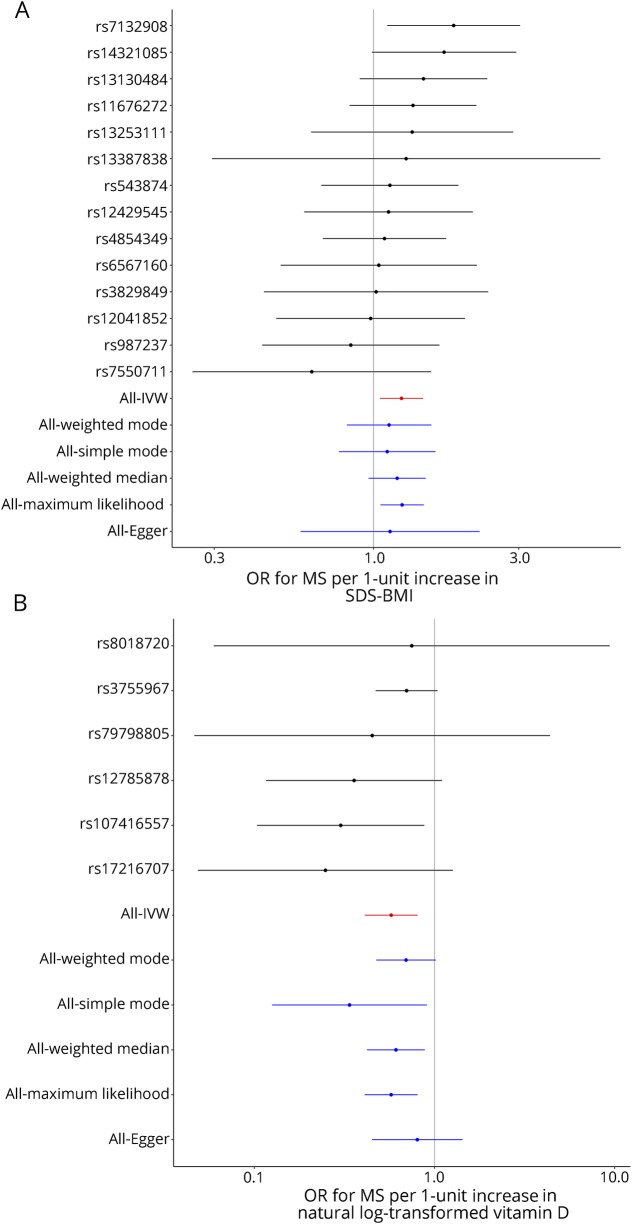
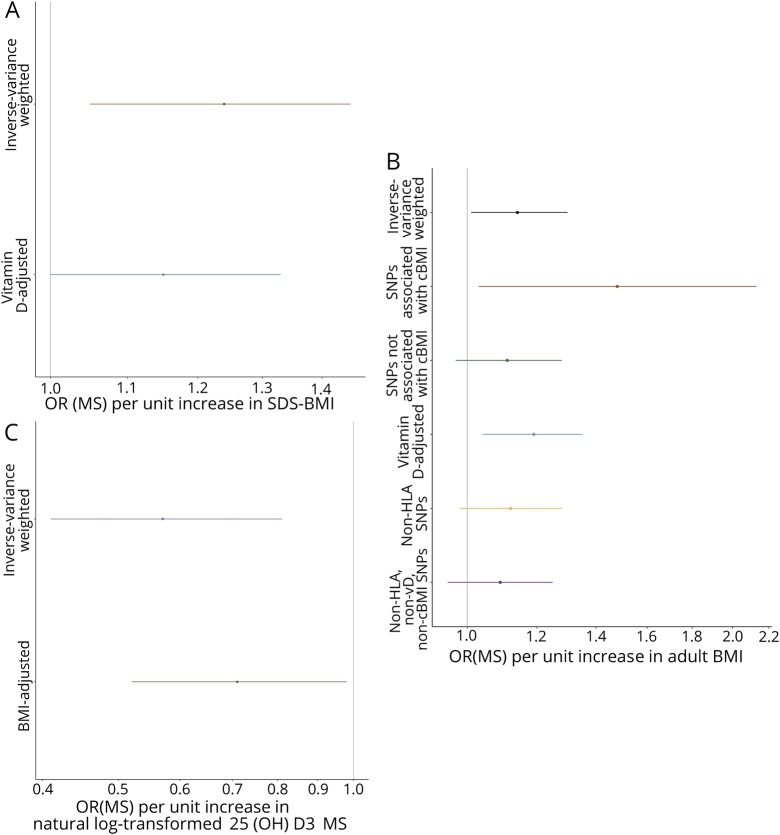
Genetically determined increased childhood BMI (OR 1.24, 95% CI 1.05-1.45, = 0.011) and adult BMI (OR 1.14, 95% CI 1.01-1.30, = 0.042) were associated with increased MS risk. The effect of genetically determined adult BMI on MS risk lessened after exclusion of 16 variants associated with childhood BMI (OR 1.11, 95% CI 0.97-1.28, = 0.121). Correcting for effects of serum vitamin D in a multivariate analysis did not alter the direction or significance of these estimates. Each genetically determined unit increase in the natural-log-transformed vitamin D level was associated with a 43% decrease in the odds of MS (OR 0.57, 95% CI 0.41-0.81, = 0.001).
We provide novel evidence that BMI before the age of 10 is an independent causal risk factor for MS and strengthen evidence for the causal role of vitamin D in the pathogenesis of MS.
更新成人体重指数(BMI)、儿童 BMI 和维生素 D 状况对多发性硬化症(MS)风险影响的因果估计。
我们使用两样本 Mendelian 随机化来确定因果估计。从相关联盟获得与研究特征相关的 SNP 关联的汇总统计数据。主要分析包括随机效应逆方差加权荟萃分析,其次是次要敏感性分析。
遗传决定的儿童 BMI 增加(OR 1.24,95%CI 1.05-1.45, = 0.011)和成人 BMI 增加(OR 1.14,95%CI 1.01-1.30, = 0.042)与 MS 风险增加相关。排除与儿童 BMI 相关的 16 个变异体后,遗传决定的成人 BMI 对 MS 风险的影响减弱(OR 1.11,95%CI 0.97-1.28, = 0.121)。在多变量分析中校正血清维生素 D 的影响并没有改变这些估计的方向或意义。每个自然对数转换的维生素 D 水平的遗传决定单位增加与 MS 几率降低 43%相关(OR 0.57,95%CI 0.41-0.81, = 0.001)。
我们提供了新的证据,证明 10 岁前的 BMI 是 MS 的独立因果风险因素,并加强了维生素 D 在 MS 发病机制中的因果作用的证据。