School of Public Health, North China University of Science and Technology, Caofeidian, Tangshan 063210, China.
Hebei Province Key Laboratory of Occupational Health and Safety for Coal Industry, School of Public Health, North China University of Science and Technology, Caofeidian, Tangshan 063210, China.
Int J Environ Res Public Health. 2020 Jan 11;17(2):483. doi: 10.3390/ijerph17020483.
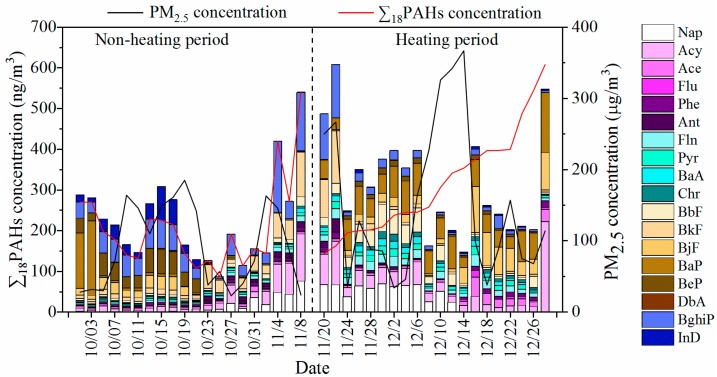
Exposure to polycyclic aromatic hydrocarbons (PAHs) may lead to adverse health risks. To understand the potential sources and carcinogenic risks of PAHs in Tangshan, 40 PM samples were collected for analysis of eighteen PM-bound PAHs during non-heating period and heating period. The results display a significant variation. The median concentration of ∑PAHs during the heating period (282 ng/m) was higher than during the non-heating period (185 ng/m). Especially, the median concentration of Benzopyrene (BaP) during the heating period (61.6 ng/m) was 16.9-fold that during the non-heating period (3.64 ng/m). It exceeded BaP annual average limit of China (1 ng/m). Diagnostic ratios (DRs) and principal component analysis (PCA) both indicated that vehicle emissions and coal and biomass combustion were the dominant contributors of PAHs pollution in Tangshan. The incremental lifetime cancer risk (ILCR) of three age groups (children, teenagers, and adults) ranged from 2.56 × 10 to 5.26 × 10 during the entire sampling periods. The 95% risk values of adults exceeded 10 during the heating periods, indicating a potential health risk from PAHs.
多环芳烃(PAHs)的暴露可能会导致健康风险。为了了解唐山地区 PAHs 的潜在来源和致癌风险,在非采暖期和采暖期采集了 40 个 PM 样本,分析了 18 种 PM 结合态 PAHs。结果显示出显著的差异。采暖期∑PAHs 的中位数浓度(282ng/m)高于非采暖期(185ng/m)。特别是,采暖期苯并芘(BaP)的中位数浓度(61.6ng/m)是非采暖期的 16.9 倍(3.64ng/m)。它超过了中国 BaP 年平均限值(1ng/m)。诊断比值(DRs)和主成分分析(PCA)均表明,机动车排放、煤炭和生物质燃烧是唐山 PAHs 污染的主要来源。三个年龄段(儿童、青少年和成年人)在整个采样期间的增量终身癌症风险(ILCR)范围为 2.56×10⁻⁶ 至 5.26×10⁻⁶。成人在采暖期的 95%风险值超过 10,表明 PAHs 存在潜在的健康风险。