Faculty of Medicine, University of Versailles Saint-Quentin-en-Yvelines, Montigny-le-Bretonneux, France.
Research and Development Unit, Parc Sanitari Sant Joan de Déu, CIBERSAM, Sant Boi de Llobregat, Barcelona, Spain.
J Gerontol A Biol Sci Med Sci. 2020 Jul 13;75(8):1572-1578. doi: 10.1093/gerona/glaa017.
The health of the caregivers is crucial to sustain informal care provision, while multimorbidity is an important health risk concept. However, studies on the association between informal caregiving and physical multimorbidity are currently lacking. Therefore, we investigated this association in adults from 48 low- and middle-income countries (LMICs).
Cross-sectional data from 242,952 adults (mean age 38.4 years) participating in the World Health Survey 2002-2004 were analyzed. Informal caregivers were considered those who provided help in the past year to a relative or friend (adult or child) who has a long-term physical or mental illness or disability, or is getting old and weak. Nine physical conditions were assessed. Multivariable logistic regression analyses were conducted to assess associations between informal caregiving and physical multimorbidity, while the between-country heterogeneity in this relationship was studied with country-wise analyses.
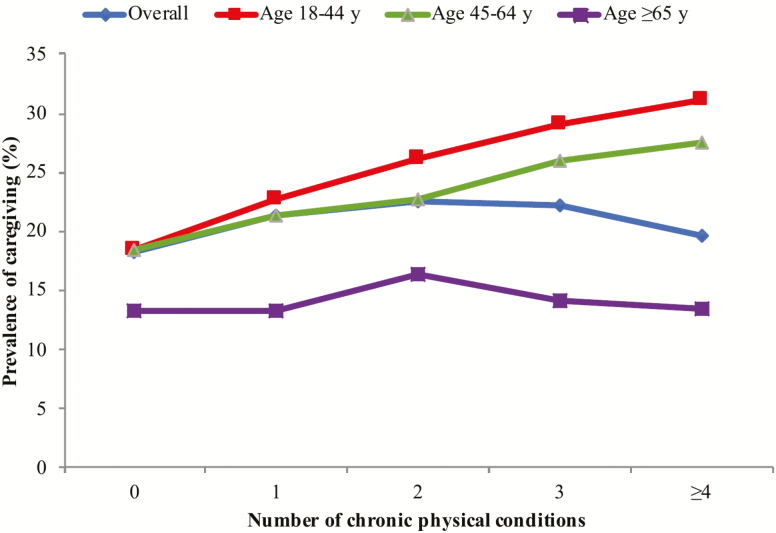
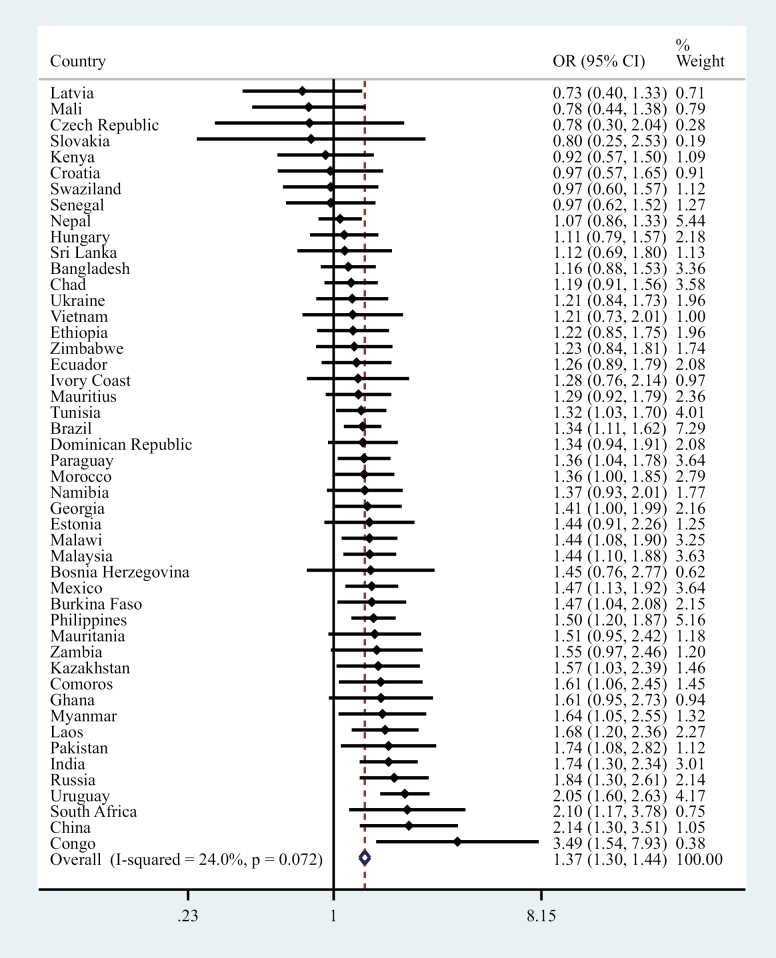
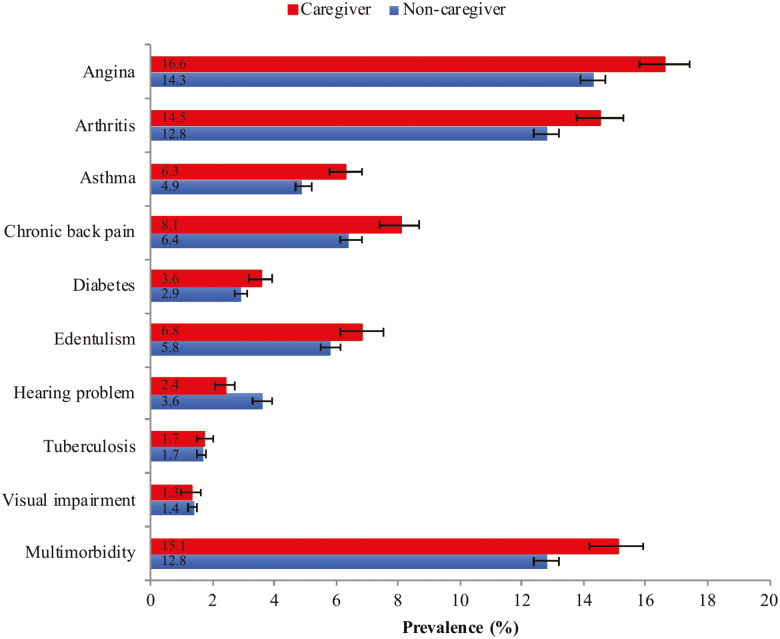
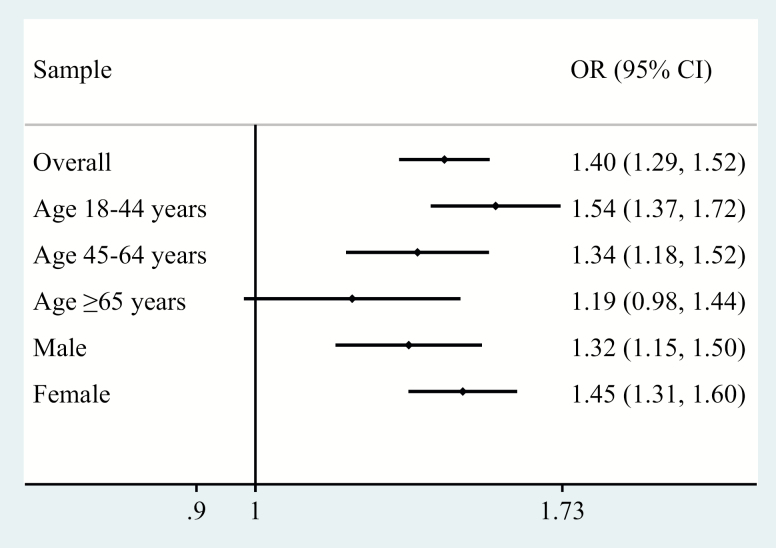
The overall prevalence of informal caregiving and physical multimorbidity (ie, two or more physical conditions) was 19.2% and 13.2%, respectively. Overall, caregivers had 1.40 (95% confidence interval = 1.29-1.52) times higher odds for physical multimorbidity. This association was particularly pronounced in younger caregivers (eg, 18-44 years: odds ratio = 1.54; 95% confidence interval = 1.37-1.72), whereas this association was not statistically significant among those aged ≥65 and older (odds ratio = 1.19; 95% confidence interval = 0.98-1.44). Country-wise analyses corroborated these findings, and there was a negligible level of between-country heterogeneity (I2 = 24.0%).
In LMICs, informal caregivers (especially young caregivers) were more likely to have physical multimorbidity. This should be taken into account in policies that address the health and well-being of informal caregivers.
照顾者的健康对于维持非正式护理至关重要,而多病共存是一个重要的健康风险概念。然而,目前关于非正式照护与身体多病共存之间关联的研究尚缺乏。因此,我们调查了来自 48 个中低收入国家(LMICs)的成年人之间的这种关联。
对 2002-2004 年参加世界卫生调查的 242952 名成年人(平均年龄 38.4 岁)的横断面数据进行了分析。被认为是非正式照顾者的人,在过去的一年中为有长期身体或精神疾病或残疾的亲戚或朋友(成人或儿童)提供帮助,或为年老体弱的人提供帮助。评估了九种身体状况。进行多变量逻辑回归分析以评估非正式照护与身体多病共存之间的关联,同时研究了国家间分析中这种关系的异质性。
总体上,非正式照护和身体多病共存(即两种或更多种身体状况)的患病率分别为 19.2%和 13.2%。总体而言,照顾者发生身体多病共存的几率高 1.40 倍(95%置信区间=1.29-1.52)。这种关联在年轻的照顾者中更为明显(例如,18-44 岁:比值比=1.54;95%置信区间=1.37-1.72),而在年龄≥65 岁的人群中这种关联无统计学意义(比值比=1.19;95%置信区间=0.98-1.44)。国家间分析证实了这些发现,且国家间的异质性程度较低(I2=24.0%)。
在 LMICs 中,非正式照顾者(尤其是年轻照顾者)更有可能患有身体多病共存。在解决非正式照顾者的健康和福祉的政策中应考虑到这一点。