Newcastle University Translational and Clinical Research Institute, Newcastle upon Tyne, United Kingdom.
Versus Arthritis Centre for Genetics and Genomics, Centre for Musculoskeletal Research, Institute of Inflammation and Repair, University of Manchester Manchester, United Kingdom; NIHR Manchester Musculoskeletal BRC, Manchester University NHS Foundation Trust, Manchester, United Kingdom.
J Allergy Clin Immunol. 2020 May;145(5):1438-1451. doi: 10.1016/j.jaci.2019.12.910. Epub 2020 Jan 13.
Defining regulatory mechanisms through which noncoding risk variants influence the cell-mediated pathogenesis of immune-mediated disease (IMD) has emerged as a priority in the post-genome-wide association study era.
With a focus on rheumatoid arthritis, we sought new insight into genetic mechanisms of adaptive immune dysregulation to help prioritize molecular pathways for targeting in this and related immune pathologies.
Whole-genome methylation and transcriptional data from isolated CD4 T cells and B cells of more than 100 genotyped and phenotyped patients with inflammatory arthritis, all of whom were naive to immunomodulatory treatments, were obtained. Analysis integrated these comprehensive data with genome-wide association study findings across IMDs and other publicly available resources.
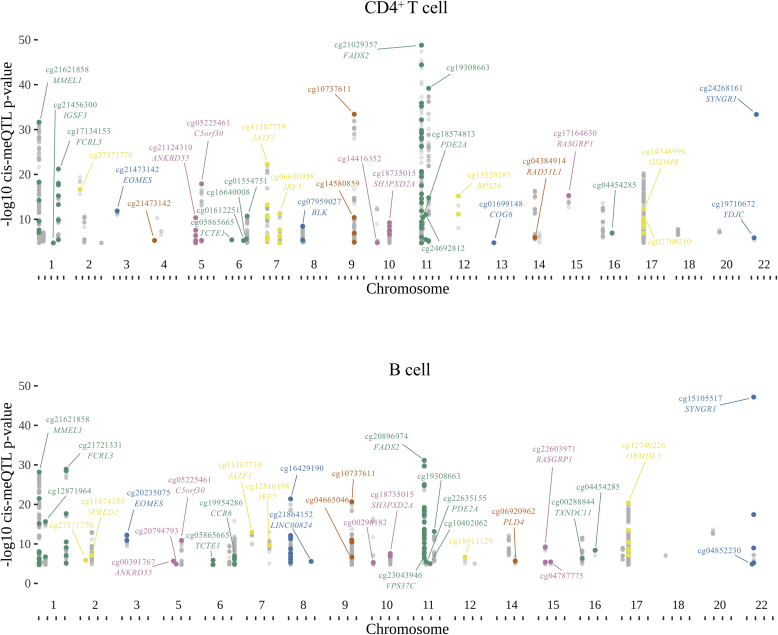
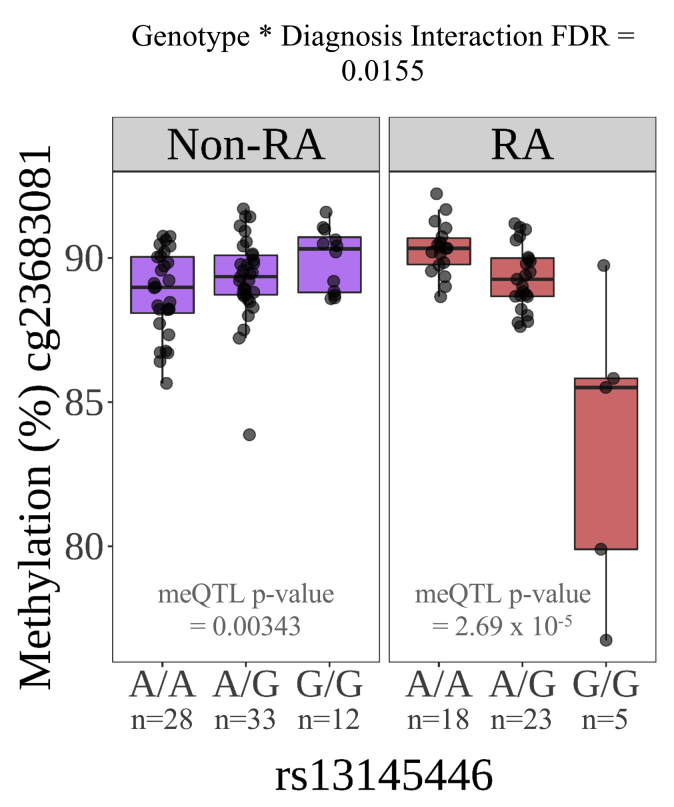
We provide strong evidence that disease-associated DNA variants regulate cis-CpG methylation in CD4 T and/or B cells at 37% RA loci. Using paired, cell-specific transcriptomic data and causal inference testing, we identify examples where site-specific DNA methylation in turn mediates gene expression, including FCRL3 in both cell types and ORMDL3/GSDMB, IL6ST/ANKRD55, and JAZF1 in CD4 T cells. A number of genes regulated in this way highlight mechanisms common to RA and other IMDs including multiple sclerosis and asthma, in turn distinguishing them from osteoarthritis, a primarily degenerative disease. Finally, we corroborate the observed effects experimentally.
Our observations highlight important mechanisms of genetic risk in RA and the wider context of immune dysregulation. They confirm the utility of DNA methylation profiling as a tool for causal gene prioritization and, potentially, therapeutic targeting in complex IMD.
在后全基因组关联研究时代,通过非编码风险变异影响细胞介导的免疫介导疾病(IMD)发病机制的调节机制已成为当务之急。
我们专注于类风湿关节炎,旨在深入了解适应性免疫失调的遗传机制,以帮助确定在这种和相关免疫病理中靶向的分子途径。
从 100 多名经过基因分型和表型分析的炎症性关节炎患者的分离 CD4 T 细胞和 B 细胞中获得了全基因组甲基化和转录数据,所有患者均对免疫调节治疗无反应。分析将这些综合数据与 IMD 和其他公开可用资源的全基因组关联研究结果进行了整合。
我们提供了强有力的证据表明,疾病相关的 DNA 变异在 37%的 RA 基因座上调节 CD4 T 和/或 B 细胞中的顺式-CpG 甲基化。使用配对的、细胞特异性转录组学数据和因果推断测试,我们确定了在某些情况下,特定于位点的 DNA 甲基化反过来介导基因表达的例子,包括两种细胞类型中的 FCRL3 和 ORMDL3/GSDMB、IL6ST/ANKRD55 以及 CD4 T 细胞中的 JAZF1。以这种方式调节的许多基因突出了 RA 和其他 IMD 包括多发性硬化症和哮喘的共同机制,从而将它们与主要为退行性疾病的骨关节炎区分开来。最后,我们通过实验证实了观察到的效应。
我们的观察结果强调了 RA 以及免疫失调的更广泛背景中的遗传风险的重要机制。它们证实了 DNA 甲基化谱作为因果基因优先级排序的工具的实用性,并且在复杂的 IMD 中具有潜在的治疗靶向性。