Orygen, the National Centre of Excellence in Youth Mental Health, Melbourne, Australia.
Centre for Youth Mental Health, University of Melbourne, Parkville, Australia.
BMC Med. 2020 Jan 17;18(1):16. doi: 10.1186/s12916-019-1475-6.
Inflammation contributes to the pathophysiology of major depressive disorder (MDD), and anti-inflammatory strategies might therefore have therapeutic potential. This trial aimed to determine whether adjunctive aspirin or rosuvastatin, compared with placebo, reduced depressive symptoms in young people (15-25 years).
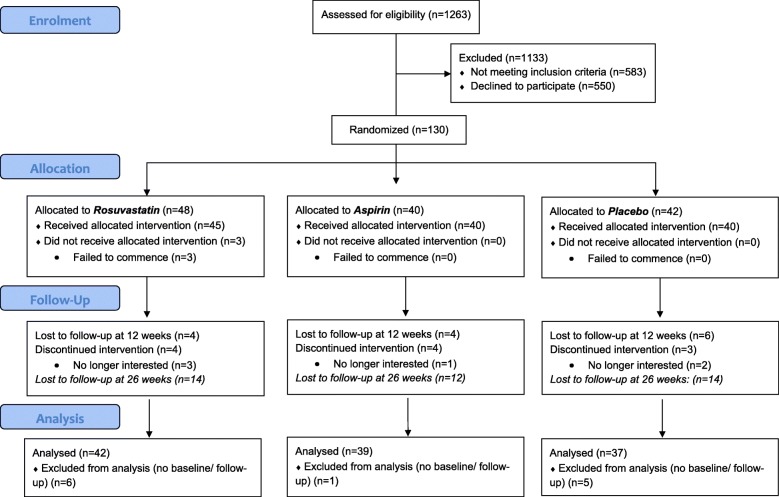
YoDA-A, Youth Depression Alleviation with Anti-inflammatory Agents, was a 12-week triple-blind, randomised, controlled trial. Participants were young people (aged 15-25 years) with moderate to severe MDD (MADRS mean at baseline 32.5 ± 6.0; N = 130; age 20.2 ± 2.6; 60% female), recruited between June 2013 and June 2017 across six sites in Victoria, Australia. In addition to treatment as usual, participants were randomised to receive aspirin (n = 40), rosuvastatin (n = 48), or placebo (n = 42), with assessments at baseline and weeks 4, 8, 12, and 26. The primary outcome was change in the Montgomery-Åsberg Depression Rating Scale (MADRS) from baseline to week 12.
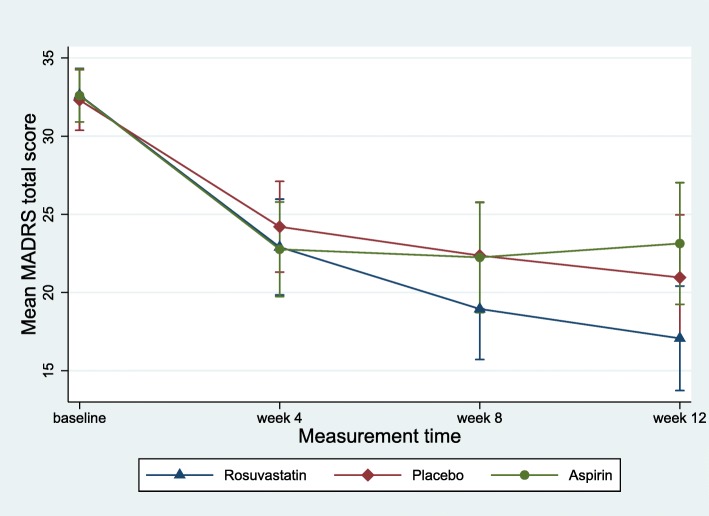
At the a priori primary endpoint of MADRS differential change from baseline at week 12, there was no significant difference between aspirin and placebo (1.9, 95% CI (- 2.8, 6.6), p = 0.433), or rosuvastatin and placebo (- 4.2, 95% CI (- 9.1, 0.6), p = 0.089). For rosuvastatin, secondary outcomes on self-rated depression and global impression, quality of life, functioning, and mania were not significantly different from placebo. Aspirin was inferior to placebo on the Quality of Life Enjoyment and Satisfaction Questionnaire (Q-LES-Q-SF) at week 12. Statins were superior to aspirin on the MADRS, the Clinical Global Impressions Severity Scale (CGI-S), and the Negative Problem Orientation Questionnaire scale (NPOQ) at week 12.
The addition of either aspirin or rosuvastatin did not to confer any beneficial effect over and above routine treatment for depression in young people. Exploratory comparisons of secondary outcomes provide limited support for a potential therapeutic role for adjunctive rosuvastatin, but not for aspirin, in youth depression.
Australian New Zealand Clinical Trials Registry, ACTRN12613000112763. Registered on 30/01/2013.
炎症是导致重度抑郁症(MDD)发病机制的因素之一,因此抗炎策略可能具有治疗潜力。本试验旨在确定与安慰剂相比,辅助使用阿司匹林或瑞舒伐他汀是否能减轻年轻人(15-25 岁)的抑郁症状。
YoDA-A(青年抑郁缓解抗炎治疗试验)是一项为期 12 周的三盲、随机、对照试验。参与者为患有中重度 MDD 的年轻人(MADRS 基线平均值为 32.5±6.0;N=130;年龄 20.2±2.6;60%为女性),于 2013 年 6 月至 2017 年 6 月期间在澳大利亚维多利亚州的 6 个地点招募。除了常规治疗外,参与者还被随机分配接受阿司匹林(n=40)、瑞舒伐他汀(n=48)或安慰剂(n=42)治疗,在基线、第 4、8、12 和 26 周进行评估。主要结局是从基线到第 12 周时蒙哥马利-阿斯伯格抑郁评定量表(MADRS)的变化。
在预先设定的主要终点——第 12 周时 MADRS 与基线的差异变化上,阿司匹林与安慰剂(1.9,95%CI(-2.8,6.6),p=0.433),或瑞舒伐他汀与安慰剂(-4.2,95%CI(-9.1,0.6),p=0.089)之间无显著差异。对于瑞舒伐他汀,自我评估抑郁和总体印象、生活质量、功能和躁狂的次要结局与安慰剂无显著差异。与安慰剂相比,阿司匹林在第 12 周时的生活质量享受和满意度问卷(Q-LES-Q-SF)评分较差。他汀类药物在第 12 周时在 MADRS、临床总体印象严重程度量表(CGI-S)和负性问题取向问卷量表(NPOQ)上优于阿司匹林。
与常规治疗相比,辅助使用阿司匹林或瑞舒伐他汀对年轻人的抑郁并没有带来任何有益的效果。对次要结局的探索性比较为辅助使用瑞舒伐他汀治疗青年抑郁提供了有限的支持,但阿司匹林则没有。
澳大利亚和新西兰临床试验注册中心,ACTRN12613000112763。于 2013 年 1 月 30 日注册。